!!! "It's not a BUG,  /o o\ / it's a FEATURE!" (508) 429-4357
( > )
\ - / INDUSTRY GADFLY: "My Cheesy Must See List for DAC 2024"
_] [_
by John Cooley of DeepChip.com
Holliston Poor Farm, P.O. Box 6222, Holliston, MA 01746-6222
/o o\ / it's a FEATURE!" (508) 429-4357
( > )
\ - / INDUSTRY GADFLY: "My Cheesy Must See List for DAC 2024"
_] [_
by John Cooley of DeepChip.com
Holliston Poor Farm, P.O. Box 6222, Holliston, MA 01746-6222
  EDITOR'S TWO NOTES:

     1. if you're an EDA vendor and I messed up somewhere -- please contact me ASAP.

     2. the DAC'24 Troublemaker's Panel is at 3:00 in the DAC Pavillion.
       My unofficial guide to the San Francisco DAC'24 exhibit floor.  Enjoy!  - John


NEW SCHOOL RTL SIMULATORS

 1.) Metrics DSim Cloud Simulator -- when Joe Costello told me his Metrics DSim was on
     par with Xcelium/VCS/Questa, I was skeptical.  So, I asked a buddy who has access
     to currect revs of those Verilog simulators to benchmark Metrics DSim against them:

        open source     Metrics       Cadence       Synopsys       Siemens
             design      DSim         Xcelium         VCS          Questa
          ---------     -------       --------      --------       --------
             Ethmac     0:40 sec      0:14 sec      0:51 sec       0:29 sec
                Pci     1:17          0:39          0:57           0:48
            vga_lcd     5:52          3:39          6:00           6:12

     Notice how DSim's runtimes are on par with VCS and Questa, and it's only 1/2 speed
     of Xcelium -- that is, DSim is comparable to a Big Three EDA simulator.
     Why this is #1 on my Must See List this year is that Metrics is handing out their
     desktop DSim simulator for free.  Yup, instead of shelling out $20K to $30K for a
     single license for a year -- like with CDNS/SNPS/SIEM -- you can download & run DSim
     on your on-prem machine at no cost.  No hidden gotchas, no expiration dates.  And
     it's not limited by # of lines of Verilog, nor gate count, nor your machine size.

     You only pay if/when you decide to run DSim in the cloud for extra oomph.  It's push
     button and costs only 1.5 cents/minute/server.  The numbers: running DSim 24/7/365
     in the cloud for a whole year sets you back only $7,884. But the BIG payoff is when
     you want to use the cloud run your regressions FAST.

     Plus, because of distributed jobs "cloud magic" -- running 1 Verilog simulation on
     DSim on 1 Azure server for 10 hours costs the same as 100 Azure server for 1 hour.

         1.5 cents X 1 server X 10 hours == 1.5 cents X 100 servers X 1 hour == $90.00

     But the real benchmark: my same user buddy who ran the original benchmarks tested
     this out.  He gets even faster (~80X) runtime speed-up in the Azure cloud because
     of, again, that distributed jobs "cloud magic":
                                                  wall clock time     DSim cost
                                                  ---------------     ---------
         1,500 test cases on 1 on-prem server        10 hours           free
         1,500 test cases in the cloud                7 minutes        $8.90

     He'd have to pay $$$$ millions for 1,500 licenses to do this with the Big 3 vendors.

     I asked Joe: "But why free??".  His answer: "Metrics is flipping the EDA business
     model on its head.  No more choking on license fees.  Making a license free removes
     our barrier to entry.  No purchase orders, no red tape.  For chip designers at
     small to mid-sized companies, FPGA designers, and students, my free DSim is an
     immediate gift for their daily HDL coding, debugging, and small designs.  Everyone
     can try it, love it -- and then get hooked on the cloud's unlimited fast and cheap
     compute power -- free from the usual Big 3 EDA license stranglehold."

     "Bottom line, using my DSim saves everyone a ton of time and money," added Joe.
     (booth 2548)  Ask for Joe Costello.  Freebie: a free Verilog simulator

            ----    ----    ----    ----    ----    ----    ----    ----    ----

     Cadence Xcelium (Rocketick RocketSim) is parallelized System Verilog across 100's
     of Intel CPUs.  In 2016, it benched 23X faster vs. VCS, Questa.  (Now it's roughly
     only 1.3X to 1.7X faster than SNPS VCS.)  It does both gate and RTL sims like VCS.
     Xcelium compiles 1 billion gates in 2 hours.  Got #3 User's Best of back in 2016,
     but that was 8 years ago.  Now mildly (30% to 70%) ahead of Sassine's SNPS VCS.

     Runs in AWS/Azure/GPC cloud.  Xcelium comes in 1K cloud packs at a discount.  Runs
     SystemC, e/Specman, VHDL, low power.  Xcelium Apps like SimAI for machine learning
     for coverage closure and bug hunting; X-pessimism for gate level bring up;
     Power Playback for parallelization of glitch accurate power estimation.  Users
     are Intel, Nvidia, Renesas, Samsung, MediaTek, Alif, AutoChips, RealTek, ST, ARM.
     (booth 1511)  Ask for Pete Hardee.  Freebie: lotto stamp

     Synopsys VCS with VSO.ai does "shift-left, and is AI-driven" to examine your RTL and
     "infer coverage while highlighting areas where coverage is needed" and "high ROI
     tests are run first".  Says users see "2-10x better regression TAT and functional
     coverage up by 5-10%".  New this year, multi-die sims and "taint propagation (T-Prop)
     for security verification".  Intel, AMD, Qualcomm, Broadcom, Nvidia, MediaTek, ST.
     (booth 2441)  Ask for Bradley Geden.  Freebie: pens & coffee

     Siemens QuestaSim bundles all Siemens Verilog/VHDL RTL simulation, emulation, low
     power, VIP, traffic generators, interconnect test, intelligent testbench, coverage,
     UVM, formal in one big smudgy bundle.  It has a Profiler for in-depth knowledge of
     the design structure for optimal runtime performance.  QuestaSim now ships with
     Visualizer debug.  ISO 26262 certification, real number modeling, P1735 encryption.
     (booth 2521)  Ask for Mark Olen.  Freebee: espresso & beer


BUGHUNTERS

 2.) NEW! -- Real Intent Sentry is a totally new static (rules based) signoff tool for
     hardware security.  It looks for "holes" in your design where malicious code could
     sneak in, be executed, and do bad things.  Sentry rivals the full formal tools
     like the CDNS Jasper Security Path App and SNPS VC Formal FSV and DPV.
     The Big-Bang-For-The-Buck here is the runtime and expertise differences between
     these 3 tools.  The full formal tools from CDNS & SNPS need 12 months to formally
     evaluate 100 million gates with a Herr Doctor Formal PhD at the customer driving
     it to correctly "mathematically prove" your design with 100% accuracy.

     In contrast, Real Intent Sentry's static analysis of 100 million gates is 5 hours;
     but static analysis is noisy with false positives -- so it'll take an added 3 weeks
     of a regular engineer doing reviews and waivers.

     So 3 weeks + 1 normal engineer vs. 12 months + Dr. Formal's time?  3 weeks wins!

     I asked Prakash why can't Cadence and Synopsys just have their own RnD create their
     own static analysis tools.  "It took us 15 years to develop our level of static
     analysis expertise; I don't think they [CDNS/SNPS] could duplicate it easily."
     (booth 2526)  Ask for Pratik Mahajan.   Freebie: LED pens

            ----    ----    ----    ----    ----    ----    ----    ----    ----

     NEW! -- Amida Achilles uses "its patented methodology to analyze RTL to reveal
     vulnerabilities that formal methods do not cover" and "gives insights into malicious
     functional, operational, and data integrity exposures, and how to prevent them."
     Huh?  Kind of vague.  Says it competes against Real Intent Sentry and Cycuity Radix.
     Joe Costello is a board member, and Jim Hogan was a founding board member.  (It was
     built with U.S. Department of Navy funding, so it's from a security mindset.)
     (booth 2442)   Ask for Margaret Schmitt.  Freebie: stuffed eagles

            ----    ----    ----    ----    ----    ----    ----    ----    ----

     Cadence Jasper now has 17 formal Apps.  Last year they added:

        - Jasper C2RTL app for checking C++ algorithms vs RTL implementation

        - Jasper FPV/SEC/Coverage to verify processor- and domain-specific
          computing-based designs (including RISC-V)

        - Jasper Superlint/CDC/RDC for RTL designers to hand off clean RTL
          for further implementation and verification

     "Our new artificial intelligence kicks ass!"  Jasper Apps finds bugs 1000's of cycles
     deep.  Tight with Xcelium and Verisium.  Tons of users gushed about the JasperGold
     Apps years ago.  (DAC'16 #1, DAC'17 #11, DAC'18 #7).  Google, Intel, ARM, Nvidia,
     Qualcomm, Samsung, ST, Analog Devices, NXP, RealTek, MediaTek all use Jasper Apps.
     (booth 1511)  Ask for Pete Hardee.  Freebie: lotto stamp

            ----    ----    ----    ----    ----    ----    ----    ----    ----

     Synopsys VC Formal uses formal techniques to prove a design's correctness.  Like
     its rivals CDNS Jasper and MENT Questa Formal, it has formal apps (12 apps actually)
     like DPV with HECTOR for datapaths (ALU, FPU, DSP etc.), AEP to extract properties,
     FCA for coverage analysis, FXP for X-propagation, CC for connectivity, FRV for
     register checks, SEQ for sequential checks, FPV for formal properties, FLP of low
     power, FSV for security, FuSa for functional saftey, and FTA for testbench analysis.
     (booth 2441)  Ask for Bradley Geden.  Freebie: pens & coffee

            ----    ----    ----    ----    ----    ----    ----    ----    ----

     Siemens OneSpin does niches that Cadence Jasper and Synopsys VC Formal doesn't
     do -- plus a ton more.  360 Verify does property checking with coverage.
     360 Quantify does a full formal coverage of your code and SVAs.  360 Safety injects
     faults into device code to see if it recovers from an operational fault in the
     field, and still works.  SystemC App Connectivity XL App sees if your 1 billion
     gate chip is interconnected properly.  Their 360 Trust tool sees if any
     HW security holes.  PortableCoverage App measures coverage.  FPU App does formal
     on IEEE 754 floating point.  26262 FMEDA tool does safety metrics (SPFM, LFM, PMHF).
     And their RISC-V Verification App does zero bug escapes and guarantees full
     compliance with the ISA.  It also does RISC-V compliance, SEE/MEE analysis, FPU,
     mutation analysis, transactional assertions and Gap-Free.  Tight with QuestaSim.

     Plus the 10 old Mentor Questa Formal formal Apps for X-checking, RTL checks,
     coverage, assertion checks, property generation, CDC, connectivity checks, post-
     silicon, register checks, unreachability; plus SLEC for safety-critical designs.
     "ISO 26262, baby!"  Marvell, Microsoft, Samsung, Cypress, Infineon, Nokia, Mediatek.
     (booth 2521)  Ask for Chris Giles.  Freebie: espresso & beer

     Siemens Questa Verification IQ (VIQ) is Sawicki's snarky reply back at
     Anirudh's CDNS Verisium launch.  Questa VIQ does "data driven verification with
     predictive and prescriptive analytics" (plus AI voodoo) "to accelerate closure,
     accelerate debug turnaround time, and provide regression efficiency."
     (booth 2521)  Ask for Mark Olen.  Freebie: espresso & beer

            ----    ----    ----    ----    ----    ----    ----    ----    ----

     Real Intent Ascent Lint RTL and netlist rule checking and sign off.
     Certified by TUV SUD for ISO-26262 (TCL2).  Has high impact rules for
     syntax, semantic, and style checks for low noise and ease of debug.
     Integrated debugger.  Rule configuration editor has severity config and
     annotations, categories, filters and searches.

     New is it does "total TAT minimization from start to sign-off."  Supports
     multiple rule sets in a single run to verify IP and new RTL in ONE run.
     New targeted debugger shows related violations in the same proximity.
     Also new is duplicate violations are rolled up into a group presentation.
     And the user can now define four custom levels of severity.  Ascent Lint
     is used by Google, Hailo, Dream Chip, Alif Semiconductor, Esperanto, Groq
     (booth 2526)  Ask for Lisa Piper.  Freebie: LED pen

     Real Intent Ascent AutoFormal identifies RTL design bugs early.  10X
     speedup & 3 million gate capacity.  It extracts RTL "implied intent"
     checks, runs formal analysis, & determines root cause errors.
     Detects FSM deadlocks, dead code & range violations, etc.
     (booth 2526)  Ask for Lisa Piper.  Freebie: LED pen

     Ausdia Timevision SOC Budgeter handles the SDC time budgetting
     across hierarchical boundaries.  Uses SDFs, timing reports and physical
     data (LEF/DEF) to produce and manage accurate timing budgets for the
     blocks used in hierarchical implementation flows.

     Ausdia Timevision SdcCheck does 200 checks.  "your SDC + checking it's intent."
     MMMC constraints, Verilog/SystemVerilog/VHDL, IEEE P.1735 encrypted RTL.
     Precise file/line backtracking pinpoint in your source RTL/SDC issues.
     (booth 2310)  Ask for Sam Appleton.  Freebie: frisbees

     Excellicon ConMan formally crafts hierarchical constraints for
     multi/merged mode SDC, promotion, clocking analysis.  Rivals Ausdia
     and Fishtail.  500+ M inst.  Concert EQ is equivalence checking for
     Top2Block, Top2Top (1D2S, 2D2S, 2D1S, SDC2ETM checking).  Does ECO
     changes, cloning, decloning, logical restructuring etc.

     Excellicon ConTree does pre-CTS analysis of clocking structure for
     proper clock skew groups, automatic creation of anchor buffers and
     creation of CTS file.  In post-CTS phase, verifies CTS for lowered
     clock latency and skew.

     Excellicon ConCert verifies timing intent & structural exceptions
     using SVA+/formal.  SDC, CTS, demotion, equiv checking.  They added
     timing budgeting and exceptions toolboxes to ConCert this year.
     LG, Samsung, Marvell, Renesas, Qualcomm, Western Digital, Maxim, ST.
     (booth 2520)  Ask for Himanshu Bhatnagar.  Freebie: dice cups

     Synopsys Timing Constraints Manager (formerly FishTail) is used for promotion and
     demotion of constraints.  Takes RTL or gate-level netlist and abstracts only the
     required behavior and structure with respect to the task being performed.
     (booth 2441)  Ask for Rimpy Chugh.  Freebie: pens & coffee

     Real Intent Meridian RDC finds messy reset metastability & glitch
     problems.  Categorizes violations, has minimum noise.  Claims in
     benchmark vs. rival it had MUCH few violations (200 vs 500,000),
     and was 8X faster (45 min vs 6 hours).  Parallel & hierarchical.
     Rivals SpyGlass RDC, Questa RDC.  200M gate full RDC in 9 hrs.
     Claims 20% faster runtime and 30% better RAM utilization.  Improved
     viewer, does save-restore incrementals, can now do targeted RDC runs
     for fast debug.  Used by Groq, Esperanto, Google, Hailo, Dream Chip
     (booth 2526)  Ask for Sanjay Thatte.  Freebie: LED pens

     Real Intent Verix SimFix detects & corrects X-pessimism in gate-level
     sims, enabling gate-level functional sign-off.  Did 100M to 350M nets.

     Real Intent Meridian RXV does X-impact analysis on RTL to avoid
     messes with reset schemes, diverse IPs.  Shows X-optimism causing
     design errors.  NO simulation vectors, nor coverage analysis nor
     simulation is needed.  Rivals Synopsys VCS Xprop, Cadence JasperGold.
     (booth 2526)  Ask for Sanjay Thatte.  Freebie: LED pens

     Amiq Verissimo is like a Spyglass linter but just for System Verilog
     testbench code.  "200+ checks in assertions, dead code, language
     pitfalls, code maintainability, and UVM methodology guidelines."
     It can auto-correct failures, and compare reports and tracking progress
     Samsung, Cisco, Qualcomm, Xilinx, Toshiba, Broadcom, Nvidea, NXP.
     (booth 1410)  Ask for Cristian Amitroaie.  Freebie: chocolates

     Siemens Visualizer (formally Avery SimXACT) automatically find X bugs
     in RTL and eliminates false X's in gate-level simulation.  Has gated
     clock X pessimism analysis and auto generated fix deposits.  It competes
     with Synopsys Verdi and Cadence SimVision/Indago/Verisium.  Siemens
     QuestaSim/Veloce/Symphony now ships with Visualizer.  "Gate simulation
     bring-up productivity is more than fixing false Xs!"  Broadcom, Nvidia,
     MediaTek, Qualcomm, Western Digital, Cavium, HPE -- and 5,000+ others.
     (booth 2521)  Ask for Mark Olen.  Freebie: espresso & beer

     Siemens Austemper KaleidoScope does mixed-signal fault injection as
     functional safety tool.  Does ISO26262 automotive stuff from OneSpin.
     It rivals Synopsys Z01X, Cadence Xcelium Safety.  KaleidoScope does
     fault injection campaigns to detect the faults.  Samsung, Rambus users
     (booth 2521)  Ask for Ann Keffer.  Freebee: espresso & beer


SILICON LIFECYCLE MANAGEMENT

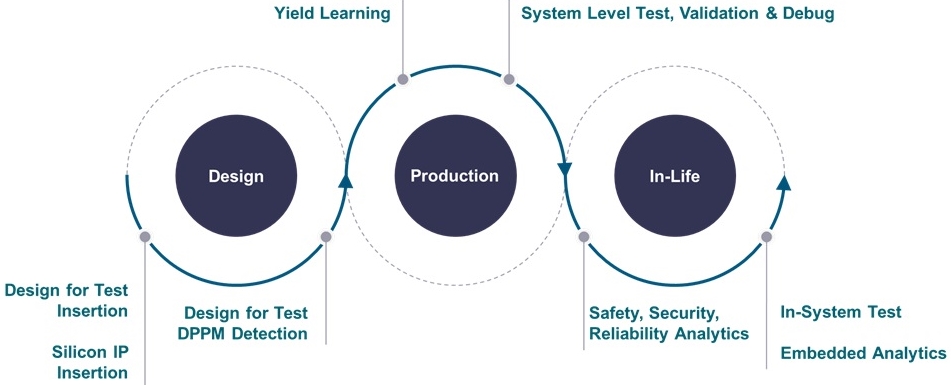
 3.) Synopsys Silicon Lifecycle Management (SLM) is SW plus embedded DW IPs to do
     SLM of your chip.  SLM In-Chip Monitor IP tracks your chip's analytics on every phase
     of the silicon lifecycle -- from initial design, to manufacturing, to in-field data.
     It does pre- and post-silicon analytics, plus hooks with Synopsys TestMAX.  Users
     are Intel, Marvell, Microsoft, Qualcomm, ST, Alibaba, ARM, Google, Amazon, MediaTek,
     Cisco, ST, Socionext, Marvell, Bosch, Arbe Robotics, Denso.  The Synopsys SLM rivals
     are Siemens Tessent, Proteantecs, and PDF Solutions Exensio/Cimetrix.  (Not sure but
     it looks like much of Synopsys SLM is a deep rebranding of Synopsys SiliconMAX.)

     NEW! -- Synopsys SLM HSAT IP takes PCIe and USB interfaces to be re-used for high-
     bandwidth production scan test.  Also manufacturing scans in-system.  Also later
     in-field scans, to find structural degradation during the device's lifetime.

     NEW! -- Synopsys SLM SHS IP automatically creates a hierarchical IEEE 1500 network
     to access and control all IP/cores at the SoC level.  It's a network for all SLM IPs
     on-chip like PVT monitors, sensors, clock delay monitors plus XLBIST -- plus SMS as
     well as chiplet interconnects like IEEE 1838.  ST, Socionext, Marvell, Bosch users.

     (booth 2441)  Ask for Ash Patel.   Freebie: LED pens & coffee

            ----    ----    ----    ----    ----    ----    ----    ----    ----

     Siemens Tessent SLM is also SW plus embedded IP to track reliability/performance of
     your silicon/package/PCB as it goes through its full lifecycle -- you know, SLM stuff.
     Siemens Streaming Scan Network (SSN) is an embedded "test data super highway" IP inside
     your chip.  "All SLM starts with test -- and our SSN is the backbone that drives
     packetized 100% payload scan data to your chiplet or multi-die design."  DFT planning
     is decoupled from design for faster TAT.  SSN cuts your power profile by reducing
     IR-drop.  It tests identical cores with on-chip compare.  Lets you tune your clock
     timing for fast silicon bring-up.  SSN is a beginning-of-life SLM tool.  It's about
     catching defects and scan testing early -- also while trying to suss out early
     manufacturing & aging defects, too.  Intel, Amazon, Broadcom, Qualcomm, Samsung, ARM

     Siemens Tessent MissionMode is on-chip infrastructure to enable chips to test and
     diagnose themselves at any point during functional operation and throughout their
     silicon lifecycle.  It has system-software based access to any test (and diagnosis)
     within an SoC.  Makes ISO 26262 possible.  Does long-term reliability requirements
     for many types of devices beyond just automobles like 5G base stations, satellites,
     and aircraft cockpit electronics.  Tessent MissionMode is a late-in-life SLM tool.

     Siemens Tessent Embedded Analytics is also a bucket of monitor IP plus software that
     "non-intrusively observes if your SoC functionally performs as it was meant to."
     Full visibility in HW/SW interactions in deployed systems.  Tessent EA is about
     answering functional HW/SW questions like "why is new version of my SW now running
     so slow?" or "why did my system hang in reboot?"  Tessent EA is the quintessential
     definition of a late-in-life SLM tool.  Seagate, Kalray, Picocom users.

     (booth 2521)  Ask for Lee Harrison.  Freebie: espresso & beer

            ----    ----    ----    ----    ----    ----    ----    ----    ----

     MAYBE? -- I got very specific hints that a Cadence SLM was coming from slides at
     CadenceLive'24 -- in the middle of all that buzz about "Digital Twin" ...

          "Digital Twin" is the stealth hot-new-thing at CDNS and SNPS this year
     ... but don't know if Anirudh will be stealth chatting Cadence SLM at DAC'24 or not.

     (booth 1511)  Ask for Anirudh Devgan.  Freebie: CDNS SLM rumors (maybe?)

            ----    ----    ----    ----    ----    ----    ----    ----    ----

     NEW! -- Keysight ELM HUB guides HW engineering teams from concept to silicon design,
     enabling workflow and IP management, reuse, security, and traceability.   I thought
     it was a Silicon Lifecycle Management tool until they said ELM HUB competes against
     the IC Manage Global Design Platform XL tool.  "PLM tools focus manufacturing parts
     bill-of-materials (BOM) and treat the silicon engineering lifecycle (concept, design,
     verification, and test) as a black box.  Keysight ELM HUB gives design teams
     granularity to manage the silicon design engineering lifecycle successfully."  WTF???

     Silicon?  Check...     Lifecycle?  Check...     Manage?  Check...
     I'm bumping ELM HUB out of the DDM TOOLS category and into the SLM TOOLS category.
     BAE Systems, Boeing, Allegro Microsystems, and Berkeley National Labs use ELM HUB.
     (booth 1501)  Ask for Amit Varde.  Freebie: stress balls


EMULATION / ACCELERATION / PROTOTYPING

 4.) NEW! -- Cadence Palladium-Z3 is Anirudh's new processor-based HW emulator based
     on his hot new uP 5nm chip -- and it's a serious blow against the new Siemens
     Veloce Strato CS -- who's uP only updated to a new 7nm chip.  ("D'oh!")
     Every chip designer deep down knows the shame of being at 7nm when your competition
     is at 5nm...  ("Ouch.")  Anyway, this new Palladium-Z3 scales to 48 billion gates.
     And it claims to have a 50% runtime improvement over the olde Palladium-Z2.

     Z3's Modular Compiler compiles an 8 billion gate netlist designs in 5 hours.  New
     this year, the new Palladium-Z3 does 4-state emulation!  Also has "full vision"
     debugging, plus record/replay.  Upper limit is 2,304 simultaneous users, but it's
     job scheduler does dynamic job relocation so users can prioritize workloads.

     Comes in air or water cooled options -- but most new Z3 installations are water
     cooled.  The old Z2 "Dynamic Duo" compiles with Protium X2 got #5 Best of 2020.
     To follow that tradition, this new Z3 says it's "Dynamic Duo II".  Like everyone
     else, the new Palladium Z3 has AI everywhere and does AWS/Azure/GCP cloud.
     Nvidia and AMD are early Palladium-Z3 users -- they spoke at its launch!
     (booth 1511)  Ask for Michael Young.  Freebie: lotto stamp

     NEW! -- Cadence Protium-X3 is an FPGA based prototyper (using the new Xilinx VP1902)
     that can scales up to 48 billion equivalent FPGA gates, "runs 3-5X faster than
     Palladium-Z3", and does super fast HW/SW sims up to 100 Mhz.  Yay, VP1902!  It
     has debug aimed at software workloads including, SVA with lightweight mode, Save and
     Restore, and FullVision for 100% signal visibility without pre-specifying probes.
     The renamed "Dynamic Duo II" compiles with Palladium-Z3 is a very big selling point
     for Protium-X2 and -X3.  (See Best of DAC 19 #1a)  Nvidia & AMD are early -X3 users.
     (booth 1511)  Ask for Michael Young.  Freebie: lotto stamp

     CDNS Palladium & Protium Cloud to add peak capacity to you Palladium/Protium runs.
     (booth 1511)  Ask for Bennett Le.  Freebie: lotto stamp

            ----    ----    ----    ----    ----    ----    ----    ----    ----

     NEW! -- Siemens Veloce Strato CS is Jean-Marie's processor-based HW emulator; scales
     up to a whopping 40 billion gates.  Strato CS's new 7nm uP chip is a great jump from
     it's prior 28nm uP -- but Anirudh's got a 5nm uP in his new Palladium-Z3.  Ouch!
     How this new Veloce Strato CS wins is it's air cooled (while the new Z3 needs to be
     water cooled) because Jean-Marie's new Strato CS uses 1/5th power Anirudh's new Z3
     uses -- a big selling point for certain customers.  (ESNUG 567 #3)  And the new
     Strato CS does a "Dynamic Duo"-type-of-co-compile with Veloce Primo CS, mimicking
     how Anirudh's HW works.  "So let's talk about the total cost of ownership now, OK?"
     (booth 2521)  Ask for Vijay Chobisa.  Freebee: beer

     Siemens Veloce Apps are tight w/ Ansys Apache PowerArtist.  Its RTL power reduction
     analysis is 4.5X faster.  There 8 other Veloce Apps: Coverage, Assertion, ICE, DFT,
     Deterministic ICE, Power, SW Debug, and Ixia Virtual Network App.  ST, Broadcom.
     (booth 2521)  Ask for Vijay Chobisa.  Freebee: espresso & beer

     NEW! -- Siemens Primo CS is like new Cadence Protium X3, but for new Siemens Veloce
     Strato CS.  Also based on hot new VP1902.  Does HW/SW runs to 25 Mhz.  Air cooled.
     40 billion gate capacity.  Easy co-compile with Veloce Strato CS and Veloce proFPGA.
     (booth 2521)  Ask for Zaid Rodriguez.  Freebee: espresso & beer

     Siemens Veloce proFPGA is like SNPS HAPS but based in Germany.  Used to mix/match
     old Xilinx Virtex 7 330T to 2000T to Altera Stratix 10.  600 M ASIC gates.  20 Gbps.
     In 5 years they shipped 1251 units to 121 customers.  Now you can add in hot new
     Xilinx VP1902's to the mix to get 100 Mhz runstimes at 4 billion gates per rack!
     (booth 2521)  Ask for Juergen Jaeger.  Freebie: espresso & beer

            ----    ----    ----    ----    ----    ----    ----    ----    ----

     NEW! -- Synopsys Zebu EP2 still uses dinosaur olde Xilinx VU19P to do HW/SW runs on
     noticeably smaller 5.6 billion gates at 25 Mhz.  (See ESNUG 596 #5)  Meh.  But it gets
     really interesting when it's teamed with the new HAPS-100 (also based on old VU19P's)
     because then -- through the magic of asynchronous clocking -- that 5.6 billion gate
     HW/SW run accelerates to a screaming fast 450 Mhz!  Ravi's roadrunner strategy is
     this: "We're small.  And devious.  And blindingly fast!"   (Ravi says he's sees
     customers dump the CDNS and Siemens way of emulation/prototyping and instead
     they're going "all in" on his ZeBu/HAPS approach.)   And he even has a Zebu Cloud
     option if you want to add peak capacity to your Zebu runs.  "BEEP! BEEP!"
     (booth 2441)  Ask for Himanshu Baath.  Freebie: pens & coffee


VIRTUOSO & RIVALS

 5.) NEW(ISH) -- Cadence Virtuoso Studio is massive amounts of AI pumped into Virtuoso's
     full custom/analog monopoly.  Studio ADE kicks off 1,000s of parallel SPICE runs &
     layout throughput is 100,000s of single 5/4/3/2nm transistors and the new GAAFets.
     Built-in Pegasus DRC/LVS for interactive signoff DRC that cuts TAT 20% by "quickly
     detecting and fixing issues before they become a problem."  Deep hooks into Cadence
     AWR Microwave Office IP for RF/microwave/mmWave and heterogeneous system designs
     (which is again more evidence that Beckley is gunning for Keysight's RF niche.)
     Virtuoso Studio has deep hooks in Spectre, Spectre-X, Spectre-FX, and Spectre FMC
     Analysis for "10,000X speedup in design space exploration for 3- to 6+-sigma
     variation analysis with Monte Carlo sims.  New this year, Beckley's Virtuoso Studio
     is in a celebrity deathmatch with Shankar's Custom Compiler over analog migration.
       DAC'23 Troublemaker Panel: Beckley claims Virtuoso does 80% analog migration
       Whoa - Shankar is now seriously gunning for Tom Beckley's Virtuoso empire
       Whoa - hands-on user benchmark confirms SNPS ASO.ai gets 50% analog migration

     Virtuoso Studio users Samsung, ADI, Nvidia, MediaTek, Qualcomm, Intel, NXP, and TSMC.
     (booth 1511)  Ask for Steven Lewis.  Freebie: lotto stamp

            ----    ----    ----    ----    ----    ----    ----    ----    ----

     Synopsys Custom Compiler is Aart's 2nd attempt on Beckley's Virtuoso monopoly.  The
     1st try was Custom Designer (which flopped.)  CC runs the old Laker3 router plus
     Ciranova Helix plus some "assistant features" to generate many different layouts
     all off of one schematic -- just sort of like how Cadence Pulsic Animate works.
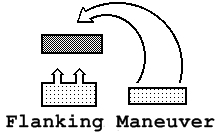
     New this year: Shankar is using an AI enhanced version of his Custom Compiler
     (driven by his SNPS ASO.ai) in order to flank Beckley's new Virtuoso Studio in
     the 10nm-7nm-5nm-3nm-2nm-1nm analog migration niche.
       Whoa - Shankar is now seriously gunning for Tom Beckley's Virtuoso empire

     They claim this "Custom Compiler is 5X more productive" -- whatever that means -- and
     it does "intuitive layout automation" plus "has Synopsys PrimeWave to help engineers
     across 1000's of simulations to find the outlier waveform behavior quickly for design
     centering and optimization" plus it does "schematic and layout-aware design migration
     to save weeks of manual and iterative effort."  Shankar really is gunning for this.
     He has 3 SNPS R&D engineers for every $1 M in CC sales -- compared to Beckley
     who only has 0.9 CDNS R&D engineers for every $1 M in Virtuoso sales.  Shankar is
     tripling down on his CC/ASO.ai per-capta-spend to beat Beckley.  Problem is Beckley's
     Virtuoso Studio is used in 8 of the Top 20 Big Boy logos for analog migration; while
     so far -- as of 6/18/2024 -- I can't find even one Top 20 Big Boy logo using CC/ASO.ai
     for production quality analog migration.  Maybe this will change at this DAC'24?
     (booth 2456)  Ask for Hany Elhak.  Freebee: pens

            ----    ----    ----    ----    ----    ----    ----    ----    ----

     Cadence Pulsic Animate does an AI-enhanced layout of analog (transistor level)
     designs, with no constraints, no scripting, no programming required.  Multi-threaded.
     It makes 100's of fully PnR-ed layouts in minutes from an OA schematic (vs. 2-3 weeks
     single layout in olde Virtuoso).  Last year it cut 40% PnR runtime 40% for Ricoh.
     Now super tight with Virtuoso.  Did 60-80% faster analog block PnR for Silicon Labs.
     Users ADI, ST, NXP, TI, Renasas, Medtronics plus 300? other logos.  Animate's wildly
     popular; which is why Shankar mimics Animate in his SNPS Custom Compiler offering.
     (booth 1511)  Ask for Steven Lewis.  Freebie: lotto stamp

            ----    ----    ----    ----    ----    ----    ----    ----    ----

     Siemens Solido Design Environment is Solido Amit taking on the Virtuoso ADE
     monopoly by launching Solido DE -- a cloud-ready, comprehensive AI-powered
     environment for analog, memory, and std cell flows, with integrated variation-aware
     design (and verification as well) with an integrated modern wave viewer, Solido
     Waveform Analyzer.

     It's a SPICE simulation environment like Virtuoso ADE that runs Siemens AFS, CDNS
     Spectre, and SNPS HSPICE/FineSim SPICEs.  (It's only a DE to fire of SPICE runs.
     Siemens schematic capture and layout by Tanner S-Edit and L-Edit.  Virtuoso does
      it with Composer and Layout Editor.)

     Also Solido DE "extends AI deeper into custom IC design/verification using
     Additive AI and Assistive AI for a disruptive impact."  Claims 1000X+ speedup with
     better accuracy.  TAT is cut by weeks!  It competes with Cadence Virtuoso ADE and
     Virtuoso Variation, Synopsys PrimeWave, Silvaco VarMan, and MunEDA.   As part of the
     distro, Solido DE is used by 90+ semi houses like Nvidia, SK Hynix, ARM, ST, Micron,
     Allegro, Ametek, Crypto Quantique, Silicon Creations, Samsung, and Infineon.
     (booth 2521)  Ask for Wei-Lii Tan.  Freebee: espresso & beer

     Siemens Insight Analyzer finds sources of leakage currents (analog, digital, and
     parasitic) with static circuit checking.  Rivals Synopsys CCK and Aniah OneCheck.
     (booth 2521).  Ask for Carey Robertson.  Freebie: espresso

     Siemens Calibre RealTime Custom does instantaneous sign-off DRC checks and fixes
     inside Virtuoso, Laker3, Custom Compiler.  Same deck, same results as batch Calibre.
     2-5X productivity improvement when fixing DRCs in 180-2nm nodes.  Double/triple
     patterning, preferred metal direction, density checks, pattern matching and voltage-
     aware DRC.  Has cells/blocks-to-macros DRCs to automatically launching batch
     Calibre jobs.  Rivals Cadence iPVS.  Qualcomm, Broadcom, SiLabs.
     (booth 2521)  Ask for Joe Davis.  Freebie: espresso & beer

     Siemens Tanner is OA-based S-Edit schematic capture, L-Edit custom layout, and
     T-Spice SPICE.  Founded 1988.  "Cost effective" prices.  The old HiPer Verify DRC
     was replaced by Calibre DRC.  Pyxis is in it, too.  Does 16/12nm now!  MEMS designers
     like Obsidian, Microgen, Innotime, Velankani, Eesy IC, Microdul AG, PragmatIC users.
     (booth 2521)  Ask for Jeff Daspit.  Freebee: espresso & beer

            ----    ----    ----    ----    ----    ----    ----    ----    ----

     Silvaco Expert is a hierarchical IC layout editor.  Schmatic driven.  10 Gig GDSII
     loads in "minutes".  Uses Calibre Interactive for DRC "on the fly".  Rapid pan/zoom.
     Equal resistance router.  OA and interop PDKs (iPDK) makes design migration easier.
     And WTF???!!  Silicon Creations uses it for 7/5nm FinFET?  Silvaco doing 7/5nm?!?
     Also Silvaco Clever 3D RC field solver does BEOL/MEOL parasitic extract.
     (booth 1539)  Ask for Babak Taheri.  Freebie: tape measure

     Silvaco Cello FinFET fine tunes std cells for slow transitions, power, voltage.
     Also multi-bit cells (saves 25-30% dynamic power, 20-25% leakage), CPU/DSP datapath
     (8-14% less area).  16/14/10/7nm.  Also does coloring, self aligned MOL, template
     based cell creation.  (booth 1539)  Ask for Babak Taheri.  Freebie: tape measure

     LibTech LibChar does std cell, IO, SRAM characterization & modeling.
     Now does PLLs.  (booth 1510)  Ask for Mehmet Cirit.

     Movellus PLL/DLL/LDO Generator is kind of weird because it creates
     *digital* versions of *analog* IP.  In this case, it's PLL's, DLL's,
     and LDO's.  Why?  Because then you can use *digital* synthesis, STA,
     PnR on your PLL/DLL/LDO -- making them portable across nodes, and
     you can do scan/ATPG/DFT on your PLL/DLL/LDO, too!  (See ESNUG 582 #2)
     So far at TSMC 16nm and Mo is working on 7nm.  Intel Capital funded.
     (booth 2311)  Ask for Mo Faisal.  Freebie: chocolates

     Keysight Visual Design Diff compares two versions of a schematic or
     layout by graphically highlighting differences directly in Virtuoso
     Supports IC 5.x (CDBA) and IC 6.x (OpenAccess).  Does hierarchical.
     Works with DesignSync & IC Manage.  Can suppress cosmetic changes.
     Batch mode to run diffs in the background and save state for later.
     Intel, Broadcom, Qualcomm, Infineon, Bosch, Marvell, Toshiba, TSMC.
     (booth 1501)  Ask for Niels Fache.  Freebie: pens

     Empyrean Skipper does super fast layout review, analysis, debug,
     layout IP protection.  1TB GDSII.  Marvel, Hisilicon, Sandisk.
     (booth 2513)  Ask for Jason Xing.  Freebie: fluffy toy

     Keysight ADS and GoldenGate SPICE is for silicon RF IC design and
     simulation.  iPDK PyCell & TSMC iRCX support, intuitive layout, does
     electro-thermal on windows, harmonic balance & circuit envelope
     converges faster.  Qorvo, Skyworks, Broadcom/Avago, Qualcomm users.
     (booth 1501)  Ask for Niels Fache.  Freebie: pens

     Keysight SOS ADS does design data management for RF engineers using
     Keysight Agilent ADS.  Northrop, IDT, Quorvo, Rohde & Schwarz, Inphi
     (booth 1531)  Ask for Niels Fache.  Freebie: pens


3D-IC / CHIPLET / MULTI-DIE DESIGN TOOLS

 6.) Cadence Integrity 3D-IC used for simultaneously designing and analyzing multiple
     chiplets.  Innovus/Virtuoso/Allegro to do system-level plan/implement/analyze
     early floorplan synthesis, cutline partitioning, concurrent 3-D placement,
     3-D dis-aggregation, die-interposer-package design with on-chip and off-chip
     signoff analysis for 2.5D/3D stacked die designs.  Has Cadence 3-D Blox advanced
     features and multiple foundry support.  In-design electro-thermal, SI/IP,
     multi-die extraction, and static timing analysis.  It competes against the
     SNPS 3D-IC Compiler/ANSS Redhawk-SC Partnership, and SNPS 3DSO.ai.
     Samsung, TSMC, UMC, Meta, Microsoft, Tesla, GUC, Socionext, Fraunhoffer, Sony,
     Broadcom, and Rivos are users.  Cadence Integrity 3D-IC was "used to design
     and verify the wafer-scale packaging for the Tesla DoJo supercomputer."
     (booth 1511)  Ask for Vinay Patwardhan.  Freebie: lotto stamp.

            ----    ----    ----    ----    ----    ----    ----    ----    ----

     Synopsys 3D-IC Compiler and 3DSO.ai is Sassine's answer to Cadence Integrity 3D-IC.
     It does early architecture exploration, system validation, die-package co-design,
     die-to-die connectivity, and tweaks for manufacturing and reliability.  It targets
     3DHI designs, with "billions of connections and routing."  It's super tight with
     PrimeTime for 3D static timing analysis, and Ansys for thermal, EMIR and
     signal/power integrity.  3DSO.ai is the AI part that drives everything underneath
     it for 2.5D and 3D multi-die designs.  AMD, Intel, Cisco, Google, Samsung, GUC
     (booth 2441)  Ask for Jim Schultz.  Freebie: pens & coffee

            ----    ----    ----    ----    ----    ----    ----    ----    ----

     NEW! -- Siemens Innovator 3D-IC is a unified cockpit for all the Siemens tools used
     in design planning, prototyping, and predictive analysis of "heterogeneously
     integrated chiplets, interposers, and package substrates using a "Digital Twin"
     unified data model of the complete semiconductor package assembly."  Certified
     for the Intel Foundry EMIB packaging platform.  This tool came about because
     Joe Sawicki in 2022 was bullshit over Tom Beckley bragging on the DAC Troublemakers
     Panel that -- at the time -- Cadence had the only working integrated 3D-IC flow
     back then.  (See ESNUG 592 #5)
       "Beckley showed 8 cherry picked 3D-IC design tasks, for his 8 Cadence
        tools.  Whereas a true, actually proven 3D-IC flow -- our Siemens flow
        for 3D-IC -- has 21 3D-IC design tasks, that involve 24 Siemens tools!"

     Now -- two years later -- at this DAC'24, see how Siemens Innovator 3D-IC cockpit
     is used to design Intel's EMIB with tons of silicon interposers embedded the package
     substrate.  Users are Qualcomm, Micron, MediaTek, Broadcom, Facebook, Samsung, Amkor
     (booth 2521)  Ask for Mike Walsh.  Freebee: espresso & beer

     Siemens Tessent Multi-Die is DFT for chiplet/multi-die designs in 2.5D or 3D.
     It supports 2.5D flows with boundary scan-based interconnect die-to-die test.  It
     "enhances 3D flows with IEEE 1838 compliant PTAP/STAP and it uses silicon-proven
     Tessent SSN as a flexible parallel port.  It "extends proven hierarchical DFT
     methodologies to 3D-IC designs."  Tessent Multi-Die lets you port 2.5D chiplets
     over to a 3D-IC implementation.  Because "using SSN bus is the easiest way to
     get in and out of chiplets that are in a stack."  TSMC and Broadcom users.
     (booth 2521)  Ask for Lee Harrison.  Freebee: espresso & beer

            ----    ----    ----    ----    ----    ----    ----    ----    ----

     RedHawk Analysis/Fusion PnR Partnership is a super tight integration
     of RedHawk-SC with Primetime-SI to work inside Sassine's Fusion Compiler.
     Now with lots of AI/ML stuff thrown in.  That's 2 EDA vendors with
     3 different db's under one hood; a difficult interop but now it works!
     Does 3D-IC, machine learning, AI.  "We added Tweaker ECO to this, too!"
     (booth 1308)  Ask for John Lee.  Freebie: stuffed animal


COMPLETE CDC SIGN-OFF

 7.) Siemens Questa CDC does post-implementation, gate-level CDC analysis and glitch
     detection for signoff.  Low noise results due to focus on implementation-based
     causes.  High QoR, high scalability.  ISO 26262.  Has gate-level stuff for FPGAs.
     New this year are it does hierarchical abstractions to speed-up the CDC analysis.
     "Cloud and AL/ML everywhere, too!"  Mediatek, Marvell, Cypress, AMD users.
     (Booth 2521)  Ask for Chris Giles.  Freebie: espresso & beer

     Cadence Jasper now has 17 formal Apps.  One of them does CDC.
     (booth 1511)  Ask for Pete Hardee.  Freebie: lotto stamp

     Siemens Questa Formal has 11 formal Apps.  One of them does CDC.
     (booth 2521)  Ask for Chris Giles.  Freebie:  espresso & beer

     Real Intent Meridian CDC for low noise RTL CDC.  Samsung used it's
     hierarchical flow and cut # of CDC violations to review by 95-98%
     and engineering time by 70%.  Claims runtime cut by 8X, and memory
     cut by 4X for 800M gate chip with 103 clock domains.   New data
     model cuts memory by 30%, noise by 5-10X.  Dynamic CDC protocols.
     New this year -- flat and hierarchical multimode sign-off, multimode
     -aware dynamic CDC models, low noise sign-off (including handshake
     and interface handling, glitch detection, and reconvergence), root
     cause groups 10X faster, incremental iterations in minutes instead
     of hours.  Samsung, Google, Nvidia, Groq, Western Digital are users.
     (booth 2526)  Ask Vikas Sachdeva.  Freebie: LED Pen.

     Ausdia Timevision-CDC does block/fullchip CDC analysis on RTL or
     gates using SDC constraints only -- so it can verify your actual
     clock groups as being CDC-safe.  500 M inst with 1000 clocks in
     8 hours.  GUI user does full tracing.  Handles flop duplication,
     retiming and merging.  Qualcomm, Nvidia, Broadcom, Mediatek, ARM
     (booth 2310)  Ask for Sam Appleton.  Freebie: frisbee


SPICE / AMS / CHARACTERIZATION

 8.) Cadence Spectre-X claimed to be 10x faster than old Spectre thus, if true, it was
     going to trash the entire SPICE ecosystem.  The truth is Spectre-X did well keeping
     up with Siemens BDA AFS, but it didn't wipe out AFS at all.  Spectre-X's big thing
     is its massive distributed computing plus it does AWS/Azure/GCP clouds.

     From last year -- "Spectre-X is 10X faster with 5X more block level capacity at
     golden SPICE accuracy."  It loves complex analog, mixed-signal and RF blocks.  Does
     millions of post-layout parasitics with 10X more performance and 5X capacity.
     Scales up to 256 cores and can leverage GPU hardware in a compute farm or on the
     cloud.  Spectre-X does mixed-signal with Xcelium digital (with RTL digital blocks
     mixed with SPICE and/or behavioral model representations for analog blocks.)
     Also from last year, Spectre-X seemed to gunning for Keysight's RF/microwave niche.
     Spectre-X has an RF extension to support harmonic balance, shooting newton, envelope
     and other RF/high frequency analyses for fast and accurate verification of high
     frequency analog & RF circuits.  These RF Spectre XDP runs are on 256 cores across
     multiple machines to allowing for bigass SPICE runs of post-layout RF/microwave
     designs.  For RF it does enhanced load pull analysis for high-speed I/O design.
     MediaTek, Renesas, Siliconworks, Texas Instruments, Microsoft, AMD.
     (booth 1511)  Ask for Steve Lewis.  Freebie: lotto stamp

            ----    ----    ----    ----    ----    ----    ----    ----    ----

     NEW! - Siemens Solido SPICE Simulation Suite adds 3 new SPICEs -- Solido SPICE,
     Solido FastSPICE and Solido LibSPICE -- in a suite with BDA AFS, Eldo, and
     Symphony.  Does analog, RF, mixed-signal, library IP, 3DIC designs.  Works closely
     with Calibre sign-off, Tessent Test, and Siemens' Electronic Board System solutions.
     Over 300 companies including Nvidia, Silicon Creations, Qualcomm, NXP, Infineon,
     Semtech, Mixel, Microsoft, Ametek, Sony, Silicon Labs, Mediatek, LG, Skyworks.
     (booth 2521).  Ask for Pradeep Thiagarajan. Freebie: espresso

     Siemens BDA AFS claims is 2x faster than parallel SPICE simulators.  20+ M elements.
     TSMC 5/4/3/2nm certified.  2X faster.  "We do a boatload of AI/ML stuff now, plus
     we're in AWS/Azure/GPC cloud." and "Our hot new AI stuff is going to give the other
     SPICE guys nightmares."  AFS with Solido, has 10x faster throughput for OCV vs.
     other SPICEs.  BDA ACE for analog characterization runs.  AFS Mega does SPICE of
     100+ M element mega arrays like memories.  In 2020, Joe Sawicki said ...

            Sawicki on his "free" AFS-XT being 5x-10x faster than Spectre-X

     which resulted in ...

            Users chose Sawicki's AFS-XT SPICE gambit as Best of 2020 #1a

     So now Siemens AFS has over 235 customers like Samsung, MediaTek, Intel, NXP,
     Broadcom, Qualcomm, SiLabs, Fujitsu, Analog Devices, Sony, LG, and Skyworks...
     (Booth 2521)  Ask for Francois Le Grix.  Freebie: espresso & beer

            ----    ----    ----    ----    ----    ----    ----    ----    ----

     Synopsys PrimeSim bundles HSPICE, PrimeSim SPICE, PrimeSim Pro, and PrimeSimXA.
     PrimeSim is GPU-accelerated SPICE and FastSPICE.  Good for big problems like
     "memory full-chip + PDN" or "full-chip CIS w/ 1K+ column ADC".  Does pre-silicon
     reliability analysis (early, normal, end-of-life failures) for Synopsys SLM.
     Samsung, SK Hynix, Nvidia, Intel, Broadcom.  (booth 2441)  Ask for Hany Elhak.

            ----    ----    ----    ----    ----    ----    ----    ----    ----

     Cadence Spectre-FX does FastSPICE.  Claims 3X faster for "advanced partitioning
     and RC reduction" and "handles several 10s of millions of RC parasitics and
     supports post-layout DSPF and extracted SPICE formats."  Transient simulations up
     to 32 cores.  Competes against Synopsys PrimesimPro and PrimesimXA.  Spectre-FX
     also does mixed-signal with the Cadence Xcelium digital simulator.  MediaTek,
     Renesas, SK hynix, Samsung Foundry, JVC Kenwood, DB GlobalChip use Spectre-FX.
     (booth 1511)  Ask for Steve Lewis.  Freebie: lotto stamp

     Cadence Liberate Trio now does aging, Liberate Insight validation and ML prediction.
     Rivals are Siliconsmart/PrimeLib, Siemens Solido, Kronos, and Predictor (Mentor).
     Maxlinear, Samsung, AMD, ARM, ST, LG, Renesas, TI, Marvell, NXP, ZTE, XFAB users.
     (booth 1511)  Ask for Steve Lewis.  Freebie: lotto stamp

     Cadence Spectre FMC Analysis does variation aware analysis of PVT corners
     on your chip.  "3 to 6+ sigma yield with 10X speedup over brute force
     Monte Carlo analysis."  Does command-line and the Virtuoso ADE gui.
     Compute farm or cloud.  It works well with Liberate Trio and Tempus.
     (booth 1511)  Ask for Steve Lewis.  Freebie: lotto stamp

            ----    ----    ----    ----    ----    ----    ----    ----    ----

     NEW! - Siemens Solido IP Validation Suite does end-to-end silicon QA across all IP
     design views and formats, as well as version-to-version IP qualification.  Includes
     Solido Crosscheck with 300+ IP validation checks and works across 32+ formats
     (Verilog/VHDL,.Libs, LEF, DEF, GDS, schematics, and more).  New Solido IPdelta
     does version-to-version IP QA for all design views and formats.  Used at ST, Mixel,
     Samsung, Microsoft, Renesas, MaxLinear, Rivos.  Competes with Empyrean Qualib.
     (booth 2521) Ask for Wei Lii Tan. Freebie: espresso

     Siemens Solido Characterization is an AI-enabled, production-accurate
     .lib generation/verification tool.  "Speeds up library characterization
     and verification by weeks, using artificial intelligence.  Finds trends
     and outliers across PVTs. Generates .libs for new PVTs instantly." For
     std cell, memory, and I/O libraries.  NLDM, CCS, CCSN, CCSP, ECSM, AOCV,
     LVF. New powerful validation GUI.  New APIs for lots of customization.
     (Booth 2521)  Ask for Jeff Dyck.  Freebie: espresso & beer

            ----    ----    ----    ----    ----    ----    ----    ----    ----

     Silvaco SmartSpice Pro is Dave Dutton's push into the memory
     fastSPICE market.  Claims "true SPICE behavior but with much faster
     generation of waveforms" and "2X speed-up on AMOLED panel and SRAM
     designs with better waveform overlay results than other simulators."
     Does 28/16/14/10/7nm.  SmartSpice (golden), SmartSpice HPP (parallel).
     Samsung and LG are users.  SmartSpice PRO for SRAM simulation.
     (booth 1539)  Ask for Babak Taheri.  Freebie: tape measure

     Empyrean ALPS is a killer SPICE from a Chinese EDA company that
     crushed FineSim/PrimeSim/Spectre-X in a 2022 user benchmark.

       Empyrean ALPS benches 2.7X to 38.4X vs. FineSim/PrimeSim/Spectre-X

     and Empyrean also kicked ass in 2020 with its ALPS-GT here with...

       Empyrean ALPS-GT crushes Spectre-X and AFS-XT is Best of 2020 #1c

     HiSilicon, Kilopass, Monolithic Power Systems, Ricoh, Toshiba are users.
     (booth 2513)  Ask for Jason Xing.  Freebie: fluffy animal

     LibTech TurboChar competes against SiliconSmart and Liberate to
     do std cell, IO, and SRAM characterization and modeling.  Has
     "massive parallelism", fast LVF/AOCV, improved auto-configuration.
     Claims it improves linearly with more CPS, "does not level off like
     queueing methods".  (booth 1510)  Ask for Mehmet Cirit.

     Silvaco Jivaro does netlist reduction for SPICE sim acceleration.
     Multithreaded for DSPF/SPF netlists.  Speeds up Spectre by 3X.  More
     accuracy.  OA DM5 is supported.  Silvaco Viso does quick analysis
     of interconnect parasitics.  Tight with Virtuoso.  Silvaco Belledonne
     does extracted netlist comparison -- for PDK optimization.
     (booth 1539)  Ask for Babak Taheri.  Freebie: tape measure

     Siemens Solido Variation Designer does variation-aware design for PVT
     corners, 3 to 9-sigma Monte Carlo, hierarchical and sensitivity analysis.
     Big thing is it cuts waaaaaaaay down on how many SPICE runs you need.
     "We got cloud & AI everywhere, too!"  Good for memory, std cell, analog/RF,
     custom digital.  TSMC, Broadcom, Nvidia, Huawei, Cypress, ARM, IBM users.
     (Booth 2521)  Ask for Jeff Dyck.  Freebie: espresso & beer

     Silvaco VarMan does Monte Carlo 3 to 8 sigma.  Supports non-Gaussian.
     Batch mode characteration of 100's of cells for you.  28nm FDSOI,
     40 cells, 100 corners, Monte Carlo at each corner, 100's of measures,
     took 173 mins using brute force MC and only 19 mins on VarMan.  It
     increases linearly to 6 sigma while claims Solido explodes hundreds
     of times more to 6 sigma.  ST Micro, Faraday, and Dolphin Integration.
     (booth 1539)  Ask for Babak Taheri.  Freebie: tape measure

     Empyrean XTime uses Big Data analysis to do "much faster accurate
     Monte Carlo silicon timing sign-off."  Does critical path, low
     power and sensitivity analysis.  Used for design margin recovery.
     (booth 2513)  Ask for Jason Xing.  Freebie: fluffy animal

     MunEDA WiCkeD was acquired by Cadence.  (booth 1511)  Ask for Andreas Ripp.


POWER / IR-DROP / NOISE / THERMAL for transistors

 9.) Cadence Celsius -- is Anirudh's thermal solver in an electro thermal simulation
     tool to rival Ansys IcePak and Siemens FloTherm for die design.  "Simulate in
     minutes designs that require hours in other tools, at the same level of accuracy."
     Celsius 3x faster simulation/design cycle turnaround time (TAT), due data handling,
     meshing, parallelization, and seamless in-design analysis with CDNS Allegro for
     PKG/PCB, Integrity for 3D-IC/chiplets, Innovus for digital PnR, Virtuoso for
     RFIC/full custom/photonics, and AWR Microwave Office for modules.  Users are BAE,
     Analog Devices, SatiXfy, ST, Bosch, Tower Semi, Rohde & Schwarz, Samsung, ARM.
     (booth 1511)  Ask for Yun Dai.  Freebie: lotto stamp

     Cadence Voltus does full-chip and 3D-IC EM-IR signoff.  Has massively parallel flat
     capacity "scales up to 1,024 CPUs"  1 B insts over 100s of compute CPUs.  Taped out
     multiple 100B+ PG node designs.  Tight with digital tools (Innovus, Tempus, Pegasus),
     and multiphysics solvers (Celsius, Sigrity, Clarity) for thermal and system power.
     Customers boost EM-IR signoff producitivy by 10x when coupled with Voltus InsightAI.
     Heard rumors MediaTek/Meta/Google/Amazon use it for AI chips.  Voltus is TSMC 2nm
     certified and "has multiple 3/5nm tapeouts.  All good silicon.  Customers happy.
     "Now in TSMC 2nm ref flow."  Nvidia, Samsung, MediaTek, Marvell, TI, ARM, Tesla,
     Cisco, Amazon, NXP, TSMC, GF, ST, ON Semi, Renesas, and ADI are all Voltus users.
     (booth 1511)  Ask for Rajat Chaudry or Karan Sahni.  Freebie: lotto stamp

     Voltus InsightAI uses generative AI to predict and then auto repair IR-Drop issues
     early.  Rivals Fusion Compiler + RedHawk-SC combo.  It's tight with Innovus, Tempus,
     Pegasus, Quantus for DRC-aware fixes on IR-Drop issues.  MediaTek, Cisco, ARM users.
     (booth 1511)  Ask for Rajat Chaudhry.  Freebie: lotto stamp

     Voltus-Fi does transistor-level noise/power signoff with Quantus QRC and MMSIM
     inside Virtuoso.  Both Voltus and Voltus-Fi are now TSMC 2nm.  MediaTek, Cisco,
     ARM, Samsung and SixSemi are users.  Rivals Ansys Totem and Synopsys HSim-PWRA.
     (booth 1511)  Ask for Ben Gu of Steve Lewis.  Freebie: lotto stamp

     Cadence Clarity is Anirudh's direct assault against the Ansys HFSS full wave
     solver empire.  Cloud, massive parallelization, plus a "breakthrough new way to
     solve the matrix", Clarity gets 10X faster speed using 12x to 32x less memory!
     (ESNUG 586 #5).  It has Ansys CEO Ajei Gopal in a defensive war.  Samsung,
     Maxlinear, Teradyne, Ambarella, Global Unichip, Baidu, Microsoft, Socionext users.
     (booth 1511)  Ask for Andrew Wang.  Freebie: lotto stamp

     Cadence Celsius EC (formerly 6SigmaET by Future Facilities) is
     electronics cooling simulation SW.  Lets mechanical engineers solve cooling issues
     with CFD and "meshing technology".  Fix cooling problems ASAP.  Can analyze airflow,
     temp, heat transfer in electronic assemblies and enclosures related to natural
     convection, forced convection, solar heating, and liquid cooling.  Rohde & Schwarz.
     (booth 1511)  Ask for Yun Dai.  Freebie: lotto stamp

            ----    ----    ----    ----    ----    ----    ----    ----    ----

     Siemens mPower -- IC signoff EMIR for analog, digital, and 3D-IC.  It rivals Ansys
     RedHawk-SC and Totem-SC, Cadence Voltus and Voltus-Fi.  "Totem and Voltus-Fi can't
     do dynamic EMIR and craps out at 1 million transistors; our mPower Analog can do
     dynamic analog EMIR on 100 million transistors, and static analog EMIR on 1.5 billion
     transistors".  mPower Analog works with DSPF, extracted views, Calbre extraction,
     Star-RC extractions, Spectre, AFS, Eldo, HSPICE ... "anything that outputs an FSDB",
     while Voltus-Fi is locked into a CDNS-only flow.

     On the digital side, an AI chip guy using mPower Digital did dymamic and static
     digital EMIR at 7nm with "1064 RISC-V processors" (which I'm guessing is around 3.5
     billion instances.)  So it looks like MENT's plan is to attack Voltus and Redhawk on
     capacity weaknesses, too.  See ESNUG 590-06.  Users are MaxLinear, Onsemi, Hammatsu.
     (booth 2521)  Ask for Joe Davis.  Freebee: espresso & beer

            ----    ----    ----    ----    ----    ----    ----    ----    ----

     Ansys Apache RedHawk-SC is full-chip/3D-IC power integrity analysis and sign-off,
     transients, simultaneous switching noise package/PCB with distributed processing.
     It's the original Apache RedHawk with the huge loyal customer base -- but now with
     lots of AI/ML thrown into your analysis.  Last reported scalable to 32 machines
     (256 cores).   "500M insts with 8B resistors plus keeping flat simulation accuracy".
     Elastic compute and claims "IR-drop in 6 hours on a 1 billion gate chip on a
     16G machine" and "does 1000 scenarios overnight".  Vector-based and vectorless.
     Clock jitter.  It was built on SeaScape ("Gear").  TSMC 7nm/5nm/3/2nm FinFET.
     (booth 1308)  Ask for John Lee.  Freebie: stuffed animal

     From a 7 year deal, Synopsys gets all its IR-drop, thermal, power analysis, and
     CFD tools from their partnership -- now $31 billion acquisition -- with Ansys.

            ----    ----    ----    ----    ----    ----    ----    ----    ----

     Synopsys Power Device WorkBench optimizes power transistors by simulating resistance
     and current flow within complex metal interconnects.  Optimize design parameters,
     such as metal layouts and bond wire configurations.  Insights into sensitivity,
     current density, electromigration, and hot spots -- so process development and device
     design groups can enhance power arrays without costly manufacturing iterations.
     (booth 2521)  Ask for Jim Schultz.  Freebee: pens


DIGITAL P&R PLUS THEIR "AI DRIVERS"

10.) Siemens Aprisa (formerly Avatar, formerly Atoptech) is the distant 3rd place
     PnR brother in a 3 brother PnR family.  After many years of legal sturm und
     drang, Aprisa is now a lawyer-safe ESNUG 592 #2 fiesty PnR brawler trying to
     lock in a 2nm island inside the Innovus/Fusion Compiler "moat" before CDNS
     and SNPS solve the 2nm chip physics problem themselves.  It's a race to 2nm!

        Ravi on Siemens' 14 new Aprisa PnR customers in only 12 months

     At DAC'24, Aprisa PnR is definitely a "must see" because DAC is the only
     non-CDNS, non-SNPS controlled open conference where you can see it.

     TSMC/Samsung certified at 5/4/3nm; tight correlation pre- to post-route and to
     Calibre sign-off.  New AI-driven macro placement algorithm.  Maxlinear says
     Aprisa floorplan in 2 hours "compared to 3 to 4 weeks with competing tools."
     Also new data bus algorithm for routing and skew balancing of 3D-IC HBM designs.
     (Booth 2521)  Ask for Alpesh Kothari.  Freebie: espresso & beer

            ----    ----    ----    ----    ----    ----    ----    ----    ----

     Cadence Innovus PnR claims to be the #1 heavyweight champ of digital PnR.  It's
     rival is Synopsys ICC2/Fusion Compiler.  Innovus claims to be #1 for 5nm and
     "delivered the world's 1st production 3nm tapeouts."  Now 2nm certified.  Innovus
     has "Smart Hierarchy" for "best TAT without sacrificing PPA."  New this year is
     it now has "backside routing" and "better AI optimization."

     Last year, the CDNS R&D guys developed "Flash PG", a language to automatically
     script production power/grid configurations that compiles in minutes.  (Usually PG
     definitions are ad hoc, done through the GUI and saved and replayed on later design
     versions -- usually messy and runtimes can be long.  "Flash PG" is a new language
     to spec out your power grid going top down -- and you can compile it to new designs.
     Lets users try out various PG combinations to dial-in IR-drop vs. area/congestion.
     goals super fast.)  Innovus + Joules also does glitch power optimization.

     Innovus now hooks into Virtuoso Studio for "simplified mixed-signal designs."

     So it's no surprise that Qualcomm, Nvidia, ST, Faraday, GF, MediaTek, ARM, Sony,
     Broadcom, Toshiba, Freescale, Juniper, Renesas, Maxlinear, Intel, Spreadtrum, NXP,
     Silicon Labs, Cypress, ImgTec, Realtek, Meta, MediaTek, Google.  Related juicy
     story: the chip inside the phone in your pocket was made with Innovus.
     (booth 1511)  Ask for Vinay Patwarhan.  Freebie: lotto stamp

     Cadence Cerebrus is the AI that drives CDNS Innovus PnR with reinforcement learning
     to automatically optimize PPA.  Used by "10 of Top 20 automotive, mobile and IoT
     applications semi companies" and "5 of the Top 10 hyperscalers"  Goes from 28nm
     all the way 7/6/4/3/2nm with 350+ tapeouts.  Has 60% better timing, and 40%
     reduced leakage, and 10X TAT engineering productivity.   Used by Nvidia, ARM,
     Qualcomm, Google, Tesla, Sony, Mediatek, Renesas, Samsung, ST, Broadcom, Intel.
     (booth 1511)  Ask for Kumkum Bhatt.  Freebie: lotto stamp

            ----    ----    ----    ----    ----    ----    ----    ----    ----

     Synopsys Fusion Compiler and IC Compiler II are Sassine's two intertwined RTL-to-GDS2
     digital PnR tools.  ICC2 is older than FC.  ICC2 has multiple internal db's while
     FC has one unified internal db.  Fusion Compiler claims 20% improved QOR and 2X
     faster time-to-results.  Fusion Compiler cockpit drives SNPS' RTL physical synthesis,
     design planning, placement, clock tree synthesis (CTS), advanced routing, physical
     synthesis-based optimization, chip finishing, path based analysis (PBA), signoff
     quality analysis and ECO optimization.  Super tight with PrimeTime.  Claims recent
     high profile ARM core PnR "win" that was 300 Mhz faster Fmax than CDNS Innovus.
     Meditek, Intel, Samsung, AMD, Microsoft, Sony, ST, Renasas, ARM, Synaptics users.

     Synopsys DSO.ai is Sassine's answer to Cadence Cerebrus with all of the
     exact same AI claims but for his SNPS Fusion Compiler.  Also has 350+ tapeouts.
     Samsung, MediaTek, ARM, Renesas, ST, IBM, SK Hynix, Microsoft, Sony, Intel users.
     (booth 2441)  Ask for Jim Schultz.  Freebee: pens & coffee


FPGA STUFF

11.) Blue Pearl Visual Verification lets FPGA engineers visually verify
     with graphical FSMs, CDC, and false path viewers with cross probing to
     RTL, with forward and reverse tracing, and linting message filtering.
     They upgraded its simultaneous clock and clock domain analysis CDC stuff.
     Reads and obfuscate encrypted IP to IEEE 1735.  It lets encrypted IP to
     be used during clock domain crossing analysis.

     From last year -- Blue Pearl added reset domain crossing RDC.  Also worked
     they with NanoXplore SAS to design/test radiation hardened FPGA designs.
     Microsoft, Lockheed, Bechtel, Raytheon, Thales, Navy Research Lab,
     Harris, Ricoh, GE Medical, MBDA, BAE, Fujitsu, NEC, Bechtel, GE.
     (booth 1439)  Ask for Simon Matthews.  Freebie: pens

     Blue Pearl HDL Creator is an editor with 2000 real-time checks to fix
     issues as you code, such as compilation and missing dependencies.
     (booth 1439)  Ask for Simon Matthews.  Freebie: pens

     Siemens Precision Synthesis does synthesis-based automated single event
     effect mitigation methods such as triple modular redundancy (TMR),
     fault-detect and fault-tolerant FSM encoding in FPGAs.  ISO 26262,
     DO-254, and IEC 61508.  SEE mitigation in safety-critical designs.
     LEC flow for datapath FPGA designs.  Siemens Precision loosely rivals
     Synopsys Synplify Premier.  Customers "have small black helicopters."
     (booth 2521)  Ask for Rakesh Jain.  Freebee: espresso & beer

     Siemens Questa Equivalent Design FPGA does equivalence checking but for
     FPGAs; sort of like Cadence Conformal, Synopsys Formality but for FPGAs.
     It does RAM reduction, identical cell detection, instance mapping, etc.
     on bigass FPGAs from Intel (Altera), AMD (Xilinx), and Microchip.  Made
     for Hi-Rel, A&D, Safety Critical, and Security on larger FPGA designs.
     (booth 2521)  Ask for Chris Giles.  Freebee: espresso & beer

     Siemens Questa PS adds PSS modeling to Questa Prime FPGA simulation
     UVM verification flows.  Does Breker Trek or CDNS Perspec in FPGAs.
     (Booth 2521)  Ask for Mark Olen.  Freebie: espresso & beer


CALIBRE, STAR-RC, & RIVALS

12.) This is Joe Sawicki's legacy: to have the tool that defined DRC/LVS.  It made 100's
     of millions of $$$$ for Mentor in it's day.  Some folks even used to describe Mentor
     as "that company that owns Calibre DRC/LVS -- and a few other smaller EDA tools."
     Siemens Calibre nmDRC is the industry's DRC king with 2nm tapeouts for sign-off and
     they're developing 1nm.  Scales to 2,000+ CPUs for designs and 10,000 CPUs for
     manufacturing.  Rivals are SNPS ICV & CDNS Pegasus.  Lots of ML/AI to see -- and
     lots cloud stuff at DAC with AWS and Azure.  TSMC, Samsung, Intel, GlobalFoundries,
     SMIC, UMC, and TowerJazz all use Calibre with in unimaginable numbers of licenses.
     (booth 2521)  Ask for John Ferguson.  Freebee: espresso & beer

     Synopsys IC Validator does DRC/LVS like Siemens Calibre.  It has tight hooks in ICC2
     and Fusion Compiler.   Scales 2000+ CPUs.  Claims "largest reticle limit chips with
     billions of transistors" and "DRC, LVS, and dummy fill in same-day turnaround time."
     It lets Fusion Compiler sign-off analysis and automatic repair. IC Validator PERC
     uses Star-RC for R-extraction and Python for programming.  That flow does netlist
     checks, netlist driving layout DRC checks, P2P, and current density checks.  SNPS ICV
     is the big challenger to Siemens Calibre.  Intel, Nvidia, Samsung, MediaTek, AMD.
     (booth 2441)   Ask for Srinivas Velivala.  Freebie: pens & coffee

     Cadence Pegasus "massively parallel DRC engine" runs "100's CPUs".  Claims 8X/12X
     faster than old MENT Calibre.  For CDNS Innovus PnR, Pegasus does signoff DRC,
     incremental DRCs, signoff metal fill, incremental metal fill, timing-aware metal
     fill, and MPT decomposition for FinFETs.  Over the years Sawicki had fun torturing
     Anirudh about there being no TSMC certified runsets (ESNUG 576 #1, 585 #1); but
     that changed April 2019 when TSMC put out certified Pegasus runsets for 7nm and
     5nm.  Now Pegasus has 2nm runsets.  Will Mike Ellow now be losing sleep on this?
     TI, Microchip, TSMC, Samsung, Global Foundries, Intel, and Microsemi are users.
     (booth 1511)  Ask for Bala Kasthuri.  Freebie: lotto stamp

     Siemens Calibre nmDRC Recon -- a blazing fast Calibre RealTime tool to quickly ID
     systematic design issues during early iterations.  Typical run times >10x faster than
     standard Calibre nmDRC.  Also, able to gray box (waiver) out known immature blocks
     for even faster run times and to supress nuisance errors accelerating designer debut.
     Used at all the IC Insight's top 25 companies.  Cloud ready on AWS/Azure.
     (booth 2521)  Ask for Michael White.  Freebee: espresso & beer

     Siemens Calibre RealTime Digital does instant sign-off DRC checking and fixing
     inside Innovus and ICC2/Fusion Compiler and Aprisa.  Same deck, same engine and
     same results as batch Calibre.  Like CDNS Pegasus Interactive and SNPS ICV,
     but it's 40% to 85% faster.  ESNUG 584 #1.  (booth 2521)  Ask for Joe Davis.

     Calibre Pattern Matching replaces text-based design rules with visual geometry
     capture and compare.  It did SRAM checking for TSMC 7/5/3/2nm.  One-click symmetry
     checking, one-click pattern identification, AI for Results Classification.  3nm use
     in volume production, pilot at 2nm.  Removes patterns that are "yield detractors."
     Aimed at 7/5/3/2/1nm designs.  Also it's key to Samsung's Closed Loop DFM for faster
     yield ramps.  Does AWS/Azure/GPC.  TSMC, Samsung, GlobalFoundries, SMIC, UMC users.
     (booth 2521)  Ask for Michael White.  Freebee: espresso & beer

     Synopsys Star-RC is the gold standard for parasitic extraction.  "5nm and below."
     "Does hybrid extraction with AI-driven reference field solver for angstrom nodes."
     "Billions of instances in one day and production proven for all multi-die designs."
     Rivals are CDNS Quantus and MENT Calibre-xACT.  Intel, Samsung, Broadcom, Qualcomm.
     (booth 2441)   Ask for Jim Schultz.  Freebie: pens & coffee

     Cadence Quantus QRC competes with Star-RCXT and Calibre-xACT.  Does multi-corner
     & statistical/inductance RLCK extraction, 16/14/10/7/5nm modeling, distributed
     processing, netlist reduction, SNA.  Double patterning, 3D-IC.  Has 41 FinFET
     customers and 3 FD-SOI.  Reliability.  Constraint validation.  Works "in-design"
     in Innovus and Virtuoso.  Quantus QRC was in AWS and Azure clouds years ago.
     (booth 1511)  Ask for Hitendra Divecha.  Freebie: lotto stamp

     Siemens Calibre-xACT does massively parallel full chip RLC parasitic extraction
     without tiling.  Processes entire net on a dedicated CPU.  No boundary nor halo
     effects.  "Attofarad accuracy with multi-million instance digital or custom
     designs."  Hybrid MOL/BEOL solver good to 3nm.  Multi-patterning.  Decks from TSMC,
     Samsung, GF available.  Tight links to Aprisa.  Both field solver or table based.
     (booth 2521)  Ask for Carey Robertson.  Freebee: espresso & beer

     Lorentz PeakView does 3D EM extraction and modeling.  Has vertical
     inductance, multi-sheet extraction, and chip-package EM co-simulation.
     Competes with Ansys HFSS.  Users are Qualcomm, TI, TSMC, GF, Samsung.
     (booth 1516)  Ask for Henry Chi.  Freebie: mugs

     Sage iDRM is a physical design rule compiler.  It finds all places
     in your physical design where your "test" rule applies -- plus where
     it's been violated.  It helps make sensible DRC decks.  22nm - 2nm.
     (booth 1522)  Ask for Coby Zelnik.  Freebie: pens

     Siemens Calibre YieldEnhancer fills both low nodes and complex analog
     blocks.  Has push button ECO Fill solution.  3nm in volume production,
     pilot at 2nm.  Cloud AWS/Azure.  Synopsys IC Validator and Cadence
     Pegasus are competitors.  TSMC, Samsung, IFS, GlobalFoundries, SMIC, UMC.
     (booth 2521)  Ask for Jeff Wilson.  Freebee: espresso & beer

     Siemens Calibre PERC does circuit reliability verification, and is in cell, block,
     and full-chip 3rd party sign-off flows to check for common electrical failures such
     as Electrostatic Discharge (ESD), Latch-Up, and Electrical Overstress (EOS).  Has
     extensions to Calibre YieldEnhancer for net-aware and orientation-aware metal fill.
     New this year, ESD for 3DIC is a real PITA.  We also do reliability for 2D plus 3DIC.
     PERC support by TSMC, GF, Samsung, TowerJazz, UMC.  Users Xilinx, Broadcom, ST, ARM.
     (booth 2521)  Ask for Carey Robertson.  Freebie: espresso & beer

     Ansys Helic Exalto does 3D electro-magnetic (EM) crosstalk analysis
     and signoff.  Has killer capacity/speed/accuracy.  12 Ghz chip with EM
     coupling through PWR/GND.  2.8mm X 700u, with AP, M12-M7.  Extracted
     in 36 hours on 20 cores.   Exalto is the only EM sign-off tool that
     can handle designs with 2,000 ports doing full RLCK extraction in
     40 hrs with 16 CPUs and 150GB of RAM.  With 32 CPUs, under 1 day.
     Exalto works with Star-RC, Quantus, Calibre-xACT.  Huawei, Qualcomm.
     (booth 1308)  Ask Yorgos Koutsoyiannopoulos.  Freebies: pens

     Ansys Helic Pharos does EM risk-analysis.  Analyzes EM isolation
     between selected victim nets and all potential aggressors; does up to
     100 billion pairs.  Pharos does 2,000 ports vs. HFSS 30 ports.  Gives
     EM isolation "heat maps" with GHz frequency sweeps.  Nothing like it
     before.  With Star-RC, Quantus QRC, Calibre-xACT.  See ESNUG 584 #4.
     (booth 1308)  Ask Yorgos Koutsoyiannopoulos.  Freebies: pens

     Siemens Calibre DesignEnhancer is analysis driven Calibre-correct
     physical design chip finisher for improved EM/IR robustness, design
     quality and time to tape out.  Competes with ICC2/Fusion and Innovus
     chip finishing tools.  Claims over 20 customers in production.
     Public customers are ST Microelectroncs, Samsung, Juniper, Intel.
     (booth 2521)  Ask for Jeff Wilson.  Freebee: espresso & beer

     Silvaco (Infiniscale) TechModeler takes IV curves from silicon or 3D
     parasitic extraction and uses a neural network to make very accurate
     behavioral Verilog-A models from a small sample size that can be
     simulated in SPICE.  It competes with Keysight's NeuroFET.
     (booth 1539)  Ask Babak Taheri.  Freebie: tape measure

     Silvaco Belledonne compares layout versus layout, quickly finds the
     differences with respect to wiring, and tells if diff is important.
     Now 2x faster and can compare 5 different netlists at the same time.
     (booth 1539)  Ask for Babak Taheri.  Freebie: tape measure

     Silvaco SmartDRC & SmartLVS -- rivals Calibre, Pegasus, IC Validator
     (booth 1539)  Ask for Babak Taheri.  Freebie: tape measure

     Silvaco Viso is their new parasitic extraction viewer.
     (booth 1539)  Ask for Babak Taheri.  Freebie: tape measure


MARGINs & ECOs

13.) Easy-Logic ECO Surgery does rewiring based functional ECO's.  Surgery does both
     pre-mask ECO and post-mask ECO.  Logic patch generation, scan chain fixing, low power
     cell insertion, and metal ECO "new ECO patches sized just 1/100 to 1/1000 of manual".
     It won ICCAD CAD contest 3 years (2012, 2013, 2014).  Runs in CDNS/SNPS/MENT flows
     (booth 2430)  Ask for Kager Tasi.  Freebie: candies

     Synopsys Tweaker is a family of physically-aware ECO tools:

             Synopsys Tweaker-T1 vs. PrimeTime-ECO vs. Cadence Tempus-ECO
                 Synopsys Tweaker-F1 vs. Cadence Conformal ECO

     Static/dynamic power ECO's.  50 M inst.  16/14/10/7/5nm FinFET.  It supports
     Intel/GF/Samsung/TSMC foundries.  Does hierachical/timing/CPU/IR-drop ECO flows.
     Samsung, Intel, AMD, NVIDIA, Google, Broadcom, Qualcomm, LG, TSMC, Mediatek, Xilinx.
     (booth 2521)  Ask for Bradley Geden.  Freebee: pens

     Empyrean XTop physical MCMM timing ECO tool.  PBA timing fixes,
     route-based timing fix.  16/14/10/7/3nm  100M inst.  5X faster.  ClockExplorer
     does CTS clock analysis and constraint generation.  It helps cuts clock
     insertion delay.  Marvell and HiSilicon are XTop users.
     (booth 2513)  Ask for Jason Xing.  Freebie: fluffy animal

     Cadence Conformal ECO Designer generates "congestion-aware ECOs" for "last-minute
     difficult ECO areas" for pre- and post-mask layout.  Fast setup, 10X TAT and clever
     scan chain preservation stuff.  Broadcom, Qualcomm, ST, Samsung, Mediatek, AMD.
     (booth 1511)  Ask for Jayanth Prakash.  Freebie: lotto stamp

     Synopsys Formality ECO automates late-stage functional ECOs.  Does targeted synthesis
     to focus only on the regions of change between the original RTL.  Then it equivalence
     checks the tiny patch that meets timing.  Samsung, Intel, AMD, NVIDIA, Google users.
     (booth 2441)  Ask for Avinash Palepu.  Freebie: pens & coffee


DESIGN COMPILER & RIVALS

14.) Cadence Genus is an attack on Aart's 35 year Design Compiler franchise.  It's
     Anirudh's home-grown, massively parallel, RTL-and-physical synthesis tool that's
     "5X faster" than Design Compiler and "1/2 iterations in block-level synthesis".
     7 years ago, Genus got #4 "Best of 2017" with users in DAC'17 #4 and won a
     user benchmark vs. DC-Graphical in ESNUG 582 #1.  But that was 7 years ago.
     Big selling point is it's tight with Cadence Innovus PnR, Tempus STA, and Joules.

     Last year Genus added intelligent awareness of congestion in synthesis, and some neat
     block-centic and datapath-centric optimizations.  Genus has nothing really new to
     say this year other than "Genus has AI everywhere and is on AWS/Azure/GCP cloud!"
     Broadcom, Texas Instruments, Cienna, MaxLinear, Cisco, ImgTec are users.
     (booth 1511)  Ask for Hitendra Divecha.  Freebie: lotto stamp

            ----    ----    ----    ----    ----    ----    ----    ----    ----

     Synopsys Design Compiler NXT is now 2x faster than Design Compiler Topo.  "We beat
     Genus in benchmarks!"  Improved correlation with ICC2 and Fusion Compiler at 5/3/2nm.
     DC is the most widely used synthesis tool with 600 logos and 35+ years in the market.
     (booth 2456)  Ask for Jim Schultz.  Freebee: pens


RISC-V vs. ARM

15.) Codasip Studio creates application specific processors starting from
     their production RISC-V IP.  It generates RTL, UVM, and the software
     design kit (compiler, debugger, profiler, ISS, etc.) from a single
     high-level language.  It competes against Synopsys ASIP Designer, ARM,
     SiFive, and Andes.  Codasip Studio 9.4.2 has better RTL performance
     and area this year. The demo shows 91% reduction in runtime and energy
     consumption with a 39% area increase.  Also shows design exploration
     to find interesting points for specific needs.   (FYI -- Axel Strotbek,
     the former CFO of Audi has now joined the Codasip BoD.)  Users are Mythic,
     Trinamic, Silicon Arts, Analogix, Xinsheng/Dahua, Dongwoon Anatech.
     (Booth 1536)  Ask for Troy Jones.  Freebie: pens

     Breker RISC-V Core and SoC Test Generator SystemVIP automatically
     generates RISC-V tests for platform issues - e.g. Coherency, Security,
     Load Store, Interrupt, etc.  Competes against Google RISCV-DV Instruction
     Generator.  IBM, Broadcom, AMD, Sanechips (ZTE), ADI use Breker instead.
     (Booth 2447)  Ask for Adnan Hamid.  Freebie: SF candy

     Synopsys Imperas ImperasDV does timing driven RISC-V custom instruction design and
     optimization.  Added configurable SystemVerilog functional coverage model
     called riscvISACOV.  "Save months of engineering effort with our lock-step
     asynchronous continuous compare flow."  NSI-TEXE, Marvell, Dolphin Design,
     Ventana, Lightelligence, Nvidia Networking (Mellanox), OpenHW Group,
     Silicon Labs, NXP, Intrinsix, lowRISC, Seagate are all Imperas users.
     (booth 2441)  Ask for Larry Lapides.  Freebie: pens

     Mirabilis VisualSim RISC-V Architect does micro-architecture system modeling
     that models your RISC-V pipeline at 98% functional and timing accuracy without the
     use of RTL or emulation.  It can execute benchmark code and provide detailed
     statistics of the instruction, pipeline, execution, TLB, Cache, memory, and
     peripherals.  VisualSim gets cycles per instruction of 0.59 in the simulation
     vs 0.56 in the actual Silicon.  This block can execute the Dhrystone, Radar, or
     network protocol code in cycle-accurate detail.  The user can easily
     modify the openly available code to import their design customization.
     RISC-V core statistics, debugging, traces, power, and timing reports.
     Qualcomm, AMD, Western Digital, Denso, Northrop Grumman, Lockheed, NASA
     (booth 2342)  Ask for Deepak Shankar.  Freebie: Indian candy


RTL & GATE POWER

16.) Cadence Joules is an RTL power cutter.  Estimates power at RTL to within 15% of
     signoff power.  It has "power scrubbers".  Joules works with Genus and Palladium.
     Guided RTL cuts power up to 25%.  RTL stimulus for activity-driven power reduction.
     Joules xReplay works with Xcelium to power reclaim and glitch power analysis using
     RTL vectors.  "Now with lots of AI and AWS/Azure/GCP cloud everywhere!"  Users
     are Qualcomm, Maxlinear, ARM, Broadcom, TI, Socionext, Renesas, Microsemi, ADI
     (booth 1511)  Ask for Jeff Roane.  Freebie: lotto stamp

     CDNS Jasper Low Power App formally verifies lower power designs that
     have multiple voltage and power-management domains.  Checks to see if there are
     any issues that pop up after the insertion of power management circuitry.
     (booth 1511)  Ask Pete Hardee.  Freebie: lotto stamp

            ----    ----    ----    ----    ----    ----    ----    ----    ----

     Synopsys PrimePower does gate-level power analysis reports.  Synopsys RTL Architect
     does predictive RTL-level power estimation.  PrimePower does average power, peak
     power, glitch power, clock network power, dynamic & leakage power, and multi-voltage
     power; with activity from RTL and gate-level vectors, and vector-less analysis.
     MediaTek, Google, Intel, Broadcom users.   (booth 2441)  Ask for William Ruby.

     Synopsys Spyglass Power users got 9% to 16% power cut on Verilog RTL.
     RTL, gate-level, or post-layout.  FSDB, VCD, SAIF and vectorless.  Does ECO's, CPF,
     UPF, mem in sleep mode.  ERC checks on P/G netlist.  Power modeling & clock gating.
     (booth 2456)  Ask for Jim Schultz.  Freebee: pens

            ----    ----    ----    ----    ----    ----    ----    ----    ----

     Siemens PowerPro Optimizer does RTL power optimization.  Users see 9% to 12% general
     Verilog RTL power savings.  37% cut in sequential logic power saving in ESNUG 535 #2.
     Chatting up their "What If" ability with to quickly understand power effects of
     potential mode, operating environment or design changes "saving hours of turn-
     around-time".  PowerPro is only tool tight with Questa SLEC, which sequentially
     verifies if your low power RTL tweaks equals your original RTL. New static checks
     portfolio.  Rivals Ansys PowerArtist, Synopsys SpyGlass Low Power, and Cadence
     Joules.  Gets ~85% correlation to gate-level.  7/5/3nm FinFET.  Qualcomm, TI,
     Samsung, ARM, Raytheon, Google, NXP are users.

     Siemens PowerPro Estimator does RTL power analysis on billion gate SoCs with million
     cycles of SW-driven workloads enabled.  Partitioning flow, multi-CPU framework.
     (booth 2521)  Ask for Fahad Mohammad or Quazi Ahmed.  Freebie: espresso

            ----    ----    ----    ----    ----    ----    ----    ----    ----

     Apache PowerArtist users saw 3% to 10% reductions.  Does automatic and guided.
     Sequential and combinational clock-gating constructs, memory light/deep sleep modes,
     and wasted power in datapath logic.  RTL power accuracy within 15% of sign-off.
     10 M gates in 1 hour.  10/7/5/3/2nm.  Handles 100M+ instances.  Hooks with RedHawk-SC
     for power grid integrity.  Also peak power & thermal hotspot analysis.  Tight hooks
     into Siemens Veloce emulation and its Power App.  Activity streaming 10X faster vs.
     old slow FSDB for millisecs of activity.  Broadcom, Nvidia, Samsung, ST, NXP, ARM.
     (booth 1308)  Ask for John Lee.  Freebie: stuffed animal

     Baum PowerBaum does static & dynamic RTL power analysis that's up to
     "100X to 200X faster" vs. PowerPro/PowerArtist/Spyglass.  "We couldn't
     find a fast/accurate tool to do this, so we built one of our own!"
     (booth 1311)  Ask for Andy Ladd.  Freebie: none

     Mirabilis VisualSim Power v2.0 measures system level power on
     your SoC or uP model.  Does power gating and sleep modes.  Users
     are China Auto, IBM, Analog Devices, AMD, and Sandia Labs
     (booth 2342)  Ask for Deepak Shankar.  Freebie: Indian candy


RTL ENVIRONMENTS & RTL SIMULATION TOOLS

17.) Cadence Verisium (formerly Cadence Indago) is Anirudh's answer to Sassine's
     SpringSoft Verdi3 empire.  Verisium Debug works by adding Big Data Capture to Root
     Cause Analysis plus "more AI stuff" -- to data mine your CDNS tool run logs -- to
     "highlight causality" and correlations causing your bug in the first place.  Does
     HW/SW bug hunting.  Verisium Manager (the AI version of CDNS vManager does
     regression optimization, failure triage, verification planning & coverage closure)
     was reported by DeepChip users to save "1hr/day/engineer" (See DAC'20 #2a).
     Verisium Apps including SemanticDiff, PinDown, WaveMiner, and AutoTriage uses AI
     to cut total debug time by 6-10x.  "We got lots of AI, AI, AI everywhere now!"
     Nvidia, Samsung, MediaTek, Analog Devices, TI, Bosch, Broadcom, Renesas, ST.
     (booth 1511)  Ask for Pete Hardee.  Freebie: lotto stamp

     Synopsys Verdi is the wildly popular design debug waveform viewer with a Qt-based
     GUI.  Aart got it with SpringSoft.  Man, it does everything!  UVM, OVM, System
     Verilog, VHDL, SVTB, VMM, SVA, CDC, FSBD, UPF/CPF, nWave, nSchema and TFV, PDML,
     CTS, SDC, STA, HW/SW.  Used for 25+ years, Verdi now has AI cut debug time.  It is
     tight with the Synopsys simulation, emulation, formal, static, timing tools; and
     includes a refreshed UI, innovative views, and correlation with transactions
     and software.  It's extensible and open architecture, based on the de-facto FSDB,
     allows users, EDA partners and customers to further extend its capabilities.
     New this year, Verdi has ML-binning of log messages, and the root cause analysis
     engines reduce bug-finding by 60X.  Intel, Microsoft, AMD, Qualcomm, Nvidia users.
     (booth 2456)  Ask for Bradley Geden.  Freebee: pens

     Cadence PinDown auto debugs regression failures by IDing the commits that cause the
     test failures and automatically assigns bug reports to the engineers who made these
     commits.  PinDown debugs down to the exact line of code.  It instantly detects
     high-risk code changes without any simulation.  Samsung, Broadcom, Synopsys users.
     (booth 1511)  Ask for Daniel Hansson.  Freebie: lotto stamp

     Defacto Star Design tools is an 8-part unified RTL design flow where
     coherency between Verilog/VHDL RTL, SDC, IP-XACT, UPF, and SystemC
     is guaranteed.  Builder does RTL design editing and exploration.
     Checker does simulation-free connectivity checks.  Low Power does
     UPF design exploration.  Other parts do padring, DFT, IP, etc.  See
     review in ESNUG 530 #2.  Users Qualcomm, Broadcom, Intel, Maxim-IC.
     (booth 1528)  Ask for Chouki Aktouf.  Freebie: candy

     Amiq Eclipse DVT IDE is an add-on to VCS/Questa/Incisive that lets
     an engineer NOT have to continuously switch between his editor and the
     "e"/SystemVerilog/VHDL simulator.  IDE is sorta like Visual C stuff.
     Samsung, Intel, Broadcom, Qualcomm, Toshiba, SK Hynix, Micron users.
     (booth 1410)  Ask for Cristian Amitroaie.  Freebie: chocolates

     Sigasi Studio is much like Amiq DVT.  System Verilog & VHDL support.
     In 2019, added Visual respresentation and GUIs for documentation.
     NXP, UTC, ASML, Thales Group, Thales Alenia Space, Airbus, Philips,
     Rohde & Schwarz, Bosch, Siemens, Facebook, MacLaren, Easics, Harris,
     Prodrive, Johnson & Johnson, SCD, ABB, Saab, BAE, EPSON, GE, Dolby
     Laboratories, CERN, Fraunhofer Institute, Heidenhain uses it.
     (booth 2416)  Ask for Bart Brosens.  Freebie: Belgian chocolates

     Sigasi Studio Veresta is a fast linter for CI/CD (analyzes Google
     OpenTitan in 27 seconds on an Intel 12700K).  Brings Sigasi Studio to the
     command line, syntax checking, lints semantic checks, and style checking.
     Works with SonarQube, Jenkins, Gitlab CI/CD, Github actions, etc.  Give
     overview on code quality.  Cuts CI/CD costs by gatekeepering broken code.
     (booth 2416)  Ask for Bart Brosens.  Freebie: Belgian chocolates

     Agnisys DVinsight is a friendly editor for UVM developement sort of
     like Amiq.  Helps your write code.  And their IDesignSpec converts
     specifications for registers/sequences into UVM/RTL.  Amazon, Google,
     Marvell, OnSemi, Rambus, Conexant, Wipro, Conexant, John Deere, CERN
     (booth 2457)  Ask for Freddy Nunez.  Freebie: travel mug


SystemC/C/C++/TLM STUFF

18.) Cadence Stratus HLS takes in untimed SystemC/C/C++ to generate Verilog RTL that
     SNPS Design Compiler or CDNS Genus can easily digest.  Can do both control logic
     and datapaths.  Claims better accuracy than Catapult.  Hooks into CDNS Genus RTL
     synth, Joules low power, and Innovus PnR.  Supposedly can see PnR congestion issues
     in your SystemC/C/C++ source.  Socionext, Qualcomm, Syntiant, Raytheon, NXP, Bosch,
     Samsung, LG, Realtek, Toshiba, Fujitsu, Ricoh all use Cadence Stratus HLS.
     (booth 1511)  Ask for Jeff Roane.  Freebie: lotto stamp

     Siemens Catapult HLS synthesizes C++/SystemC/MatchLib into
     Verilog/VHDL to target either FPGA or ASIC.  Does top-down and bottom up,
     cuts project times 50% and verification costs by 80%.  C->RTL visualizer.
     Has libs and I/O for Xilinx and Altera to crank clock freq, has hooks
     into Siemens Oasys-RTL.  Partnership with Synopsys for better correlation
     and QoR.  Toolkits for AI/Machine Learning (YOLO Tiny) and complicated
     math.  AC_data_types open source on GitHub and still way faster than
     SystemC types with no ambiguities.  It's the King of HLS/HLV.  Rivals
     Cadence Stratus, Xilinx Vivado HLS.  Nvidia, Google, ST, Meta, Alibaba.
     (booth 2521)  Ask for Stuart Clubb.  Freebee: espresso & beer

     Siemens Catapult Coverage does formal/lint checks on synthesizable
     SystemC and C++ to prevent ambiguous or bad logic mistakes.  Coverage
     covers C statement, branch, toggle, expression, and array indexing; all
     done hundreds of times faster than RTL simulation coverage.  Qualcomm,
     Nvidia, ST, Google, FotoNation, SeeCubic, Bosch, Fujitsu, Toshiba.
     (booth 2521)  Ask for Stuart Clubb.  Freebee: espresso & beer

     Siemens SLEC does SystemC/C++/C-to-RTL functional equivalence.  Tight
     EC with Catapult; less tight vs. SNPS Synphony or CDNS Stratus.  Also
     C++ assertion/property checks.  Rivals Synopsys Hector and Jasper EC.
     Runs "bottom up" partitions.  LSF support.  Nvidia, Google, ARM users
     (booth 2521)  Ask for Stuart Clubb.  Freebie: expresso & beer

     Siemens Catapult Formal are formal verification apps for coverage,
     equivalency, and RTL assurance in the Catapult HLS flow.  Unique to
     the Catapult ecosystem.  (booth 2521)  Ask for Stuart Clubb.

     Synopsys Imperas does virtual platform based software development, debug and test.
     Acceleration on multicore hosts.  It competes against Cadence Virtual, Synopsys
     Virtualizer, Mentor Vista, and Wind River Simics.   NoCs.  Fault injection.  Linux,
     FreeRTOS, OpenRTOS, uC/OS, MQX, eCoS.  Imperas OVP has 40 EPKs, 170 CPU models of
     ARM, MIPS, RISC-V.  Users ImgTec, Renesas, Recore, Altera, Audi, AMD, Nagravision.
     (booth 2441)  Ask for Larry Lapides.  Freebie: USB charger

     Synopsys Synphony HLS plays here but probably not showing at this DAC.


VERIFICATION IP

19.) Siemens Questa Verification IP (VIP) is a big ass library of UVM VIP.

      - AMBA Family (CHI 5, ACE 4, ACE-Lite, AXI4, AXI3, AHB, APB);
        PCIe Family (PCIE 4.0, PCIe 3.0, PCIe 2.0, PCIe 1.1, PIPE, PIE-8,
        SR-IOV, MR-IOV, NVMe, AHCI); USB Family (USB 3.1, USB 3.0+OTG,
        USB PD, PIPE, xHCI, SSIC, USB 2.0+OTG, UTMI+, UTMI, ULPI, oHCI,
        eHCI); Ethernet (400G, 100G, 50G, 40G, 25G, 10G, 1G, 100M, 10M,
        PTP, MDIO, EEE, MII, RMII, GMII, TBI, RTBI, SGMII, RGMII, QSGMII,
        BASE-X, BASE-T, BASE-R, BASE-W, CAUI, XGMII, XAUI, XLAUI, RXAUI,
        HI-MoM, XSBI, XLGMII, CGMII, HiGig2, FEC, Auto-Neg); Serial Family
        (SmartCard, SPI-TI, SPI-Moto, SPI-NS, SPI 4.2, UART, I3C, I2C 5.0,
        I2S-Philips, I2S-TI, JTAG); MIPI Family (MPHY 3.0, LLI 2.0,
        DSI 1.1, CSI-3, CSI-2, DigRFv4 1.2, HSI 1.0.1, Unipro 1.6,
        UFS 2.0); DDR Family (LPDDR4, LPDDR3, LPDDR2, DDR4, DDR3, DDR2,
        DFI 3.1, Wide IO 2, DRAM Model Generator); FLASH Family (SDCard4.2,
        SDIO4.1, eMMc5.1, ONFI4.0, Toggle, UFS, Parallel NOR, Serial NOR);
        Display (CDC, DisplayPort, eDP, V-by-One, HDMI 2.1, HDMI 2.0,
        HDMI 1.4, HDCP 1.4); HyperBus (Hyperram, Hyperflash); Auto (CAN,
        CAN-FD, LIN); Mil-Aero (Spacewire, 1553b, PCI); 5G (JESD204B,
        CPRI); Storage Family (SATA); NVMe over Fabric, Interlaken, I3C.

     Now added PCIe 5, USB 3.2, DDR 5, LPDDR 5, UXSGMII, Ethernet Base T

     Each protocol comes with a testplan, functional coverage, assertions,
     examples and stimulus.  ARM, Cypress, Microsemi, Marvell, ST users.
     "Oh, don't forget we have 1700 combinations of memory models, too!"
     (booth 2521)  Ask for Gordon Allen.  Freebee: espresso & beer

     Siemens Avery IP (VIP) does PCIe 5.0, DDR5, HBM2E, CXL, CCIX,
     Gen-Z, Ethernet 400G, CSI/DSI, I3C; ARM and RISC-V.  "Use all 59 VIPs
     with one license."   UCIe this year!  Samsung, Broadcom, Xilinx, Marvell.
     (booth 2521)  Ask for Gordon Allen.  Freebee: espresso & beer

            ----    ----    ----    ----    ----    ----    ----    ----    ----

     Cadence Verification IP (VIP) is a mix of Verisity Specman "e" VIP
     plus the Denali VIP plus homegrown CDNS VIP from consulting gigs.

      - have VIP for "AMBA 5 CHI-e, AXI, ACE, eMMC 5.0, HDMI 2.1, GDDR6/7, DDR5,
        LPDDR5, MIPI C-PHY, 2, MIPI SoundWire, PCI Express Gen 4/5/6, CXL 2/3,
        TileLink, UART, SPI, I3C, USB 3/4, Ethernet 25G/50G/100G/400G/800G,
        HBM 2/3, HMC, MIPI CSI-2, MIPI DSI-2.

      - Recently added UCIe, PCIe 7, HBM4, USB-4, Ethernet 1600G, SWI3S

     Denali-style API, all simulated VIP runs on VCS, Questa and Xcelium.
     "VCS or Questa customers do not need Specman e".  TripleCheck.  "CDNS VIP
     runs 2x faster vs. SNPS VIP due to optimized VIP C cores!"  Broadcom, HP,
     IBM, Intel, LSI, Hitachi, Marvell, Qualcomm, Samsung all use CDNS VIP.
     (booth 1511)  Ask for Boyd Phelps.  Freebie: lotto stamp

            ----    ----    ----    ----    ----    ----    ----    ----    ----

     SmartDV SmartCompiler lets users customize any of the 700+ SmartDV
     standards-based design IP and VIP products in the SmartDV catalog.
     It uses a proprietary high-level language input to automate creating
     and/or customizing of IP -- and spits it out in the user's desired
     methodology.  The resulting "IP Your Way" is higher quality and more
     cost-effective than manual customization, with 10x less engineering
     effort.  "We've been using SmartCompiler for 16 years to generate
     literally all of our own IP.  We've customized 100's of IP cores."
     (booth 2429)   Ask for Mohith Haridoss.  Freebie: Starbucks gift card


PORTABLE STIMULUS

20.) Portable Stimulus (PSS) promises UVM reuse from HW all the way to SW.

         UVM Simulation ==> HW/SW Emulation ==> final post-Silicon

     For a good detailed tech primer on PSS, see ESNUG 578 #1, #2, #3.

     Breker TrekSoC had slipped behind CDNS Perspec in "Best of 2018".  (DAC'18 #2b)
     But I still recommend seeing Breker at DAC'24 because you can easily see Perspec at
     all the CDNlive events.  In 2019, Breker added DSL input, and better synthesis to
     UVM.  Then in 2023 "we extended it to handle complex SoC verification requirements,
     firmware, processor cores."  Breker's strength is it's output is easy to make into
     testbenches.  Broadcom, Nvidia, Intel, ADI, AMD, ZTE are all Breker users.
     (booth 2447)  Ask for Adnan Hamid.  Freebie: SF candy

     Cadence Perspec is the not-C++ but DSL side.  It's a multi-core ARM/RISC-V verification
     library/tool for cache coherency, distributed virtual memory, low power.  "We're
     swimming in ARM and RISC-V cores, John!!! Swimming!"  Five years ago, Cadence Perspec
     was voted #2 overall by users as "Best of 2018".  (See DAC'18 #2a).  Qualcomm, AMD,
     Analog Devices, Samsung, Mediatek, Renesas, ST, TI, and Infineon use Perspec.
     (booth 1511)  Ask for Pete Hardee.  Freebie: lotto stamp

     Siemens Questa PSS adds PSS modeling to UVM flows.  Complements Cadence Perspec
     and Breker Trek.  Works with Questa in real time.  View PSS scenarios even before
     running simulations.  You can view PSS scenarios even before running simulations.
     (booth 2521)  Ask for Tom Fitzpatrick.  Freebie: espresso

     Synopsys still isn't showing a PSS tool at DAC'24.  Rumor was years ago they were
     looking at acquiring Breker to fill that hole; but that didn't happen.


HARD & SOFT IP

21.) Synopsys is showing its Virage DW ARC 600 & 700 cores, plus its mem IP, plus std
     cell libs; that all directly compete against ARM.  DW ARC HS4x and HS4xD processors.
     6000 DMIPS per core.  Security.  ARC now has 226 customers.  DW ARC comes in low
     power and audio.  "Hey!  You engineers!  STOP looking at those damn RISC-V cores!"
     (booth 2441)  Ask for Joachim Kunkel.  Freebee: pens

     Cadence IP Portfolio has interface IP for USB, PCIe, MIPI, Ethernet; analog
     mixed-signal IP for 224G/112G/56G SerDes, ADC, DAC, AFE, power mgmt; peripheral IP
     for I2C, I2S, PWM; Denali memory IP for HBM 4/3, GDDR 7/6, DDR/LPDDR, 5X/5/4 with
     up to 9600 Mbps WideI/O, NAND Flash; Tensilica for baseband, audio, imaging/video.
     PCIe 7/6/5 with CXL and IDE, UCIe 32G AP/SP.  New this year -- they have chiplet
     IP for automotive with ARM.  (booth 1511)  Ask Boyd Phelps.  Freebie: lotto stamp

     Silvaco Samsung Foundry IP -- holy crap!  How did Iliya's little tiny
     company manage to get the rights to sell Samsung Foundry design IP for
     their 14nm, 11nm, 10nm, 8nm FinFet and 28nm FD-SOI process nodes???
     PCIe, DDR/LPDDR, MIPI PHY, Ethernet, HDMI, USB3.1, DisplayPort,
     V-by-One; along with data converters, PLLs and other analog IP.
     (booth 1539)  Ask Babak Taheri.  Freebie: tape measure

     Silvaco Xena scans a chip-level database to list all detected IP and
     versions of that IP.  Works for embedded SW, too.  It scores the
     extent to which IP exists in the chip, from its entirety to fragments.
     (booth 1539)  Ask Babak Taheri.  Freebie: tape measure

     Silvaco NanGate IoT Std Cell Libs are "IoT optimized" full custom
     libraries.  9000 cells, 5 VTs, 3 gate lengths.  28/40/65/90nm si proven.
     Cut area 8-14%.  "Our 8T 28nm GF lib got 55% higher raw gate density."
     (booth 1539)  Ask Babak Taheri.  Freebie: tape measure

     Analog Bits is what its name implies: low power, small footprint
     28 nm IP for precision clocking, PLL, DLL, SERDES, SRAM, TCAM, IO.
     (booth 1342)  Ask for Mahesh Tirupattur.  Freebie: none

     CAST has a mess of 8051 cores, GPU and accelerator IP cores, CAN FD,
     H.264 encoders, JPEG IP.  Geon "secure" uP, J2716, MIL-STD 1553.
     (booth 2411)  Ask Nikos Zervas.  Freebie: stylus pen

     Silicon Creations LLC sells Fractional-N PLL and SerDes IP that's
     "proven on 20 process nodes".  Now multiple proven 7nm PLLs this year.
     "We have 5nm PLLs, too!"  TSMC, SMIC, UMC, GF, Samsung, ARM, Toshiba
     (booth 2225)  Ask for Andrew Cole.  Freebie: USB car chargers

     True Circuits sells IP for low-jitter PLLs and DLLs for TSMC, UMC,
     GloFlo, CP 180nm to 7FF+.  (booth 1337)  As for John Maneatis.


TEST/SCAN/BIST/JTAG/FAULTS/DFT

22.) Here's why Mike Ellow's test brainiacs are crushing Sassine & Anirudh in test.
     Siemens Streaming Scan Network (SSN) drives packetized scan data
     (100% payload, no address data) to your chiplet/multi-die design.  Cuts
     test time 80%.  Scalable.  "Your core DFT planning is decoupled from your
     chip, thus boosting your TAT".  Can do plug-and-play last-minute design
     changes without affecting DFT architecture.  Cuts your power profile by
     reducing IR-drop -- meaning passing more margins on your first silicon.
     Tests identical cores with on-chip compare.  Well-designed clock timing
     for fast silicon bring-up.  Supports hierarchical and tiled designs.
     Supports burn-in and scan chain failure analysis through laser voltage
     probing/imaging (LVP/LVI).  Intel, Amazon, Broadcom, Qualcomm, Samsung.
     (booth 2521)  Ask for Lee Harrison.  Freebee: espresso & beer

     Siemens Tessent Diagnosis localizes silicon manufacturing defects by
     analyzing failing test cycles from the ATE using design data and with
     Tessent TestKompress ATPG patterns.  Diagnosis data is routinely used to
     guide failure analysis and volume diagnosis to improve yield.  Competes
     with Synopsys TestMax Diagnosis.   New this year, LVI/LVP guided by chain
     diagnosis making it even easier for designs containing SSN.  Encrypted
     design collateral can be shared by the fabless to enable foundries to
     run diagnosis.  (This encrypted flow changes all the names in a design
     including pin names, instances and blocks to a garbled string that lets
     the foundry to run diagnosis, while simultaneously protecting the IP of
     the fabless so bare design names are no longer visible.)  It also has a
     SSN on-chip-compare so multiple identical cores to be tested all together
     saving a tone of test time.  Qualcomm, TSMC, Microsoft, Samsung, Cypress
     (booth 2521)  Ask for Lee Harrison.  Freebee: espresso & beer

     Siemens TestKompress does hierarchical ATPG.  Patterns are generated
     independently for each core.  Can be retargeted at chip top-level.
     10x faster generate time and 1/10th CPU time of Synopsys TetraMAX.
     Pattern count is 1/2, so less test time.  Also this core-level ATPG
     means no wait for whole design to be done before ATPG generation.
     TestKompress does end-to-end hierarchical, which takes DFT out
     of the critical path, reduces ATPG and diagnosis runtime by 10X,
     and pattern count by another 2X.  Users are Broadcom, NXP, Renesas,
     OnSemi, Intel, NXP, Mediatek, Spreadtrum, and Annapurna Labs.
     (booth 2521)  Ask for Geir Eide.  Freebie: espresso & beer

     Siemens Tessent MissionMode does hardware functional safety stuff by
     system-level low latency access to on-chip test resources for on-
     line test and diagnosis.  Non-destrictive memory tests, too.  Works
     with Tessent LogicBIST and MemoryBIST or other IJTAG test IP.

     Siemens Tessent ScanPro places test points in netlist for compression.
     Adding 1%-2% area for a 3X to 4X reduction in ATPG test patterns.
     If 100X compression with Synopsys TestKompress, Mentor ScanPro gets
     300X to 400X.  VersaPoints for hybrid ATPG/BIST coverage.  OCC
     insertion, X-bounding for logic BIST.  Improves logic BIST coverage
     by 2%-4% and gets to 90% coverage 8x faster.  ISO 26262 likes this.
     (booth 2521)  Ask for Geir Eide.  Freebie: espresso & beer.

     Siemens Tessent IJTAG lets IEEE 1687 compliant blocks be hierarchically
     scan accessable.  Automatic ICL design and PDL retargeting at any design
     level.  New this year -- you can run IJTAG faster using TCK clock
     stretching as well as ICL visualization and faster debug capabilities.
     (booth 2521)  Ask for Lee Harrison.  Freebee: espresso & beer

     Siemens Tessent RISC-V Trace Encoder does post-silicon debug and software
     dev on RISC-V designs by monitoring program execution in real time.  It
     encodes program execution (instruction trace) and the data from "load and
     store" instructions (data trace), outputting trace in compressed format.
     It's a cycle-accurate trace so the user can optimize software performance.
     Competes with SiFive Insight.  Seagate uses our Tessent RISC-V traces.
     (booth 2521)  Ask for Geir Eide.  Freebie: espresso & beer.

     Siemens Tessent Embedded Analytics is a bucket of IP, embedded, and host-
     run software and software development kits to "slash SoC validation cost,
     provide system-wide real-time debug, and post-deployment analytics based
     on functional monitoring."  Competes with Synopsys SiliconMAX.  Showing
     a new powerful software stack letting users develop/debug/monitoring
     applications running either embedded on the SoC, or on a separate host.
     (booth 2521)  Ask for Geir Eide.  Freebie: espresso & beer.

     Siemens Tessent LogicBIST-OST software improves BIST coverage and
     reduces time-to-coverage for ISO 26262 by inserting patented Observation
     Scan Technology (OST) test points.  These points are observed every shift
     cycle meaning less patterns are needed.  Renesas, Intel, Microchip.
     (booth 2521)  Ask for Lee Harrison.  Freebee: espresso & beer

            ----    ----    ----    ----    ----    ----    ----    ----    ----

     Synopsys TestMAX DFT because of tight hooks with Design Compiler, TestMAX DFT
     stitches (and architects) scan chains to all the flip-flops in your chip, then
     TestMAX ATPG generates ATPG vectors for those scan chains.  It does clever
     tweaks to be power friendly.  Competes with Siemens Tessent and Cadence Modus.
     Since Design Compiler has 600 logos, I suspect TestMAX DFT has 70% of them.
     (booth 2441)  Ask for Sri Ganta.  Freebie: pens & coffee

     Cadence Modus Test does scan insertion, compression, ATPG, logic and memory BIST.
     Physically aware 2D elastic compression cuts test logic wirelength by 2.6X.  Has
     compression ratios 400X.  Takes 1/3rd tester time.  Works with Genus RTL synthesis
     and because of hooks into Innovus/Genus it has lower routing congestion, fast
     yield ramp.  Texas Instruments, GlobalFoundries, Microsemi, Sequans users.
     (booth 1511)  Ask for Jeff Roane.  Freebie: lotto stamp

     Real Intent Meridian DFT is multi-test-mode static analysis to do
     "shift-left" using specialized, fine-grained rules for early detection of
     DFT issues.  Rivals SpyGlass DFT/TestMax Advisor, Siemens Tessent ScanPro.
     It checks multiple sets of rules in a single run, reducing setup time,
     speeding up runtime, and accelerating debug. Does several million gates
     in minutes with low peak memory footprint.  Low noise, and ha fine rule
     granularity to cut noise speed up debug and root cause analysis.
     Fast setup, "takes only hours vs weeks for other DFT static tools."
     FYI -- This is Real Intent's 25 year in business!  Congrats Prakash!!!
     (booth 2625)  Ask for Kanad Chakraborty.  Freebie: LED pens

     Real Intent SafeConnect does connectivity and glitch detection on
     early RTL and netlist level designs.  Competes against SNPS Connectivity
     Check and CDNS Connectivity Verification.  Native command execution for
     10X better runtime.  Configuration commands for flexible, compact
     specification.  Options to control reporting and noise reduction.  UPF
     for design power intent analysis.  Shows signal connectivity.  Has a
     library of pre-defined checks.  Tight debug with annotated schematics
     (booth 2625)  Ask for Sanjay Thatte.  Freebie: LED pens

     Synopsys SpyGlass DFT does "RTL analysis for stuck-at/at-speed
     testablity, low power design, JTAG/IEEE1500" and "RTL fault coverage
     estimation for stuck-at, transition and random-resistive faults."
     (booth 2456)  Ask Ravi Subramanian.  Freebie: pens


ROLL-YOUR-OWN EDA SOFTWARE STUFF

23.) Verific sells System Verilog, VHDL, UPF parsers with C++ interfaces
     to EDA developers.  Perl and python APIs.  Synopsys, Cadence,
     Mentor, Ansys, Xilinx, Altera, AMD, Nvidia, Infineon, Samsung,
     AMD users.  Has Invio, a collection of high-level Python APIs that
     make it easier to interface with their core Verific parsers.
     (booth 1414)  Ask for Michiel Ligthart.  Freebie: stuffed giraffe

     Mirabilis Collaborator generates docs and javascript for executing
     models within a web browser.  Used as specification or a customer
     demonstration tool.  Does parameter/algorithmic/topology changes.
     (booth 2342)  Ask for Deepak Shankar.  Freebie: Indian candy

     Mirabilis VisualSim MBSE SoC Designer lets you import your SysML
     to use Model Based Systems Engineering (MBSE) as the front-end for your
     design process.  VisualSim maps the behavior to a hardware platform, runs
     simulation to estimate runtime and power of the proposed system.  There
     is no emulator, RTL or software code required for this process.  It is
     done using a virtual simulation model.  Cuts development costs by 40%.
     Northrop Grumman, Sandia National Labs, Shenzhen ICC, and Denso.
     (booth 2242)  Ask for Deepak Shankar.  Freebie: Indian candy


WORKSPACE, DESIGN DATA MANAGMENT, & IP TOOLS

24.) IC Manage Holodeck bursts your on-prem chips and EDA tool flow into the
     AWS/Azure/GCP cloud.  It does intelligent data cheery-picking and only
     uploads what the EDA needs on demand.  With Holodeck, Xilinx got a 99%
     faster 1st EDA tool launch, 99% smaller cloud footprint, used 41% less
     CPU time in the cloud.  Demoing VCS, RedHawk-SC, Virtuoso, Calibre

       Dean on IC Manage Holodeck hybrid/native cloud speedup & less storage

     IC Manage GDP design & IP data management system lets digital/custom
     designers find, modify, release & track design data through tapeout.
     Bug interdependency management.  Multi-tier web stuff.  Samsung, AMD,
     Intel, Xilinx, Nvidia, Nokia, Northrop Grumman, Viasat, Aquantia.

     IC Manage GDP-XL adds the following features to GDP: Customizable
     schemas by project or component, with easily extendable templates.
     Supports central, distributed & hybrid development. Web UI, REST API.
     AMD, Nvidia, Samsung, Infineon, NXP, Microsoft, Qualcomm, Microchip, Rios
     (booth 2317)  Ask for Shiv Sikand.  Freebie: Ghirardelli chocolates

     IC Manage PeerCache for "hybrid cloud bursting & HPC cloud apps".  Run
     existing jobs in cloud in minutes, with minimum cloud storage costs.
     PeerCache dynamically determines exact data needed by a job for fast
     upload, with no data duplication or synch needed.  ESNUG 582 #8.  Also
     supports pure cloud apps. Delivers scale out I/O.  On-prem & cloud
     infrastructure-compatible.  Got top 5 "Best of 2017".  (DAC'17 #5)
     (booth 2317)  Ask for Shiv Sikand.  Freebie: Ghirardelli chocolates

     IC Manage IP Central makes all a company's IP to be searchable and accessible to
     every single design team to use.  Google-like UI with filtering, then automatically
     view and generate a datasheet.  IP Central supports all DM systems and Git.
     What's new: IP Central scales to 100M+ IP objects.  Time machine feature gives
     you full traceability & recovery of every database operation -- you literally
     have version control of your db operations.  NXP, Samsung, and Viasat users.
     (booth 2317) Ask for Shiv Sikand.  Freebie: Ghirardelli chocolates

     IC Manage Envision competes with Cadence vManager but claims it's 10X-100X faster.
     Uses big data algorithms for customized visual analytics and interactive reports
     across mixed vendors.  New: Jira integration of verification failure signatures.
     (booth 2317) Ask for Shiv Sikand.  Freebie: Ghirardelli chocolates

            ----    ----    ----    ----    ----    ----    ----    ----    ----

     Cadence vManager is just like Questa VRM, but has an API bug systems,
     source systems, or agile development systems.  Very verificationy.
     Deep hooks with Cadence Incisive, Palladium, Xcelium, and JasperGold.
     Fujitsu, Analog Devices, ST, Qualcomm, Allegro, Infineon, Teradyne.
     "vManager now has lots of AI and is on AWS/Azure/GPC clouds now, too!"
     (booth 1511)  Ask for Pete Hardee.  Freebie: lotto stamp

            ----    ----    ----    ----    ----    ----    ----    ----    ----

     Siemens Questa VRM is verification run management system that combines
     coverage metrics from formal, CDC, simulation, and emulation engines.
     Accellera UCIS standard, and Jenkins regressions.  Competes with Cadence
     vManager and Synopsys Execution Manager.  Now swimming with AI/ML stuff
     everywhere; plus Questa VRM does AWS/Azure/GCP.  Nokia, Micron users.
     (Booth 2521)  Ask for Mark Olen.  Freebie: espresso & beer

     Siemens Solido CrossCheck (formly from Fractal) is a weird all knowing, all
     seeing IP checker.  It literally compares IP that's in 33 different formats
     (Verilog, VHDL, .lib, LEF, DEF, GDS, schematics, etc.) to see how equivalent
     they are.  Sooooooo I can cross check my Verilog RTL to my GDS2 version
     of a block to see if they're equal?

     Here's the backstory to how CrossCheck ended up in Sawicki's hands:

       How Amit & Ravi staged a (tiny) Pearl Harbor on Anirudh & Aart

     It does "in-view and cross-view checks to Qualib Enable your IP"???  It
     has 300+ IP validation checks across 33 formats  At this DAC'23 they'll
     be showing its zippy parsing speeds with Calibre DRC.  Used by 50+ semi
     companies with public endorsements from STMicro, Samsung, and Mixel.
     (booth 2521)  Ask for Siddharth Ravikumar.  Freebee: espresso & beer

            ----    ----    ----    ----    ----    ----    ----    ----    ----

     Keysight HUB (former ClioSoft) manages IP enterprise wide.  HUB Crawler
     crawls internal IP repositories and design data management solutions to
     locate and catalog enterprise-wide IP.  HUB Security does traceabilty
     and geofencing capabilities for IP security and export controls.
     Full hierarchical traceability for the Bill-of-Materials (BOM) through
     the silicon lifecycle from SoCs to chiplets.  "We got lots of customers."
     (booth 1531)  Ask for Karim Khalfan.  Freebie: pens

     Keysight SOS7 (formerly ClioSoft) does HW configuration mgmt
     and rev control for Virtuoso, Laker, Custom Compiler, and Keysight ADS.
     Built-in IP management and reuse.  Soft integrations with in-house
     flows.  Better security, improved IP traceability, Jenkins integrations.
     "SOS7 does cloud, too!"  Sparce populate.  Hooks to JIRA, Trac, Bugzilla.
     Claims new technology results in "97.3% disk file storage savings."
     Google, Analog Devices, Infineon, Toshiba, Marvell, TSMC, HiSilicon
     (booth 1531)  Ask for Karim Khalfan.  Freebie: pens

     Empyrean Qualib also does format consistency checks on hard IP?
     But whatever it is, Marvell, SMIC, and HiSilicon use Qualib.
     (booth 2513)  Ask for Jason Xing.  Freebie: fluffy animal

     Amazon AWS might be the #1 host for EDA tools.  (booth 1532)

     Microsoft Azure might be the #2 host for EDA tools.  (booth 2435)

     Google Cloud is a distant #3 host for EDA tools.  (booth 1445)

     IBM Cloud is very distant #4 mostly for IBM tools.  Not at DAC.

     Alibaba Cloud only in China and is unknown in EDA.  Not at DAC.
EDITOR'S NOTE: Again my Troublemaker's Panel is 3:00 in the DAC Pavillion. - John
-----

  John Cooley runs DeepChip.com, is a contract ASIC designer, and loves
  hearing from engineers at  or (508) 429-4357.
|
|