( ESNUG 496 Item 7 ) -------------------------------------------- [12/15/11]
From: [ A Little Bird ]
Subject: Reader details how SNPS-LAVA dramatically raises SPICE prices
Hi John,
Keep me anonymous.
Here's my rundown of the SPICE Wars pre- and post- LAVA acquisition. I've
included pictures to illustrate the coming changes.
THE PRE-LAVA ACQUISITION SPICE WARS LANDSCAPE
 Custom Digital/IO, Memory/Standard Cell Library
Simulators:
- Significant resources went to Synopsys HSPICE/HSIM/XA versus Magma
FineSim war.
- Magma generated $20 to $30 million in FineSim sales/year. They may
actually have sucked their sales pipeline a bit dry and I suspect they
were having trouble sustaining sales at that level.
- Magma left approximately $50 million/year on the table by aggressively
discounting. This impacted Synopsys run rate by an additional $70
million/year in their Fast SPICE franchise. Synopsys' original
franchise was cut from $130 million down to $50 million - $60
million/year.
Environments:
- Solido and MunEDA have grown to provide environments for the memory
and digital territories that are integrated with SPICE vendors.
Characteristics are they run command line batch mode with netlist
input, which is common for these territories. They have 'Switzerland'
positions of being SPICE neutral, providing integrations with all the
simulator vendors and driving simulator license usage across designer
compute farms.
Microwave/RF
Simulators:
- Cadence dominates the RF simulation territory with SpectreRF.
- Cadence at war with BDA AFS and Agilent GoldenGate/ADS.
- National Instruments dominates Microwave territory as a result of
purchasing AWR and are fully capable of taking Agilent head on.
National Instruments is at war with Agilent GoldenGate/ADS.
- Synopsys and Magma will each eventually try to push into this
territory.
Environments:
- Cadence has the dominant environment with ADE, which protects its
SpectreRF simulator from attacks. SpectreRF can be 2x-3x slower than
competitors, but providing the environment buys them time to make
their simulator more competitive. The use of SKILL as an extension to
this environment makes switching cost significant to most customers.
- Solido and MunEDA provide simulation environments for variation
design. Their strategy has been to provide environments integrated
with ADE. They are SPICE neutral, linking to EDA SPICE vendors and
driving simulator license usage across compute farms.
Analog/Mixed-Signal
Simulators:
- Cadence dominates the Analog/Mixed simulation territory with Spectre
and APS. They developed the APS simulator to protect against BDA
attack.
- BDA is growing currently taking approximately $20 million in
sales/year, mostly from Cadence, establishing itself as a real
contender for this space.
- Mentor has plateaued with Eldo doing about $20 million in sales/year.
They have no growth of revenue or new logos. ST is the biggest
signature customer of Eldo.
- Synopsys, Magma and Agilent are trying to push into this territory.
In Synopsys' case, this is also a significant opportunity to help out
their IP business.
Environments:
- Cadence ADE is the dominant environment, by most accounts 70% of the
market, fortressing Spectre/APS from attacks. Spectre/APS can be
2x-3x slower than competitors, but owning the environment gives them
time to make their simulator more competitive.
- Synopsys Custom Designer has largely failed to get market traction by
going head-to-head against Cadence ADE, mostly because they started
with the layout side of the equation instead of developing an
electrical analysis capability.
- Solido and MunEDA provides simulation environment for variation
design. Their strategy has been to provide environments integrated
with ADE. Their SPICE neutrality provides links to all SPICE vendors
and drives simulator license usage across compute farms.
THE POST-LAVA ACQUISITION SPICE WARS CHANGES
Custom Digital/IO, Memory/Standard Cell Library
Simulators:
- Significant resources went to Synopsys HSPICE/HSIM/XA versus Magma
FineSim war.
- Magma generated $20 to $30 million in FineSim sales/year. They may
actually have sucked their sales pipeline a bit dry and I suspect they
were having trouble sustaining sales at that level.
- Magma left approximately $50 million/year on the table by aggressively
discounting. This impacted Synopsys run rate by an additional $70
million/year in their Fast SPICE franchise. Synopsys' original
franchise was cut from $130 million down to $50 million - $60
million/year.
Environments:
- Solido and MunEDA have grown to provide environments for the memory
and digital territories that are integrated with SPICE vendors.
Characteristics are they run command line batch mode with netlist
input, which is common for these territories. They have 'Switzerland'
positions of being SPICE neutral, providing integrations with all the
simulator vendors and driving simulator license usage across designer
compute farms.
Microwave/RF
Simulators:
- Cadence dominates the RF simulation territory with SpectreRF.
- Cadence at war with BDA AFS and Agilent GoldenGate/ADS.
- National Instruments dominates Microwave territory as a result of
purchasing AWR and are fully capable of taking Agilent head on.
National Instruments is at war with Agilent GoldenGate/ADS.
- Synopsys and Magma will each eventually try to push into this
territory.
Environments:
- Cadence has the dominant environment with ADE, which protects its
SpectreRF simulator from attacks. SpectreRF can be 2x-3x slower than
competitors, but providing the environment buys them time to make
their simulator more competitive. The use of SKILL as an extension to
this environment makes switching cost significant to most customers.
- Solido and MunEDA provide simulation environments for variation
design. Their strategy has been to provide environments integrated
with ADE. They are SPICE neutral, linking to EDA SPICE vendors and
driving simulator license usage across compute farms.
Analog/Mixed-Signal
Simulators:
- Cadence dominates the Analog/Mixed simulation territory with Spectre
and APS. They developed the APS simulator to protect against BDA
attack.
- BDA is growing currently taking approximately $20 million in
sales/year, mostly from Cadence, establishing itself as a real
contender for this space.
- Mentor has plateaued with Eldo doing about $20 million in sales/year.
They have no growth of revenue or new logos. ST is the biggest
signature customer of Eldo.
- Synopsys, Magma and Agilent are trying to push into this territory.
In Synopsys' case, this is also a significant opportunity to help out
their IP business.
Environments:
- Cadence ADE is the dominant environment, by most accounts 70% of the
market, fortressing Spectre/APS from attacks. Spectre/APS can be
2x-3x slower than competitors, but owning the environment gives them
time to make their simulator more competitive.
- Synopsys Custom Designer has largely failed to get market traction by
going head-to-head against Cadence ADE, mostly because they started
with the layout side of the equation instead of developing an
electrical analysis capability.
- Solido and MunEDA provides simulation environment for variation
design. Their strategy has been to provide environments integrated
with ADE. Their SPICE neutrality provides links to all SPICE vendors
and drives simulator license usage across compute farms.
THE POST-LAVA ACQUISITION SPICE WARS CHANGES
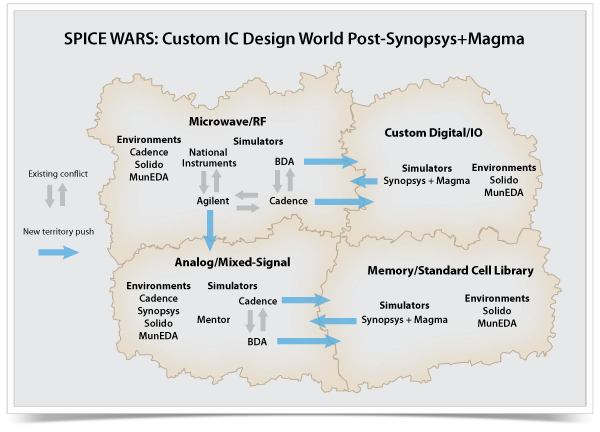 - With Synopsys annexing Magma FineSim through the recent acquisition,
Synopsys will monopolize the Custom Digital/IO and Memory/Standard
Cell Library territories. Synopsys will recapture their estimated $70
million/year in lost business to Magma, and with Magma's history of
price cutting and commoditizing now eliminated, the overall market
size for SPICE tools will increase. This definitely fortresses the
former Synopsys franchise with its huge margins to counter the low to
negative margins seen in its IP business.
- FineSim customers will start seeing their Synopsys salespeople after
the close in Q2 2012, who will tell them how their price is going up
dramatically. I suspect there will be very little discounting
considered by Synopsys.
- Disappearance of Magma as the second source SPICE vendor that
customers demand in the Custom Digital/IO and Memory/Standard Cell
Library territories presents a real opportunity for Cadence and BDA to
try to win market share here. Both companies have solid franchises in
the Analog/Mixed Signal/RF territories, and Digital and Memory
characterization is immediately adjacent to both.
- Customers are already calling Cadence and BDA to line up alternatives
to FineSim. Cadence has the resources to extend its current
offerings, and BDA has the capacity, accuracy and precision to compete
in memory and digital.
- Synopsys resources can now be shifted from fighting Magma in its home
turf to pushing into Microwave/RF and Analog/Mixed-Signal territories,
trying to take market share from Cadence, BDA, Agilent, Mentor, and
National Instruments. To achieve this, Synopsys will look to have a
competitive electrical and characterization environment in the next
two years.
- Solido's and MunEDA's SPICE environment for all the territories now
become a key weapon for simulation vendors in the SPICE Wars, to drive
simulator usage and fortress current simulator position, similar to
Cadence's strategy with ADE in Analog/Mixed-Signal territory.
- Cadence and BDA can use Solido's or MunEDA's batch netlist-based
environments to penetrate Custom Digital/IO and Memory/Standard Cell
Library territories. Synopsys can use the Solido's or MunEDA's
ADE-integrated environment to attack into Analog/Mixed-Signal and
Microwave/RF territories. Agilent can use the environments to attack
into Analog/Mixed-Signal territory.
- The new battles will start now but really heat up in Q2 2012. Right
now Magma will look at every deal out there that is renewing in the
next 1 to 3 years and try to convince customers to renew now while
they still can discount. It will be difficult for Synopsys to control
this behavior before the deal is completed.
Finally, there are still risks to the Synopsys acquisition of Magma
actually going through:
- Synopsys may fail to obtain regulatory approval. There is significant
overlap in Synopsys' and Magma's product portfolio, Synopsys will have
a monopoly in a significant chunk of the SPICE market and customers
will be faced with higher prices. FTC usually doesn't stop EDA deals,
but expect some kind of consent decree that allows for opening HSPICE
formats and calls as a way to get the deal done. The asymmetry of
Synopsys' break fee to Magma at only $13 million, versus the $30
million break fee Magma would need to pay Synopsys shows that Synopsys
sees some risk in getting regulatory approval.
- Cadence may still take a run at Magma. Synopsys is paying a 27%
premium of $7.35/share, compared to the $8.40/share Magma's stock was
trading at in July. With the 68.45 million shares Magma has
outstanding, a Cadence bid of $7.85/share would cover the $30 million
break fee Magma would need to pay. This would give Cadence
significant share in the Custom Digital/IO and Memory/Standard Cell
Library territories and keep Synopsys from monopolizing these
territories.
The SPICE Wars are definitely heating up. Expect the BDA simulator and
Solido and MunEDA environments to be acquisition targets as the various
simulator players - Synopsys, Cadence, Mentor, Agilent, National
Instruments - look at having bigger stakes in the SPICE Wars. With Ansys'
recent moves into EDA through their purchase of Apache, they will see this
as an adjacent market and will probably go after Analog/RF first.
Even beyond custom IC, the first half of 2012 will see acquisition activity
that we haven't seen for over five years in EDA.
Furthermore, as custom designers start to look at nanoscale projects, the
traditional simulation markets should start to have more simulator usage
which will drive growth in the overall custom market. Eventually,
cloud-based approaches will find their way into the SPICE wars. The
measured use business model will actually increase simulator usage and
revenue. The only thing standing in the way is the foundry's willingness
to allow their process data and foundry rules to be placed on a cloud.
Interestingly, none of us has any problem with all our credit card and
debit card activity running on a cloud today. It will happen - the
question is when.
- [ A Little Bird ]
- With Synopsys annexing Magma FineSim through the recent acquisition,
Synopsys will monopolize the Custom Digital/IO and Memory/Standard
Cell Library territories. Synopsys will recapture their estimated $70
million/year in lost business to Magma, and with Magma's history of
price cutting and commoditizing now eliminated, the overall market
size for SPICE tools will increase. This definitely fortresses the
former Synopsys franchise with its huge margins to counter the low to
negative margins seen in its IP business.
- FineSim customers will start seeing their Synopsys salespeople after
the close in Q2 2012, who will tell them how their price is going up
dramatically. I suspect there will be very little discounting
considered by Synopsys.
- Disappearance of Magma as the second source SPICE vendor that
customers demand in the Custom Digital/IO and Memory/Standard Cell
Library territories presents a real opportunity for Cadence and BDA to
try to win market share here. Both companies have solid franchises in
the Analog/Mixed Signal/RF territories, and Digital and Memory
characterization is immediately adjacent to both.
- Customers are already calling Cadence and BDA to line up alternatives
to FineSim. Cadence has the resources to extend its current
offerings, and BDA has the capacity, accuracy and precision to compete
in memory and digital.
- Synopsys resources can now be shifted from fighting Magma in its home
turf to pushing into Microwave/RF and Analog/Mixed-Signal territories,
trying to take market share from Cadence, BDA, Agilent, Mentor, and
National Instruments. To achieve this, Synopsys will look to have a
competitive electrical and characterization environment in the next
two years.
- Solido's and MunEDA's SPICE environment for all the territories now
become a key weapon for simulation vendors in the SPICE Wars, to drive
simulator usage and fortress current simulator position, similar to
Cadence's strategy with ADE in Analog/Mixed-Signal territory.
- Cadence and BDA can use Solido's or MunEDA's batch netlist-based
environments to penetrate Custom Digital/IO and Memory/Standard Cell
Library territories. Synopsys can use the Solido's or MunEDA's
ADE-integrated environment to attack into Analog/Mixed-Signal and
Microwave/RF territories. Agilent can use the environments to attack
into Analog/Mixed-Signal territory.
- The new battles will start now but really heat up in Q2 2012. Right
now Magma will look at every deal out there that is renewing in the
next 1 to 3 years and try to convince customers to renew now while
they still can discount. It will be difficult for Synopsys to control
this behavior before the deal is completed.
Finally, there are still risks to the Synopsys acquisition of Magma
actually going through:
- Synopsys may fail to obtain regulatory approval. There is significant
overlap in Synopsys' and Magma's product portfolio, Synopsys will have
a monopoly in a significant chunk of the SPICE market and customers
will be faced with higher prices. FTC usually doesn't stop EDA deals,
but expect some kind of consent decree that allows for opening HSPICE
formats and calls as a way to get the deal done. The asymmetry of
Synopsys' break fee to Magma at only $13 million, versus the $30
million break fee Magma would need to pay Synopsys shows that Synopsys
sees some risk in getting regulatory approval.
- Cadence may still take a run at Magma. Synopsys is paying a 27%
premium of $7.35/share, compared to the $8.40/share Magma's stock was
trading at in July. With the 68.45 million shares Magma has
outstanding, a Cadence bid of $7.85/share would cover the $30 million
break fee Magma would need to pay. This would give Cadence
significant share in the Custom Digital/IO and Memory/Standard Cell
Library territories and keep Synopsys from monopolizing these
territories.
The SPICE Wars are definitely heating up. Expect the BDA simulator and
Solido and MunEDA environments to be acquisition targets as the various
simulator players - Synopsys, Cadence, Mentor, Agilent, National
Instruments - look at having bigger stakes in the SPICE Wars. With Ansys'
recent moves into EDA through their purchase of Apache, they will see this
as an adjacent market and will probably go after Analog/RF first.
Even beyond custom IC, the first half of 2012 will see acquisition activity
that we haven't seen for over five years in EDA.
Furthermore, as custom designers start to look at nanoscale projects, the
traditional simulation markets should start to have more simulator usage
which will drive growth in the overall custom market. Eventually,
cloud-based approaches will find their way into the SPICE wars. The
measured use business model will actually increase simulator usage and
revenue. The only thing standing in the way is the foundry's willingness
to allow their process data and foundry rules to be placed on a cloud.
Interestingly, none of us has any problem with all our credit card and
debit card activity running on a cloud today. It will happen - the
question is when.
- [ A Little Bird ]
Join
Index
Next->Item
|
|


