( ESNUG 590 Item 06 ) --------------------------------------------- [12/10/21]

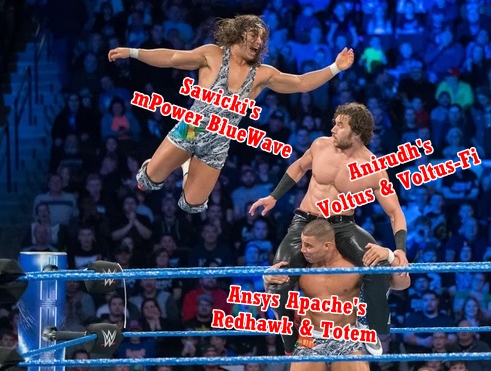
Subject: Sawicki's new BlueWave mPower body slams Anirudh's Voltus-Fi in EMIR

ET TU, BRUTE?: One fun part of a competitive EDA market is how rival vendors
will suddenly out of nowhere attack another rival in an unexpected niche.
In this case, while Aniridh is deeply engrossed with his Cadence Voltus &
Voltus-Fi offerings attacking Apache/ANSS Redhawk-SC & Totem's near monopolies
in the digital & analog EMIR space with ...

  Redhawk/ICC2/Fusion vs. Voltus/Innovus/Tempus is Best of 2019 #11
  Costello on EDA ossification, cloud, and RedHawk vs. GreenHawk
  Anirudh and Sawicki on iffy Apache IR-drop #'s vs. Voltus/Innovus
  A second CDNS Voltus-DP vs. ANSS Gear RedHawk-DMP user benchmark
  The Nvidia stealth benchmark of CDNS Voltus vs. ANSS Gear RedHawk
  ANSS "Jolly" on why Big Data is a bad fit for EDA and chip design
  TSMC, Dell, Verdi 3, Voltus-Fi, CDNS Protium, Pyxis, Gabriele
  Industry Gadfly: "A brief history of Apache and its IPO"

... suddenly out of nowhere, 6 weeks ago, in a tool niche which is totally
new to MENT/Siemens to cover -- Joe Sawicki launched his new BlueWave mPower
tool set for analog & digital EMIR analysis -- directly body slamming into
Anirudh's Voltus and Voltus-Fi EMIR tools!
When you think of it, watching the Big 3 EDA rivals go at each other is not
all that different from watching a WWE professional wrestling match.

        ----    ----    ----    ----    ----    ----    ----

HOW MPOWER BLUEWAVE PLANS TO WIN: Because of geometric growth problems where
if you have N transistors they need N^2 analysis, once analog designs get past
around 1 millionish transistors, Totem and Voltus-Fi can't do dynamic EMIR;
whereas MENT claims their mPower Analog can "do dynamic EMIR on 100 million
transistors, and static EMIR on 1.5 Billion transistors" through some magical
and occult techniques.  "They can't do it, while we can."  And MENT claims
mPower Analog works with DSPF, extracted views, Calbre extraction, Star-RC
extractions, Spectre, AFS, Eldo, HSPICE ... "anything that outputs an FSDB"
... while Voltus-Fi is locked into a CDNS-only flow.

On the digital side, their launch had an AI chip guy using mPower Digital
to do dymamic and static digital EMIR at 7nm with "1064 RISC-V processors"
(which I'm guessing is around 3 to 3.5 Billion instances.)  So it looks like
MENT's plan is to attack Voltus & Redhawk on capacity weaknesses, too.

        ----    ----    ----    ----    ----    ----    ----

WHAT COOLEY CAN CONFIRM (FOR NOW): Below I have an mPower BlueWave beta user
who's also a hands-on Voltus-Fi user, talking about the operational problems
he's directly seeing with Voltus-Fi
and why he's giving MENT mPower Analog a try instead.  (Basically he says
for extracted view EMIR, Voltus-Fi is still only beta quality SW and it
doesn't integrate well with the rest of the Cadence analog flow.)

        ----    ----    ----    ----    ----    ----    ----

WHAT COOLEY CAN'T CONFIRM (FOR NOW): I did not get any mPower Analog capacity
numbers from that user; nor any comparitive data to Voltus-Fi on stuff like
runtime, file sizes, memory footprint used, etc.

And I haven't had a chance yet to confirm with any mPower Digital user on
any of these claims mPower Digital has against CDNS Voltus and ANSS Redhawk.

        ----    ----    ----    ----    ----    ----    ----

    From: [ An Anon RF Designer ]
    To: [ John Cooley of DeepChip.com ]

    Ok, John, why not?

    If you decide to publish my feedback, I would like to remain anonymous.

    As I told you earlier, I have noticed my small team of RF designers
    all dreading -- and often procrastinating -- when it comes to running
    transistor-level EM and IR-drop on their mixed-signal designs.

    It's due to several reasons, but the foremost culprit lies in their
    difficulty in running Cadence Voltus-Fi and interpreting its results.

    Since a lot of our designs are in older nodes (90nm, 130nm, and 180nm),
    we run Voltus-Fi on Quantus, with QRC "extracted views" (as opposed to
    using a DSPF netlist; due to the lack of DSPF support in those PDKs.)

    Voltus-Fi still beta & too many false violations

    What we see is Voltus-Fi will often freeze, crash, or display null
    results when loading Spectre simulation results.  When results do
    successfully load into Voltus-Fi, our RF designers are then faced with
    the onerous task of filtering out a flood of false violations.
    (While the false violations cannot be completely blamed on Voltus-FI,
    Cadence has shown little interest to fix our too-many-false-violations
    problem.  They are neither updating the tool nor providing better
    guidance for creating extraction decks to get around this.)

    In fact, the tickets we placed about the Voltus-FI crashes were never
    addressed either.

    Voltus-Fi results have loading problems with ADE

    Even the Voltus-Fi setup isn't as easy as we would like -- the Spectre
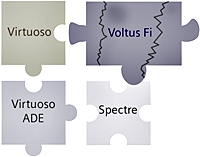
    results from Virtuoso ADE is not automatically fed into Voltus-Fi
    when it is invoked from the ADE cockpit (Cadence Explorer/Assembler).

    Roughly 90% of the time, loading the Voltus-Fi results into ADE causes
    segmentation faults.  So we have to redo it and redo it and redo it
    until it finally loads into ADE.
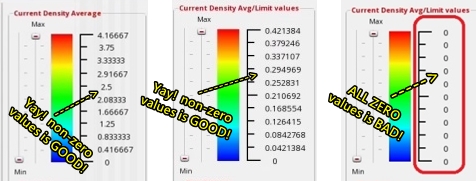
    Sometimes it'll load but overlays in ADE are all blue -- or the scale
    goes from 0 to 0 -- meaning all zero voltage drops which is wrong;
    meaning the true results aren't actually in.

    Voltus-Fi hangs onto old results

    Even when closing Voltus-Fi with results in it, we have run into
    issues where the Voltus-Fi license will not release and/or the color
    map layers are not removed from the layer palette.  So a new Voltus-Fi
    analysis would have the prior color map layers in it instead of the new
    analysis color map showing!  For us, Voltus-Fi isn't fully debugged yet.

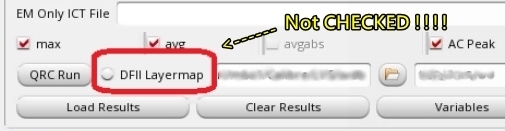
    Also, when the Voltus Fi L form is first launched and the EM simulation
    tab is selected, the DFII Layermap check box may not be selected.
    If this is not selected and you try to load the results, the results
    will fail to load.

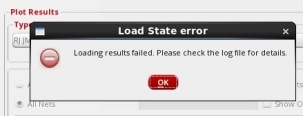
    Hitting "load results" with DFII Layermap unchecked gives an error in
    the Voltus-Fi Log window.
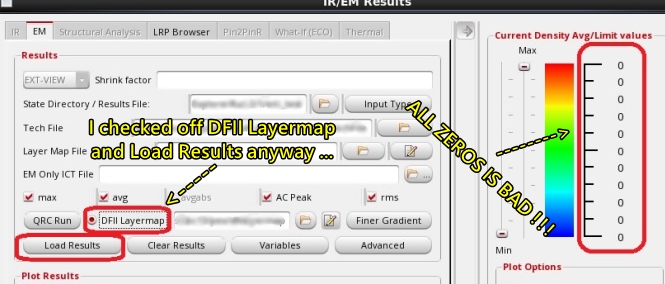
    Now, even if the DFII Layermap button is checked (it can't be unchecked
    after you select it) and you try to load results, the plot will come up
    blank with the scale going from 0 to 0 -- ALL ZEROS -- which is bad!
    If you get this error, you'll need to perform a "Clear Results" before
    trying "Load Results" again else you'll continue to get all "0's" in
    the color map.  Even then, the issue may persist.  In that case, you
    need to close Voltus Fi and reopen.  Once you reopen, make sure to
    check the "DFII Layermap" button before trying to load the results.

        ----    ----    ----    ----    ----    ----    ----

    One of the selling points Cadence has is all Cadence tools are supposed
    to be compatitible with each other.  The other Cadence selling point is
    by now their released tools should be past beta quality.
    We're not seeing this with their Spectre/Voltus-Fi/ADE combination.

        ----    ----    ----    ----    ----    ----    ----

    OUR CAVEAT: One reason why we might be having so many issues with
    Voltus-Fi is we're not working in DSPF; and Voltus-Fi is tailored to
    DSPF.  We use extracted view, which works poorly with Voltus-Fi.
    Voltus-Fi is just now using Smart View (which is an extracted view
    used to generate an DSPF) and it's still not working well yet.

    (Again, the 90nm/130nm/180nm PDKs only come in extracted view, so
    we're forced to make extracted view work for our designs.)

    Or maybe it's how we set-up Voltus-Fi?  (But I doubt it.)

    Since EM and IR set-ups are the same, but EM includes a techfile (for
    current density limits), our important Voltus-Fi EM settings are:

    State Directory/Results File.  This is the path to the PSF results.
    I usually copy and paste this from the results browser.  If the tool
    wasn't such a pile of crap, it would load this info automatically.

    Tech File: This is the qrcTechfile in the PDK install directory.
    This should be automatically loaded.  If not, you may need to talk
    with a CAD person to set it up.

    QRC RUN: When you hit the "QRC Run" button, the QRC run directory
    and Run Name are displayed.   They should match those of the
    extracted view created with your CDNS or MENT extractor

    Input Type: After you copy the directory to the results in, hit
    this button to select the results to load.   Here, we are just
    looking at DC results.

    DFII Layermap: When you click on this button, the layermap file is
    displayed.  Typically, it is located in the PDK Install Directory
    and should be prepopulated.  If not, talk to a CAD person.

    IF I AM SETTING SOMETHING WRONG HERE, PLEASE REPLY TO COOLEY SO HE
    CAN FORWARD YOUR CORRECTIONS TO ME.

        ----    ----    ----    ----    ----    ----    ----
        ----    ----    ----    ----    ----    ----    ----
        ----    ----    ----    ----    ----    ----    ----

    Mentor mPower (BlueWave)

    Given the serious annoyances we were seeing with Voltus-Fi, we were
    excited to hear about the Mentor mPower (BlueWave) EMIR tool.  To be
    honest, we wanted to give Apache Totem a try, but we couldn't get a
    Totem license from Ansys.  However, Mentor's R&D was eager for us to
    beta mPower.  So working with their R&D for a few months, we found
    their EMIR results very promising.

    Unlike Voltus-Fi, the mPower internal results load very quickly and,
    in my experience, is stable.  In fact, while I was trying to come up
    with a speed comparison, Voltus-Fi crashed so many times (or displayed
    all null results) that I gave up on the endeavor.

    Once BlueWave is internally loaded, navigation is easy and intuitive.

    WARNING #1: Just like Voltus-Fi, right now mPower (BlueWave) is also
    not well integrated with the Cadence ADE; so your mPower EMIR analysis
    work must be done within mPower.  All your changes must be later done
    in ADE.  Siemens R&D wants to tighen this integration, but it's not
    there yet.

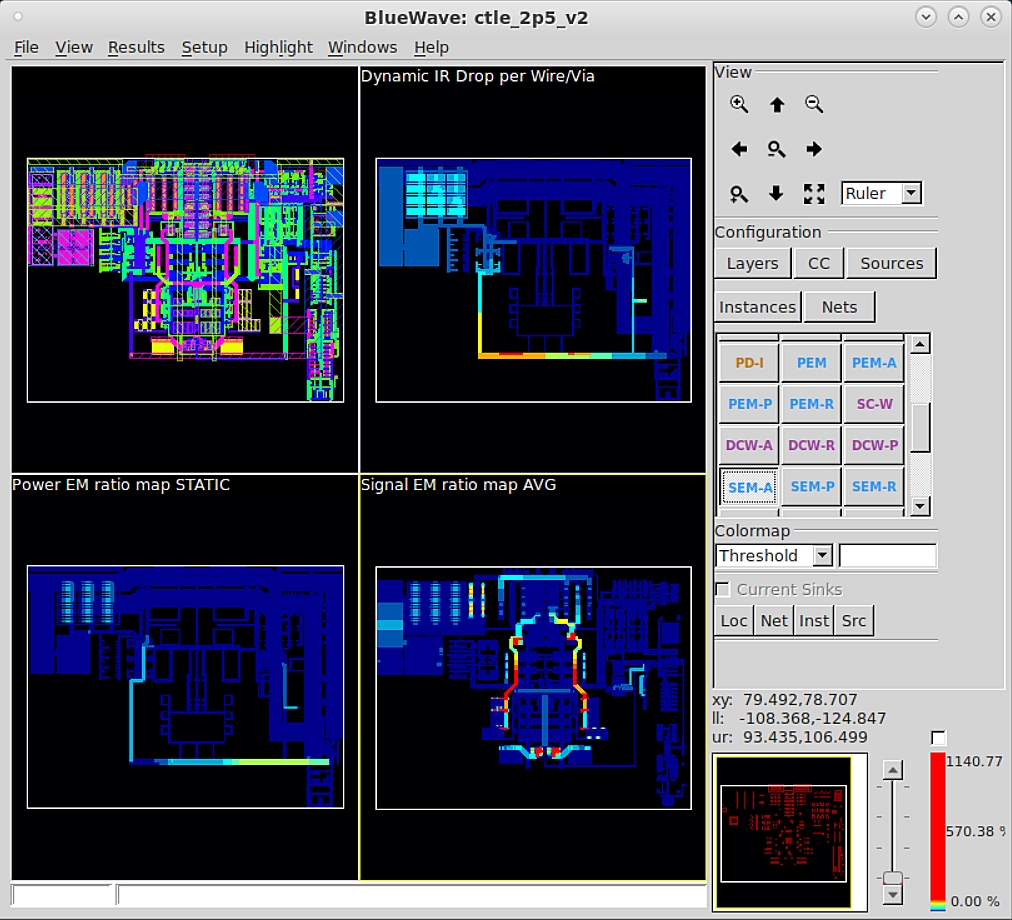
    The ability to display four subwindows, each showing a different colormap
    (static-IR, dynamic-IR, static-EM, dynamic-EM, etc.) is extremely
    useful.  Since mPower displays the colormap in a new window -- instead
    of the Cadence way of overlaying it on the Cadence layout -- the mPower
    way of zooming, panning, and exploring its results is fast and responsive
    without slowing down the ADE layout editor.
(click on pic to enlarge image)
|
    Furthermore, unlike Voltus-Fi, there are no extra layers ever added
    to the layer palette in mPower.  Querying the values associated with a
    highlighted region in mPower is easy as well.

    WARNING #2: One of the downfalls with the mPower colormap appearing in a
    stand-alone window is that our designer needs to locate the problematic
    area in the ADE layout editor in order to fix the problem.  As a fix,
    Mentor R&D tweaked mPower so the user can connect to the ADE layout
    editor and zoom into the region being queried in the mPower colormap
    window.  The designer also has the option of loading the mPower results
    directly into the Calibre RVE tool so that violations can be analyzed
    just like LVS/DRC violations.

    Maybe it's because we're a beta user, but it's been in our experience
    Mentor's R&D has been very responsive about overcoming the sea of
    false-violations that come with poorly fractured nets or stacked vias.

    MENT mPower allows CDNS extractors and CDNS DRC!

    At our request, Mentor enabled mPower the use of Cadence Quantus QRC
    views for the extracted view (non-DSPF) flow.  This surprised us because
    how Calibre obsessesd Mentor is!  Letting us use a Calibre rival
    is very useful because we can give mPower a wider deployment across
    our projects.  (Some of our designs are being done in environments where
    Calibre xRC is not available.  There are also license limitations that
    are alleviated by having this flexibility.  In comparison, Voltus-Fi
    only accepts Cadence QRC views for the extracted view flow.)

    On top of that, MENT mPower works with MENT Calibre for LVS, but it
    also accepts Cadence PVS and Assura LVS; but not Pegasus, though!


    MENT mPower vs. Cadence Voltus Fi on false violations

    While the time we had to parse through the data of both EMIR tools was
    limited, the mPower results seem to align with what Voltus-Fi reported;
    but mPower had fewer (and different) false violations.

    Furthermore, most false violations that show up in mPower were either
    really small or appear as a thin line making them easy to detect (and
    hopefully waive in a future release).

    WARNING #3: One issue we ran into near the end of our mPower (BlueWave)
    demo was the inability to waive the few false violations that occurred.
    However, this is a feature that Mentor R&D has planned to add in the
    future and I am currently in talks with management to secure a seat of
    the tool for further exploration.

        ----    ----    ----    ----    ----    ----    ----

    We're Looking at Thermal, too

    Something that we are considering more of these days is thermal analysis
    on some of our large, high power chips.  Since Cadence Celsius builds
    off of Voltus, this is likely another area where we might use Mentor
    mPower to speed up our RF design process.  We'll see.

        ----    ----    ----    ----    ----    ----    ----

    Given what I've seen so far, there could be a time in the near future
    where our RF engineers may not dread EMIR analysis like they do now.

        - [ An Anon RF Designer ]

    P.S. Thanks for allowing me to vent, John.


Related Articles:

    Redhawk/ICC2/Fusion vs. Voltus/Innovus/Tempus is Best of 2019 #11
    Costello on EDA ossification, cloud, and RedHawk vs. GreenHawk
    Anirudh and Sawicki on iffy Apache IR-drop #'s vs. Voltus/Innovus
    A second CDNS Voltus-DP vs. ANSS Gear RedHawk-DMP user benchmark
    The Nvidia stealth benchmark of CDNS Voltus vs. ANSS Gear RedHawk
    ANSS "Jolly" on why Big Data is a bad fit for EDA and chip design
    TSMC, Dell, Verdi 3, Voltus-Fi, CDNS Protium, Pyxis, Gabriele
    Industry Gadfly: "A brief history of Apache and its IPO"
Join
Index
Next->Item
|
|