( ESNUG 601 Item 3 ) ------------------------------------------------------- [09/17/26]

Subject: Dean on 1000s of agentic AI workspaces; Shiv on IP lifecycle management
                     The live DAC'26 Troublemakers Panel

  Cooley: Dean.

    Dean: Yes.

  Cooley: What's your goal?  What's IC Manage's goal when you're doing AI for GDP,
          which is for design and IP management?  Are you trying to replace all the
          CAD engineers the same way that Paul (Cunningham of Cadence) is not
          trying to replace the chip designers?

    Dean: What we're doing at IC Manage is giving the tools to the IT and CAD teams
          to basically support all of these AI agents that are being deployed.

          What we do in design management at IC Manage is we create workspaces.  The
          workspaces get all the files that the engineer needs to work on, whether those
          are partial files, full files, late revision, different versions, whatever.

          And we assemble all that.

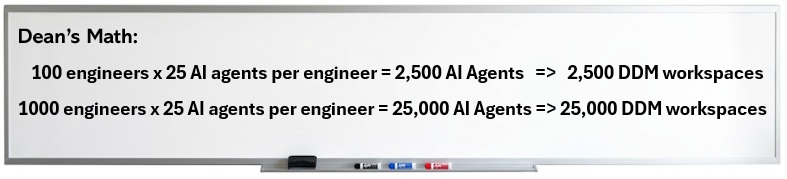
          And there are maybe 100 or 1,000 engineers working.
          But now, each one of those 100 or 1,000 engineers might have 25 AI agents
          working for him.  And so instead of 100 or 1,000 workspaces, we're going
          to end up with 2,500 to 25,000 workspaces that need to be assembled,
          created, managed, and merged back in.

  Cooley: Why don't you just make one workspace and just copy it again and again
          and again and again and again?

    Dean: Well, because each one of those workspaces is likely different.   Each
          workspace is most likely doing a different task.

          I'm doing layout in one.  I'm doing synthesis in another.  I'm doing RTL
          creation.  I'm doing RTL with some behavioral models.  You know, I'm just
          working on this one cell.  I'm doing an analog.

          The workspaces are very rarely the same between two engineers.

          If I'm going to do a regression test, I might have a bunch that are the
          same; but in a normal design environment, I won't.
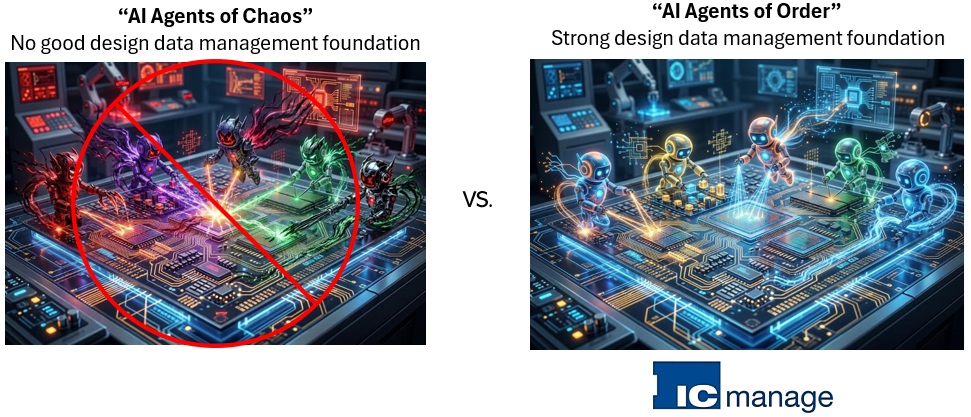
          And if you don't manage this and control it -- what you're going to end up
          with is, instead of 25,000 agents doing work (i.e. "Agents of Order");
          you're going to end up with 25,000 "Agents of Chaos" -- basically trashing
          your design.

  Cooley: Okay.

    Dean: And so that's the problem that, you know, IC Manage is known for scaling
          that up and doing that.  And so, we're scaling it up for our customers
          even more.

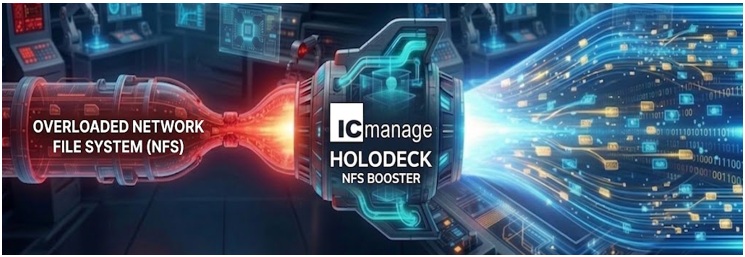
          The second problem that the number of AI agents working on your design
          is your Network Files Systems (NFS) are going to get overloaded.  They
          are already slow and will bottleneck.
          So, we've created the IC Manage NFS booster Holodeck.

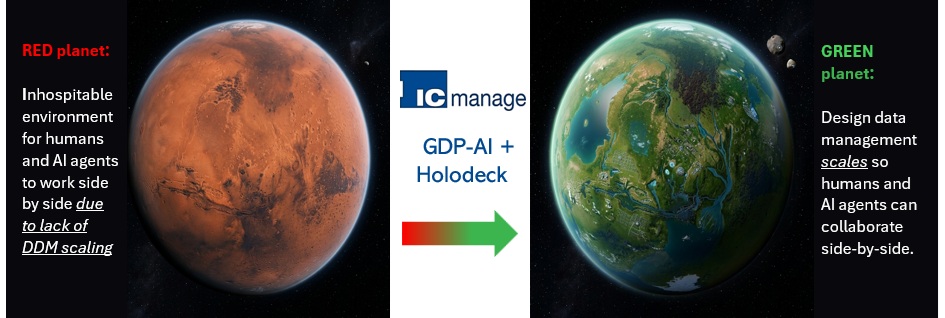
          And those two together (GPD-AI plus Holodeck) create basically a whole
          platform where we turn the red planet green; to make an environment
          for your AI to grow.
  Cooley: Red planet green?

    Dean: Yeah.  It's the scifi analogy of where you're going to turn Mars into
          a habitable planet.

  Cooley: Okay.
    Paul: "Total Recall".

 [ EDITOR'S NOTE: In the movie "Total Recall", Arnold Schwarzenegger tries to
   make the red planet, Mars, green -- thus habitable by humans.  - John ]

    Dean: Yeah, yeah, yeah.

  Cooley: (to Paul) You know what that is?

    Dean: It goes to 11.  Ours goes to 11.

          [Laughter.]
 [ EDITOR'S NOTE: "Ours goes to 11" means taking something to the extreme.  It
   comes from the 1984 comedy film "This Is Spinal Tap", where the guitarist
   shows off his amplifier with volume knobs numbered up to 11 instead of the
   usual 10, famously explaining that it is "one louder".  - John  ]

    Dean: And then at the same time, you know, we're kind of putting AI agent
          technology -- into the design management platform to basically
          automate workspace creation and to do IP life cycle management and
          get all design elements into the IP database -- so that engineers
          don't have to waste time doing that.
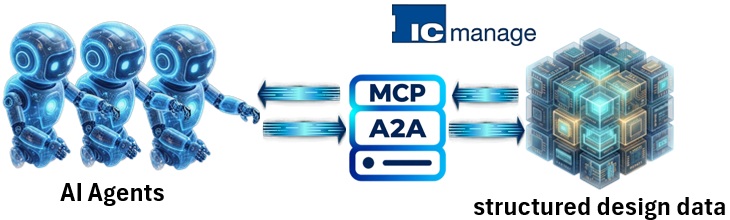
          We have the structured data of your design -- and making it accessible
          easily by your agentic AI tools -- so they can use A2A (Agent to Agent)
          and MCP to access the design and IP data and do more.

          And so, it's basically all of the backbone for all of this AI to run
          on because -- otherwise you're just going to end up with AI and chaos.

 [ EDITOR'S NOTE: For those of you unfamiliar with A2A; here's an example from Gemini AI:
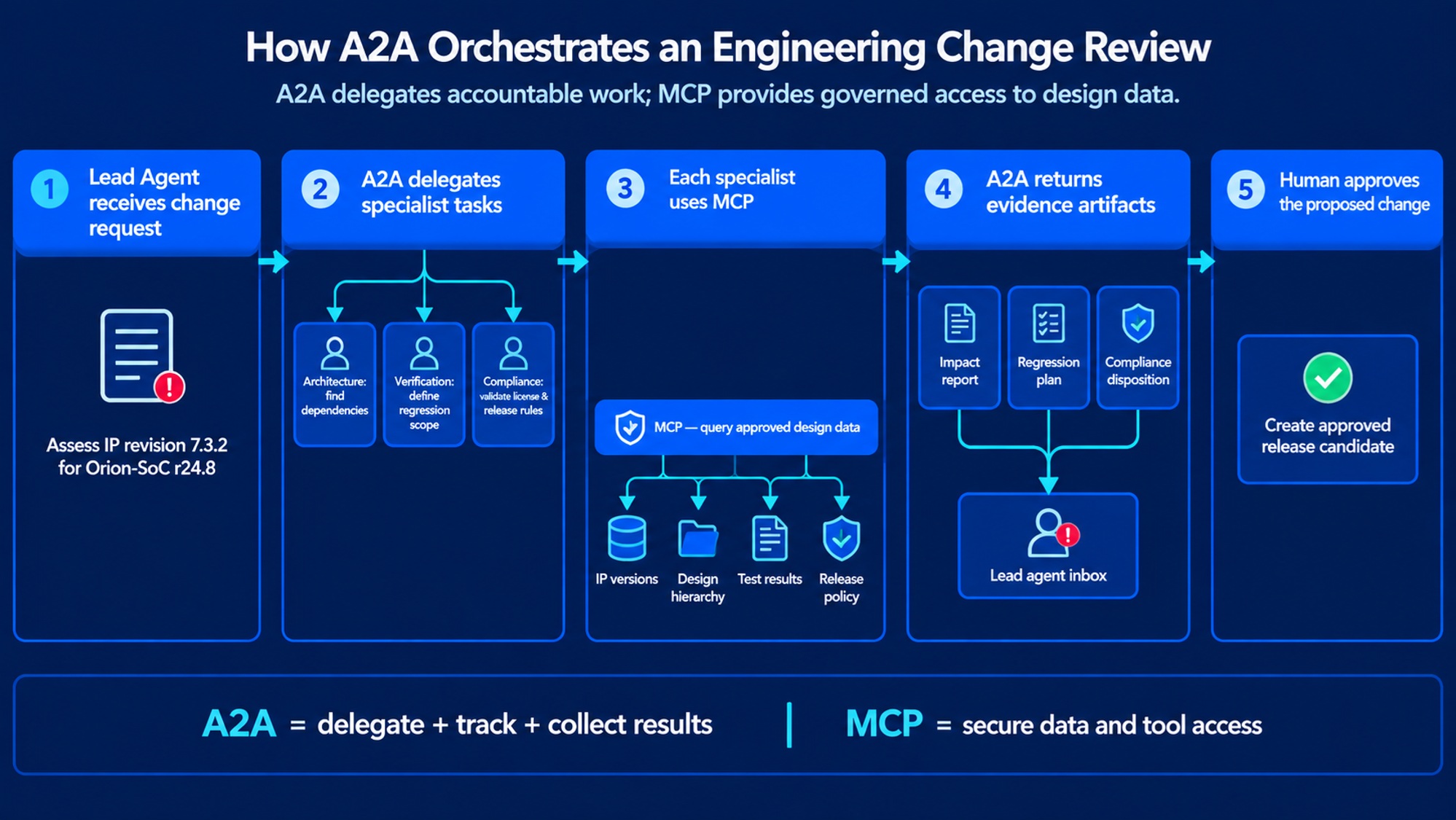
(click on pic to enlarge image)
|
   See how A2A delegates work?  And how MCP provides access to tools & data?  - John ]

  Cooley: Okay.

            ----    ----    ----    ----    ----    ----    ----    ----    ----
            ----    ----    ----    ----    ----    ----    ----    ----    ----
            ----    ----    ----    ----    ----    ----    ----    ----    ----

IT'S ALSO ABOUT IP LIFECYCLE MANAGEMENT: Two weeks after the Longbeach DAC'26, I
gave Dean's IC Manage COO and head DDM tech wizard, Shiv Sikand, a call for him to
explain what had Dean meant when he said this in the Troublemaker's panel:
    Dean: And then at the same time, you know, we're kind of putting AI agent
          technology -- into the design management platform to basically
          automate workspace creation and to do IP life cycle management and
          get all design elements into the IP database -- so that engineers
          don't have to waste time doing that.

After lots of blah blah blah blah, blah back and forth while looking at IC Manage's
web page, this graphic (below) boils down what Dean was talking about on stage -- namely
Dean was chatting up how his GDP-AI worked.

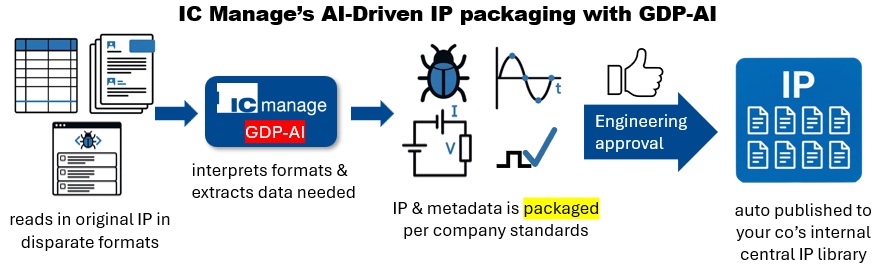
3 PROBLEMS, 3 SOLUTIONS: It's easier to just share how IC Manage GDP-AI came out as
a simple realization of IP creator psychology along with IP user psychology:

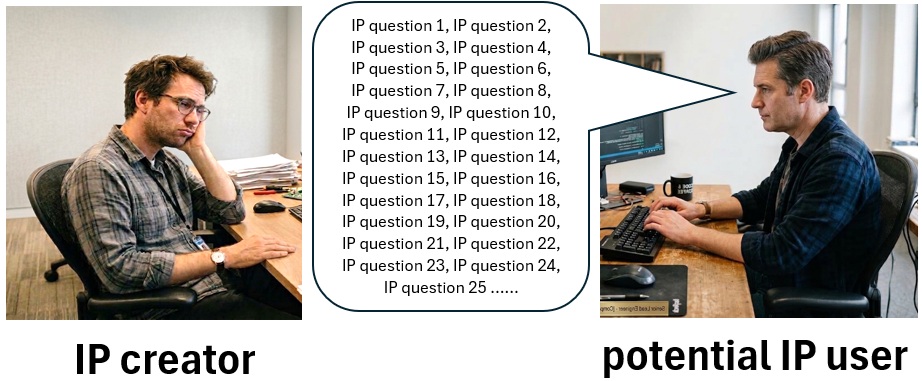
    PROBLEM 1: Once the IP creator has created his IP and babied it to
    get it 99% tested and debugged so it's usable and portable -- he wants to
    package & publish that new IP -- and to later NOT want to answer 1,001 questions
    from all the potential IP users on "how to use" his new IP.
(click on pic to enlarge image)
|
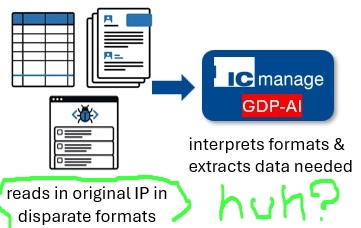
    SOLUTION 1: To internally publish his IP, all the IP creator has to do is point
    IC Manage GDP-AI to the directory of the raw data for his new IP -- and GDP-AI
    goes in and uses AI to extract the right meta and design data, and then package
    that new IP according to company standards.  All the IP creator has to do is
    review and accept it -- then that new IP is published to the central IP library.

            ----    ----    ----    ----    ----    ----    ----    ----    ----

    PROBLEM 2: Once the IP creator has published his new IP -- he does NOT later want
    to answer 1,001 general questions from the many potential IP users on "how to use"
    his new IP.
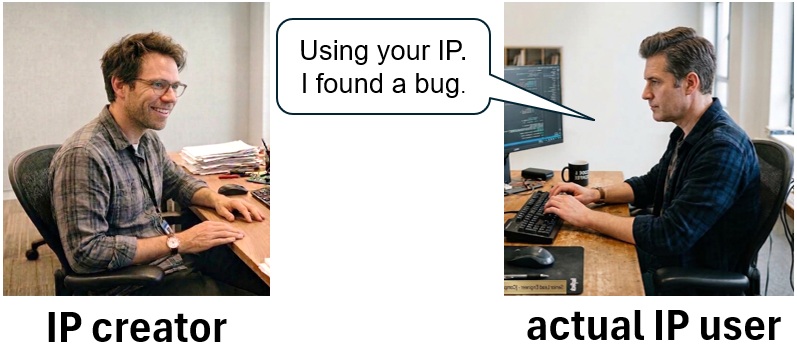
    SOLUTION 2: GDP-AI understands the IP to such a level that it has has an
    AI queryable model of that particular IP.  It can answers IP user's semantic
    questions -- and only actual IP design bugs are forwarded to the IP developer.
    Got that?

    Because of this IC Manage GDP-AI IP packaging, the IP creator does NOT have
    to deal with those 1,001 inane IP user support questions -- but the
    IP creator is still pulled in to deal with the few serious bugs in his
    new IP that he must fix.

            ----    ----    ----    ----    ----    ----    ----    ----    ----

    PROBLEM 3: As an IP user, how do I find the internal IP that my company has that
    best suits my current project's needs?  How can I be sure in detail that it'll
    work for my current project's needs?

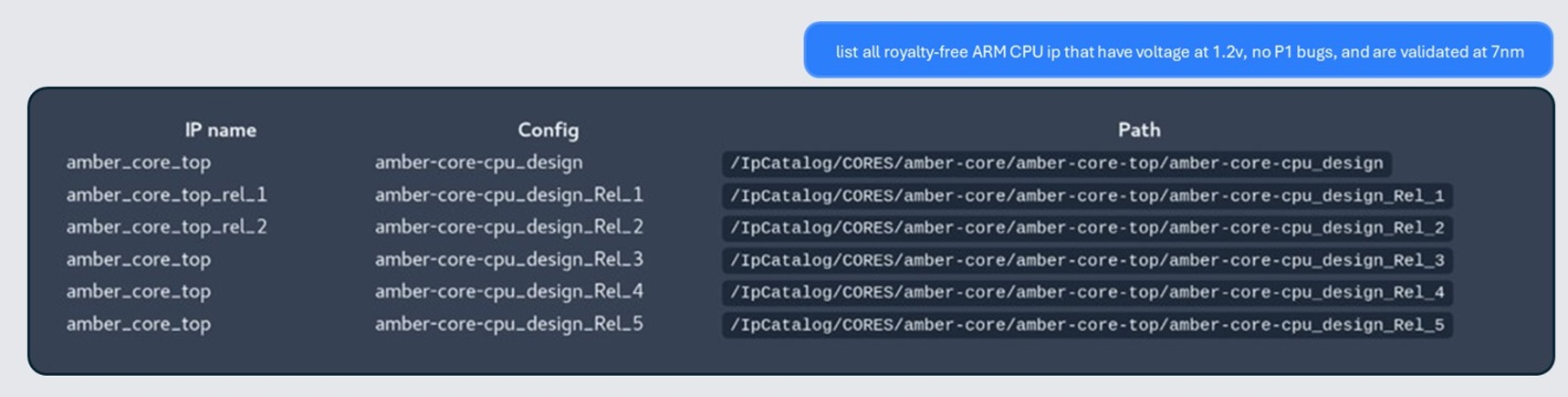
    SOLUTION 3: IP users use conversational AI queries for IP discovery in GDP-AI.
    It interprets intent and returns the best-suited IP and configurations for the
    designer to assess.  It can also dynamically render customized datasheets, with
    links to external systems such as documentation management and bug tracking.

    For example, here's a conversational AI query:
And here's the results of that conversational AI query:
(click on pic to enlarge image)
|
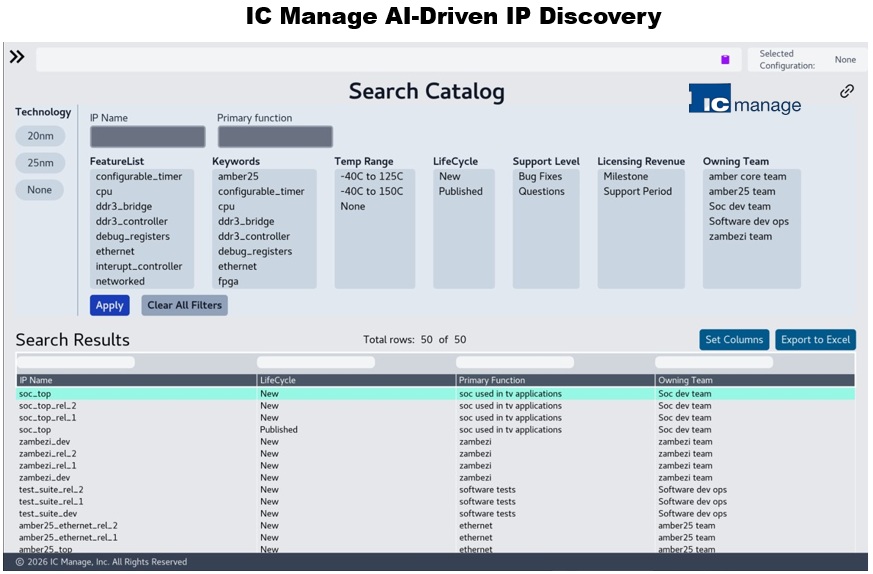
    Or the IP user can use a Google-like search and filtering.  A web UI-based search
    for keyword searching across your company's entire IP catalog.  Designers can also
    filter by IP classification (such as analog, digital, etc.) and specific
    properties such as technology node.
(click on pic to enlarge image)
|
            ----    ----    ----    ----    ----    ----    ----    ----    ----
            ----    ----    ----    ----    ----    ----    ----    ----    ----
            ----    ----    ----    ----    ----    ----    ----    ----    ----

HOLY $%&#!, IT READS EVERYTHING!: One of the more obvious "baits" that I almost always
fall for is whenever an EDA vendor makes an All-Powerful-Yet-Empty claim.
For GDP-AI, it was the empty claim "it reads in original IP in disparate formats".

So I came down on Shiv Sikand like a ton of bricks on text while he was trapped on
the road somewhere where he was 29 time zones away from me.

 Cooley: I need an exhaustive list of all disparate formats that GDP-AI reads in.

   Shiv: It can read any text format used for IP packaging.

 Cooley: Please be more specific.

                   [then I kept looping "please be more specific." ]

   Shiv: Doc, ppt, PDF, text, csv.
         Can also read jpg.
         And of course it also reads .MD
         Markdown in HTML
         It can also read code, such as verilog RTL, C, C++.
         And voice notes.

 Cooley: Voice notes???

   Shiv: These days people have gotten so used to talking to AI rather than
         typing, you can give GDP-AI an mp3 file of human instructions.

 Cooley: Can it read GDS2 in any way?

   Shiv: It can read GDS2 binaries.
         Identify the top cell and hierarchy.
         Interpret layer/datatype usage if you provide the PDK layer map.
         Review an exported cell or hierarchy report.
         Diagnose common import/stream-out problems, including missing
         references, wrong units, layer-map mismatches, flattened hierarchy,
         and malformed polygons.
         Draft scripts or workflows using tools such as KLayout Python/Ruby,
         gdstk, gdspy, or proprietary signoff/layout tools.
         It can compare two GDS revisions structurally -- for example,
         changed cells, new references, changed bounding boxes, layer usage,
         or geometry counts.

 Cooley: whoa.

 Cooley: what about netlists?

   Shiv: For netlists, it does design hierarchy: top module, preserved
         submodules, leaf cells, black boxes, generated blocks,
         repeated IP, and the consequences of flattening.

   Shiv: It can't do timing before you ask.
 Cooley: Whelp, I am humbled.

         I guess your GDP-AI really can read in original IP in disparate formats.

            ----    ----    ----    ----    ----    ----    ----    ----    ----
            ----    ----    ----    ----    ----    ----    ----    ----    ----
            ----    ----    ----    ----    ----    ----    ----    ----    ----

SHIV'S REVENGE: After I shamefully lost my battle with Shiv doubting his GDP-AI's
ability to read in IP in disparate formats -- D'oh! -- Shiv followed up in text with:

   Shiv: I hope you explain that IC Manage's IP management is also
         about IP lifecycle management.  IPs are not one and done;
         they constantly evolve.

Crap.  I lied to Shiv with:

 Cooley: Of course, I'm including the lifecycle management stuff.

         I'm not an idiot, you know.

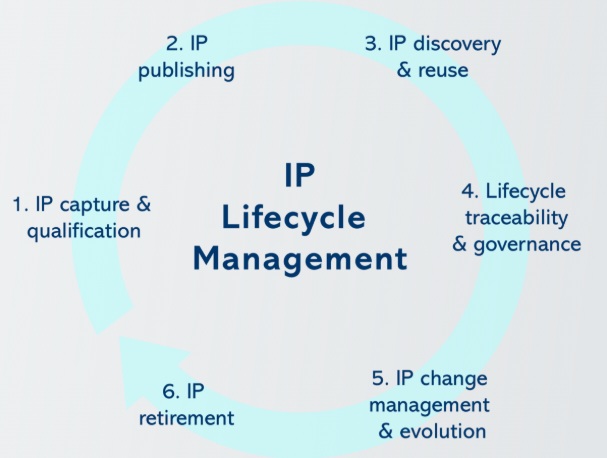
And here's what I've found out about GDP-AI's lifecycle management from a quick
scrubbing through the ICmanage.com web site:
I hate to admit this, but Shiv was right.  I found a boatload of lifecycle management
here that I didn't cover.

And that I only covered the first 3 steps in this lifecycle pic.  :(

Exercise left to the reader: go look up IP lifecycle management on the ICmanage.com
web site -- because there's no way I'm regurgitating all that stuff here.  - John

  "IP reuse is inherently difficult due to competing demands on our IP developers'
   time, the variety of historic designs, and the quantity of different
   methodologies involved.

   With IC Manage, we were able to deliver a global IP Catalog as a key part of
   NXP's strategy to fully leverage the value of our internal IP."

       - Udi Landen VP of Engineering Design Enablement at NXP Semiconductors

            ----    ----    ----    ----    ----    ----    ----    ----    ----

Related Articles

    Dean's IC Manage IP Central makes searchable 100 million IP libraries
    Why is Billionaire Dean still in the EDA ghetto running IC Manage?
    Dean on IC Manage Holodeck hybrid/native cloud speedup & less storage
    IC Manage Dean on how design data management has changed in 14 years
    Sawicki on cloud EDA is 12 hours of burst compute on 6,000 CPU's
    Users on IC Manage/CDNS/Cliosoft/MENT cloud gets #5 "Best of 2018"
    Dean, Anirudh, and Sawicki on Big Data versus Machine Learning
    Shiv on IC Manage PeerCache for cloud bursting without EDA retooling
    Dean on hybrid cloud bursting EDA flows with IC Manage PeerCache
    IC Manage Envision tapeout predictor was #8 best tool at DAC'16
    How Dean Drako's 1/2 billion dollar "side hobby" might change EDA
Join
Index
Next->Item
|
|