( DAC'16 Item 7 ) ----------------------------------------------- [05/05/17]

Subject: CDNS Innovus/Voltus, Apache Redhawk, ICC/ICC2, MENT Nitro-SoC

UNEXPECTED INNOVUS/VOLTUS ANSWERS: When I do these "best tool of DAC" surveys
the answers in the PnR space are almost always something like ICC/ICC2 vs.
Innovus vs. Olympus/Nitro-SoC vs. Atoptech type user comments.

This year was different.

This year it was users talking about Innovus with Voltus, or Innovus with
Voltus and Tempus.  Huh?
In a kind of rushed launch at DAC'16, Apache/Ansys had prematurely announced
their Big Data multi-CPU SeaHawk IR-drop tool.  The problem was SeaHawk has
accuracy & repeatability issues.

 Sawicki: "I've heard some things in terms of power, in terms of one
           solution, where if you do a different number of CPU's you get
           a different answer for nodal voltage.  (See ESNUG 561 #1)

           That's not good.  It's worse than inaccurate, inaccurate is
           kind of eh, compared to what?  But inconsistent sucks."

               - from Joe Sawicki on the DAC'16 Troublemakers Panel

And to make a bad situation worse, this puts John "Jolly" Lee's R&D staff in
a tug-of-war between trying to maintain an elderly declining RedHawk or
to beef up their newer next-gen SeaHawk.
And to make a bad situation even worser, Aniridh's CDNS sales army has been
in a full frontal assault against Apache/Ansys by chatting up the advantages
of getting IR-drop closed inside an Innovus PnR flow.
 (click to enlarge pic)
|
That's 93% fewer victims.  And 26% less IR-peak.  All within Innovus PnR.
Sexy stuff for chip designers doing 16/14/10/7nm.  Bad news for "Jolly".

        ----    ----    ----    ----    ----    ----    ----

PRIMETIME STILL KICKS ASS: Yea, Anirudh has been trying to make inroads
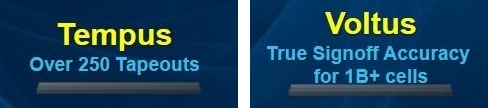
against Aart's Primetime monopoly.  He's even claiming 250+ tapeouts
with Tempus -- but that's against a 20 year PrimeTime history of easily
10,000 tapeouts or more.  "Hey, you gotta start somewhere!"  The Tempus
users may really like that it's super tight with Innovus, but they're NOT
abandoning Primetime in droves (yet).

        ----    ----    ----    ----    ----    ----    ----

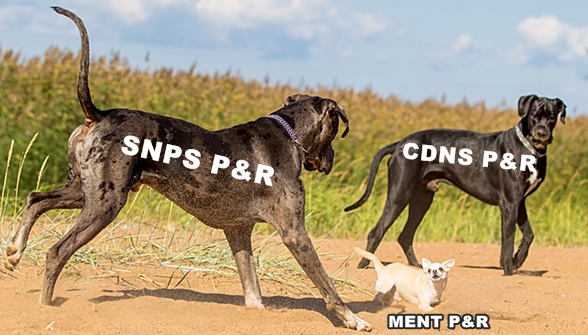
MENT OLYMPUS/NITRO-SOC: Yes, the "big dog" PnR battle is between Innovus
and ICC/ICC2 -- but judging from the user comments, Wally's Nitro-SoC PnR is
still representing well(ish), too.  I see MENT as the "little dog" in the
digital PnR wars, small and determined.  Not a threat to either Aart nor
Anirudh -- but they do get their small piece of the PnR pie.

        ----    ----    ----    ----    ----    ----    ----

AND ATOPTECH IS DEAD: or at least that's what the DAC attendees thought.
It's an olde story in EDA.  A brutal lawsuit from a large competitor kills
off a small start-up.  Just ask Nassda, Extreme-DA, and now ATOP...

        ----    ----    ----    ----    ----    ----    ----
        ----    ----    ----    ----    ----    ----    ----
        ----    ----    ----    ----    ----    ----    ----

      QUESTION ASKED:

        Q: "What were the 3 or 4 most INTERESTING specific EDA tools
            you've seen this year?  WHY did they interest you?"

        ----    ----    ----    ----    ----    ----    ----

CADENCE INNOVUS & VOLTUS

    Cadence Innovus

    We've been using Cadence Innovus P&R with CTS for a over year.  We were
    an early partner.

    Innovus takes you from a gate level netlist to a timing-closed design,
    and Cadence went for more parallelism it.  We do large-scale designs and
    wanted the improved runtime and capacity.

      - We found that implementing 2-3 million instances through P&R
        now only takes 12-24 hours, where it used to take 2-3 days.

      - This runtime includes analysis, floor planning changes, and
        iterations.  Once we get into 24 hour turnaround, that meets
        our needs.

      - We don't tend to run blocks larger than 2-3 Million gates as it's
        harder to manage boundaries.

    P&R has made a lot of progress over the last 10 years.  In 2006, we
    were running 1 million instance blocks.  We spent lots of time on ECOs,
    routing gaps, and hard timing optimization.  Most of these problems
    are now solved on the Innovus side -- but it was harder for us to spot
    obvious gaps during optimization.

    Now Innovus just runs, closes timing, and we move on.

    Cadence seems to be investing in this area more than Synopsys is in
    ICC/ICC2 (and in EDA tools in general).  My impression is that Cadence
    continues to see EDA as a worthwhile to invest in,  while Synopsys is
    diversifying more into non-EDA SW security areas.

    Cadence is also building out a full implementation flow for Innovus,
    Tempus, and Voltus.  They are moving toward common user interface, a
    common code base, and reuse of the engines.

    There seems to be lots of industry interest in using Voltus.  Folks are
    not very happy with RedHawk since Ansys' acquisition of Apache.  The
    Innovus/Voltus integration is good, including lots of consistency in the
    interfaces.  However, Voltus is not yet mature as a product.  Cadence
    is still catching up in supporting all the interest.  For example, folks
    have their own power sign off, and their own IR-drop sign off.  Unlike
    a Tempus/STA signoff, a power signoff requires much more development.

    Cadence tools in general originally came from a bunch of acquisitions,
    so there used to be an issue of diff databases, creating data exchange
    and constraints issues.  For example SDC might annotate in one tool but
    not the other.  These issues are now gone, after the focused effort
    over the last 4-5 years.  You now get timing consistency, and the CDNS
    tools all see the same critical path.

    We'd absolutely recommend it.

        ----    ----    ----    ----    ----    ----    ----

    Cadence Innovus

    I attended update presentations at DAC with Cadence Innovus P&R tool and
    we're also hands-on users of it ourselves.

    It feels like Innovus is gaining share in the market against products
    like Synopsys ICC/ICC2.

    1. Innovus' biggest claim-to-fame is runtime and high capacity with
       reasonable runtime.  To benchmark:

         - We used Innovus on our ARM core design.

         - We ran 1.2M instances.

         - We ran it across 16 CPUs, and saw 25% to 50% performance speed
           up vs Encounter.  (The larger designers sped up more.)

         - Our PPA quality was maintained.

    2. Each of Innovus' optimization steps has more multi-threading over
       Encounter.  It uses compute resources more efficiently.  Innovus'
       ECO capability has also improved.  Our total implementation time
       for the full Innovus flow with timing reports, clocks inserted,
       power reduction and final detailed execution was:

         - now 3 days with Innovus

         - used to take us 7 days with Encounter.

    We got this full flow speed up, even when using Synopsys Primetime.
    CSNS claims you can get more benefits with theit more deeply
    integrated Tempus -- i.e. an ECO flow with sign off timing -- but
    we didn't try it.

    3. Innovus supports multi-mode, multi-corner timing set-ups.

         - We could define all of our scenarios for the tool up front and
           enable them at different parts of the design flow.  For example,
           for sign off, run all corners; but for implementation only a
           subset of corners.

         - You can have an environment where block size is only 1M, and
           still run all scenarios.

    Cadence discussed enhancements to Innovus GigaPlace and GigaOptat DAC.
    This is the "heavy lifting" optimized placement part done early in the
    PnR flow.  The placement must be done right for your design to work
    and Cadence is investing lots of R&D there.

    One example is that you used to be able to abut all the cells in the
    library.  But at 10nm you must leave a space between certain cells,
    while others can still be abutted.  GigaPlace understands these foundry
    DRC cell-based rules.  I.e. it understands that some cells don't place
    well with others and does the right thing.

    We used Innovus at 10nm and it avoided that kind of violations that
    could not simply be fixed with just metal movements later.  P&R tools
    must comprehend this.  In fact, that was a key driver for us move to
    Innovus from Encounter.

        ----    ----    ----    ----    ----    ----    ----

    Innovus seems to have maturity now.

    The key players (TSMC, Samsung, GF, ICF) have certified it down to 7nm.
    Even saw a presentation on a 5nm test chip by IMEC that was done with
    Innovus.  They are really driving the curve.

    I heard that QCOM, Nvidia, Marvell, HiSilicon, and MediaTek are some
    of the more recent adopters.

    For EMIR signoff Voltus is taking marketshare.  RedHawk has a hard time.
    I believe that Ansys rushed their SeaHawk release -- this leaves them
    with two separate products and a great opportunity that Cadence is
    exploiting to grow.  Cadence has paid attention to ease of use by
    adding a VCD visual display analyser (for example) to visualise high
    resistive paths in the GUI.  Voltus is fast, too.

    Voltus still has growing pains and bugs to iron out.  For example,
    it has little support for hierarchy.  Also the Voltus save/restore
    was buggy and core dumped.

    That said it's a good product.  Watch out Ansys!

        ----    ----    ----    ----    ----    ----    ----

    Innovus -- I see massive traction in the 16nm market market adopting it.
    Anirudh was smart to integrate his Tempus and Voltus to his PnR.  That
    moved our management over towards Cadence.

    I wonder if Innovus will also be the next gen tool for 10nm and 7nm.

        ----    ----    ----    ----    ----    ----    ----

    I've used Cadence Innovus with Tempus for my last two projects.

    I'm currently working on an ARM core.  My overall assessment:

      - You can be productive with Innovus without a lot of past PnR
        experience.  The flow/methodology can give you "tapeout quality:
        for your design with a lot of automation, and without a steep
        learning curve.  Anirudh has managed to make it easier to build
        quality designs for a non-expert, so you can send your designs
        to less sophisticated design centers.

      - Innovus is also powerful for a physical design expert.  You can
        drive it harder -- it does, of course, take some time to know
        which knobs to use in this mode.

    Innovus speed is very fast compared to the P&R tools I used a couple of
    years ago -- AtopTech and Magma Talus.  I can now run at least 2X the
    size of a design overnight as I did previously.  To do this we took
    advantage of Innovus 16 CPU parallel distribution.

      - For 2-3M instances, in an overnight Innovus run, we can get
        simple placement.

      - For 1M instances, in an overnight Innovus run, we can get:
        placement optimization, Clock Tree Synthesis optimism (CTS)
        and routing optimization.

    From a capacity standpoint, the largest block we've tried successfully
    was 4M instances.

    Innovus is also strong for its full entire flow.  We used to use
    Synopsys Primetime for our timing sign-off, and it took us a lot longer
    due to correlation issues, then did a number of shadow runs with Tempus.

    Once we made sure the accuracy was okay, we switched to doing timing
    MCMM sign-off with Tempus.  Going through PnR is much faster now.

      - We go through timing sign off with restricted corners (and
        usually this is the bottleneck) as we cannot afford to look at
        all modes and all operating corners during optimization.

      - When we setting up Innovus for timing closure, we get very close
        right away.  Even so, some corners may not be covered --  this is
        where the Innovus/Tempus full sign-off integration makes a big
        difference.  The timing tool and back annotation are completely
        compatible and tightly correlated.

      - We do a lot of timing ECOs.  Once Innovus is done, we go back and
        forth to close the loop to resolve the timing violations.  We try
        to minimize over-design by avoiding extra margin during timing
        optimization and close only the viloations required by signoff
        timer.

    We still use Ansys Redhawk for gate-level power analysis, but we've
    heard good things about Voltus, and are looking at it now.  We are once
    again doing shadow runs to verify Voltus' sign-off accuracy before we
    decide to switch over.

    Innovus gives us "tapeout quality QoR" quickly.  Innovus also allows
    us to push hard for performance or area when desired.

    Innovus seems to doing much better in the market in last 2 years.  In
    the past, I used to hear bad opinions of Cadence PnR (from other people,
    since I wasn't a user then.)

    That has changed under Anirudh.  Based on my experience over these
    last 2 projects, I'd definitely recommend Innovus.

        ----    ----    ----    ----    ----    ----    ----

    We are using Cadence Innovus, Tempus, and Voltus.  We've seen some
    capacity improvements in Innovus as compared with the old Cadence EDI
    a couple of years ago.  We have a different generation of blocks now
    so I can't make a direct comparison (16nm vs. 28nm), but we would have
    had to split these 10nm blocks up to get them through EDI.

    GigaPlace and GigaOpt are key technologies within Innovus.  We've seen
    better QoR with these.  GigaPlace is their timing closure aware placer,
    and GigaOpt is used throughout for timing closure.

    We use Innovus for two major modes: set-up timing, and hold timing,
    where we add additional view constraints -- more and more info.  We
    use 4 CPUs for set-up timing mode, and 8 CPUs for hold timing mode.
    The largest blocks that we've run through Innovus are 1M-2M instances,
    and highly complicated in Ghz terms and phases of clock frequencies.

      - At 16nm with messy timing, we are pushing against the limits and
        causing Innovus to work harder.  It takes a week to go through
        entire flow, including Tempus and Voltus.

      - We can get the smaller, less timing compilcated blocks through
        the full flow in 2-3 days.

    Innovus has signoff and ECO integration with Tempus and Voltus.  You
    can call Tempus from within Innovus, but we use Tempus standalone.
    Tempus ECO allows you to do last mile timing and power and area,
    which we use.

    We are trying 7nm, which is working on the bleeding edge, and Anirudh's
    R&D has been very responsive about fixing the bugs we find.

    We also use Voltus standalone.  Cadence's Voltus integration is less
    mature; we would like to see more Dynamic IR-aware optimization, and
    Cadence is starting work on that.

        ----    ----    ----    ----    ----    ----    ----

    Innovus.  Cadence discussed better TAT, performance scalability, ability
    to handle very large blocks, signoff and ECO Integration with Tempus and
    Voltus.

    Each of these features is significant, and it all has to work together.
    The high capacity with the integrations (signoff & ECO) represent a leap
    forward to any other design flow.  The industry is full of stories where
    the design flow has made the difference between successful designs and
    designs which were either never built or were late to the market.

    Innovus is one of the great products in EDA history.  Anirudh recruited
    a very strong team from many places, including many key developers and
    product owners from Magma, to add to Cadence's existing resources.  He
    also re-architected and re-architected wherever needed.

    The result is something of a "super-tool" with all critical features for
    10nm design of the other implementation tools in the industry, with
    better integration and better runtime/capacity.

    If Cadence's competitors don't make similar investments (and maybe if
    they do), Innovus is well positioned to dominate physical implementation
    now & in the years to come.

        ----    ----    ----    ----    ----    ----    ----

    Innovus.  Their Imec 5nm DAC presentation was good.  Not as detailed
    as what you had, John.   (See ESNUG 554 #3.)

        ----    ----    ----    ----    ----    ----    ----

    We're leaning Innovus for our 7nm chip.

        ----    ----    ----    ----    ----    ----    ----
        ----    ----    ----    ----    ----    ----    ----
        ----    ----    ----    ----    ----    ----    ----

ANSYS/APACHE SEAHAWK & REDHAWK

    The new tool Ansys tool, Seahawk, with elastic computing.  Impressive
    computation time and data management.

    We are interested in benchmarking it as soon as possible on our design
    flow and on our compute farm.

        ----    ----    ----    ----    ----    ----    ----

    We're staying Redhawk for now.

        ----    ----    ----    ----    ----    ----    ----
        ----    ----    ----    ----    ----    ----    ----
        ----    ----    ----    ----    ----    ----    ----

MENTOR NITRO-SOC

        ----    ----    ----    ----    ----    ----    ----

    Nitro throughput of 2M inst in 24 hours for PnR caught my attention.

    Mentor claims that Nitro is a complete rewrite of all the key engines
    including placer, optimizer, router and the database.  They have also
    completely overhauled the flow scripts and used multi-processing and
    threading.

    Dynamic power-aware flow and 10% additional power reduction vs ICC2,
    area and die size down 10% using abutted floorplanning and area
    recovery.  Direct interface to Calibre -- run Calibre DRC/DP/DFM
    checks and automatically fix violations.

    ST and Nvidia presented.  Overall a very interesting tool

        ----    ----    ----    ----    ----    ----    ----

    Mentor's Nitro P&R system was interesting.  Their runtime claims are
    5 time faster compared to their previous generation with a throughput
    of 2 million instances in 24 hours.  Support for 10nm and integration
    with Calibre, power analysis and optimization delivering 10% less
    power, especially for FinFET nodes.

    Their channel-less hierarchical floorplanning methodology supposedly
    cuts down die size and area to the tune of 10% compared to the channel
    based flows.  Nvidia presented on the Nitro hierarchical floorplanning
    and how it helped reduce their floorplanning cycles.

        ----    ----    ----    ----    ----    ----    ----

    Nitro-SoC is faster this year.

    The speedup is apparently from the complete rewrite of all the engines
    and also from utilizing hardware for parallelization. They enhanced the
    interface to Calibre to handle multi patterning rule fixing for smaller
    nodes (14/10nm) which should reduce the physical verification cycles.

    We typically go through 4-5 iterations for DRC clean-up and this should
    help drop it down significantly.

        ----    ----    ----    ----    ----    ----    ----
        ----    ----    ----    ----    ----    ----    ----
        ----    ----    ----    ----    ----    ----    ----

SYNOPSYS ICC/ICC2 -- oops!  got no user comments!

        ----    ----    ----    ----    ----    ----    ----


        ----    ----    ----    ----    ----    ----    ----


        ----    ----    ----    ----    ----    ----    ----


        ----    ----    ----    ----    ----    ----    ----


        ----    ----    ----    ----    ----    ----    ----
        ----    ----    ----    ----    ----    ----    ----
        ----    ----    ----    ----    ----    ----    ----

ATOPTECH

    Don't want to be negative but the Atoptech booth was empty at DAC.

        ----    ----    ----    ----    ----    ----    ----

    We're looking at Innovus to replace ICC.

    We disqualified Atoptech because of the lawsuit issues.  Too messy.

        ----    ----    ----    ----    ----    ----    ----

    I don't think Atoptech will be around by next DAC.

        ----    ----    ----    ----    ----    ----    ----

    ATOP booth == ghost town

        ----    ----    ----    ----    ----    ----    ----

Related Articles

    Real Intent and Blue Pearl get #2 overall for Best EDA of 2016
    IC Manage PeerCache and CDNS Rocketick get #3 as Best of 2016
    MENT Calypto Catapult single handedly gets #4 Best EDA of 2016
    BDA, Solido, MunEDA, and Silvaco get #5 for Best EDA of 2016
Join
Index
Next->Item
|
|