( DAC'20 Item 01a ) ----------------------------------------------- [02/12/21]

Subject: Users choose Joe Sawicki's AFS-XT SPICE gambit as Best of 2020 #1a

SAWICKI'S GAMBIT: MENT BDA AFS has a strong beachhead in enemy Spectre SPICE
territory but the enemy has Virtuoso ADE fortresses controlling access to
the analog/MS design mainland.  So what does Sawicki do?

He makes his already fast BDA AFS even ~5x to 10x faster and then he does
NOT charge even one penny to the users for this upgrade -- on the crazy wacko
gambit that happier customers will buy more BDA licenses because they're
happier with it!
   "... if you have your customers by being able to turn on a switch
    can go take advantage of this new capability and run 5-10 times
    faster [FOR FREE] they're going to use that particular SPICE
    simulator more often."

        - Joe Sawicki, Siemens/MENT bigwig, 10/16/2020 in ESNUG 588 #21

And holy crap!  Judging from the comments I've received from a sea of SPICE
users and analog designers to my survey -- Sawicki's Gambit appears to be
working!  (To get a sense of this, I highlighted each time a SPICE user said
the words "free" or any cost related stuff in their comments below.)

        ----    ----    ----    ----    ----    ----    ----

2ND AFS-XT BENCHMARK: 18 months ago, Anirudh announced his Spectre-X SPICE
simulator that was expressly aimed at crushing the Mentor/Siemens BDA AFS
insurgency that was troubling Anirudh's Spectre empire.  Then, as expected,
8 months later there was a *ton* of Cadence Spectre-X user skepticism until
two hands-on user benchmarks confirming that Spectre-X was ~3.6x to 4.7x
faster and used 1/3rd the memory Spectre-APS uses ...

    Cadence Spectre-X skeptics & early sightings is Best of 2019 #2b

... which put those skeptical Spectre-X user doubts to bed.
Now, ~6 months ago Ravi did a direct counter-attack against CDNS Spectre-X
with AFS-XT benching "3x to 11x faster than Spectre-X."  (ESNUG 588 #20)

And what you'll find here in the comments is a 2nd user benchmark confirming
Siemens/Mentor BDA AFS-XT is "2.2x (most accurate) to 3.3x (least accurate)
faster than Cadence Spectre-X."  That is, the SPICE Tech War is on!  :)

        ----    ----    ----    ----    ----    ----    ----

THAT OLD SCHOOL CUSTOMER BASE: Yea, while AFS-XT's zippy new (free) speed-up
is sexy for many, I was surprised at how many of the BDA SPICE users could
care less.
That is, they're happy with plain olde original AFS and as long as it was
faster than Cadence Spectre-APS they'd stick with AFS.  I have two AFS vs.
Spectre-APS benmarks -- and even an AFS vs. Tanner T-Spice user benchmark
in the comments below!

        ----    ----    ----    ----    ----    ----    ----

OOPS, NEVER MIND: Remember that sleazy "corkage fee" last year where CDNS
tried to put a surcharge on BDA users inside the Virtuoso ADE environment?
    "It appears that the 2014 settlement has now -- 6 years later -- timed
     out because Cadence has recently started charging a "corkage fee"
     (i.e. an extra license fee) to all users if they want to use BDA AFS
     integrated within Virtuoso ADE.  (And, like a persistant cough that
     won't go away, it's making the users pissed off against Cadence!"

          - from http://www.deepchip.com/items/dac19-02a.html

It turns out the Big EDA Customers like Apple, Qualcomm, Intel, etc. all
collectively told Cadence to effectively "**** ***!" on this idea.
And now Cadence Sales only tries these games on smaller, weaker start-ups
and the start-ups counter by stalling and dragging out the sales cycle until
the Cadence Sales guys relent.  Nice try, but no one's buying it!

        ----    ----    ----    ----    ----    ----    ----
        ----    ----    ----    ----    ----    ----    ----
        ----    ----    ----    ----    ----    ----    ----

      QUESTION ASKED:

        Q: "What were the 3 or 4 most INTERESTING specific EDA tools
            you've seen in 2020?  WHY did they interest you?"

        ----    ----    ----    ----    ----    ----    ----

THE "FREE IS GOOD!" USERS


    Our management strongly approves this AFS-XT upgrade because it's free.

        ----    ----    ----    ----    ----    ----    ----

    Free is the right price for us to upgrade to AFS-XT.

        ----    ----    ----    ----    ----    ----    ----

    Sawicki is right about AFS being best-in-class SPICE.

    We use the Virtuoso ADE enviroment.  Our purchasing department wants
    us to switch from AFS to Spectre just to cut down on internal
    paperwork.  But our engineers want AFS because of better runtimes.

    When Spectre-X was announced, the Cadence sales force got our
    purchasing department to push for it.  "One supplier is better than
    two, three, four suppliers."  We were almost going to switch over
    to be all-CDNS, then Ravi showed us AFS-XT.

    Making the AFS-XT free shut up our purchasing guys.  Brilliant move.

        ----    ----    ----    ----    ----    ----    ----

    When I told my boss that the AFS-XT upgrade was free, he told me to
    "Find out what the catch is on this.  There's something wrong."

        ----    ----    ----    ----    ----    ----    ----

    Damn skippy, Sawicki is right.  SW upgrades SHOULD be free.  That's
    what an annual subscription fee is supposed to cover!

        ----    ----    ----    ----    ----    ----    ----

    AFS-XT.  It's free and faster.

        ----    ----    ----    ----    ----    ----    ----

    Got to say the free Mentor AFS-XT upgrade.

        ----    ----    ----    ----    ----    ----    ----

    That AFS-XT is free for us is extremely compelling for my mgmt.

        ----    ----    ----    ----    ----    ----    ----

    Sawicki is correct.  We're one of his "happier customers" buying
    more BDA licenses because its -XT upgrade is free.

        ----    ----    ----    ----    ----    ----    ----

    Biggest lie --

    When I asked my CDNS salesman why their Spectre-X upgrade wasn't free,
    (like how the BDA AFS-XT upgrade is) he tried to BS us that "Spectre-X
    is a totally new SPICE simulator."

    "Oh, so does that means we have to now completely requalify Spectre-X
    as *new* software?  That's going to take some time ..."

    He wasn't happy.

        ----    ----    ----    ----    ----    ----    ----

    Our prelim look is AFS-XT ("red") only about 1.7X faster than AfS itself;
    which may be why it's a free upgrade.  This is no RC-reduction involved.

    We'll take that speed-up for free, though.

        ----    ----    ----    ----    ----    ----    ----

    Sawicki is telling the truth.  We are buying more SPICE licenses.  That
    free speed-up upgrade helped us decide on it being AFS.

        ----    ----    ----    ----    ----    ----    ----

    #1 goes to MENT for its free SPICE upgrade.

        ----    ----    ----    ----    ----    ----    ----

    We design memories.  free ASF performance upgrades is our Best of 2020.

        ----    ----    ----    ----    ----    ----    ----

    Senior mgmt asked us why speed upgrades aren't already paid for with our
    subscription payments with all SPICE vendors?  Why is it different that
    Siemens is doing this?  We didn't have a good answer for them.

        ----    ----    ----    ----    ----    ----    ----

    John -

    My circuit guys say "THANK YOU!" for the AFT-XT v Spectre-X benchmark
    in ESNUG 588 #20.  Knowing that -XT is ~8x faster only for post-layout
    simulations (and not for pre-layout) surprised them.  Algorithmically
    and mathematically they should be the same problem, no?

        ----    ----    ----    ----    ----    ----    ----

    For a Calibre hack, Sawicki knows his SPICE users spot on.  Making
    the AFS speed upgrade free made it a no-brainer for us to try it.  If
    it works out, we'll likely end up buying more BDA licenses.

        ----    ----    ----    ----    ----    ----    ----

    FYI -- AFS-XT only accelerates post-layout circuits.  For anything
    pre-layout, you might as well just use AFS.  free is good, though.

        ----    ----    ----    ----    ----    ----    ----

    AFS-Extreme.  We like free.

        ----    ----    ----    ----    ----    ----    ----

    Tell Sawicki "Thanks for the free upgrade, Joe!"

        ----    ----    ----    ----    ----    ----    ----

    We long time users of AFS.  Now faster for free?; it's good for us.

        ----    ----    ----    ----    ----    ----    ----

    Siemens Mentor BDA AFS hand down has the best technical support that
    I've ever seen in EDA.  Adding free speed-up is even nicer.

        ----    ----    ----    ----    ----    ----    ----

    We've been having Ravi visiting us since the early BDA days when he
    was a nobody.  Now that he's an industry Big Guy, it's classy that
    instead of pawning us off to an account manager, Ravi still visits
    us at least once a year.

        ----    ----    ----    ----    ----    ----    ----

    We buy AFS and FineSim licenses in bulk.  Same as last 3 years.

    We probably convert some AFS over to AFS-XT because it's free.

        ----    ----    ----    ----    ----    ----    ----
        ----    ----    ----    ----    ----    ----    ----
        ----    ----    ----    ----    ----    ----    ----
A 2ND BDA AFS-XT VS. CDNS SPECTRE-X USER BENCHMARK

        ----    ----    ----    ----    ----    ----    ----

    We use Siemens/Mentor AFS-eXTreme (AFS-XT).  It's the new version of
    their AFS analog SPICE simulator that has tremendous speed-up over
    the original AFS without losing accuracy.

    WARNING: we've found that AFS-XT is *only* fast for cases where we have
    a large post-layout RC-extracted analog netlist.  Beyond that, AFS-XT
    and AFS' speeds are fairly comparable for pre-layout schematic netlists.

    But we now use AFS-XT for both pre-layout and post-layout designs.

        - AFS-XT uses the same license as AFS -- at no additional cost.
        - In contrast, you must pay extra for Cadence Spectre-X.

    The largest design we've run on AFS-XT was an analog SRAM with 6 million
    total elements (before reduction.)  AFS-XT worked fine.  We ran it on
    16 cores.  After some experimentation, we determined that for an SRAM
    design of our size, 16 cores was the sweet spot maximum speed-up
    benefits versus any overhead.

    I have some benchmarks below.  We already have AFS, AFS-XT, Spectre,
    Spectre-APS in-house and had Spectre-X for our benchmarking.


    COMPARISON 1: AFS-XT vs. Spectre-X

    Ran our 6 million element design (with reduction) on both simulators.

        - Accuracy settings: Moderate
        - # of cores: 16

    Performance
                           Runtimes
                           --------
        AFS-XT (green)      1.0 day
        Spectre-X (MX)      1.5 to 2.0 days [moderate accuracy]

    Convergence

        - Both simulators converged fine for us.

        - Spectre-X tries to calculate the DC points faster (if we use
          +dcopt option) -- it takes longer if I don't use that option.

        - AFS-XT doesn't have a dcopt-type option, but I saw no difference;
          it didn't impact its performance nor convergence.

    Transient Noise

        - AFS-XT works well for transient noise; and is faster than
          Spectre-X.


    COMPARISON 2: AFS, AFS-XT, and Spectre-X

    We did an RC extraction of our 100,000+ element PLL in MENT Calibre-xRC
    and CDNS Quantus QRC across different modes.

    We then ran a comparison of AFS, AFS-XT, and Spectre-X.

    I ran my benchmarks on the pre-production AFS-XT (version 2020.3).  This
    is important because Mentor added a 2nd category for the AFS-XT
    production version 2020.4.  AFS now has category 1 for red, green, and
    blue.  It also has a category 2 (netlist reduction) for red, green, and
    blue.

    Similarly, Spectre-X has category 1 for CX, AX, MX, LX, and VX.  It also
    has a category 2 for CX, AX, MX, LX, and VX, for netlist reduction.  We
    only benchmarked CX, AX and MX.

    All runs were with 16 cores, with similar accuracy modes.

        - "Vanilla" AFS (without -XT) has the same high accuracy as
          AFS-XT red

        - AFS-XT: Most accurate to least accurate: AFS-XT red, AFS-XT
          green, AFS-XT blue

        - Spectre-X: Most accurate to least accurate: Spectre-X (CX),
          Spectre-X (AX), Spectre-X (MX)

    Our results are below.


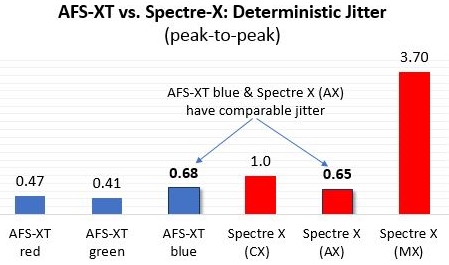
    JITTER

    Jitter is one of the most important metrics for us.

    AFS-XT outperformed Spectre-X in terms of deterministic jitter
    (deterministic jitter is dominant over random jitter for us therefore we
    only care about deterministic jitter).

    We can use AFS-XT's lower accuracy setting (blue) and get the same
    jitter as Spectre-X's medium accuracy setting (AX).
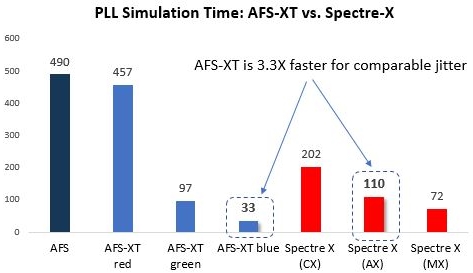
    PERFORMANCE

    You can see from the runtimes below, that for comparable jitter, we can
    get 3.3X more speed up using AFS-XT vs Spectre X.  (Remember AFS-XT's
    lower accuracy setting gives us comparable jitter accuracy as Spectre
    X's medium accuracy setting.)

    Bottom line: AFS-XT reduces our simulation time a lot, while maintaining
    acceptable accuracy.
    Methodology

    How we use the different SPICE simulators.

    At top-level, we mostly use Mentor's Symphony mixed signal simulator.
    We use it to verify that the functionally all works together.

    At the block-level:

        - We primarily use Mentor AFS-XT.  We did not purchase Spectre-X
          following our eval, because we stuck to Mentor's AFS-XT that was
          both faster and free.

        - We start with AFS-XT's fastest, lowest accuracy setting
          (blue), to see if the accuracy is acceptable.  If it isn't,
          then we move up to AFS-XT's middle accuracy setting (green).

        - On the Cadence side, we use old school Cadence Spectre mostly
          for small blocks.  For large blocks we use Spectre-APS.

    Conclusion

    In the end, with Siemens/Mentor AFS-XT, we get both design time savings
    and a cost savings (literally "faster" for free!)

    At my company, we have a fixed number of AFS licenses which we bumped up
    to -XT.  And with -XT, since we can finish our SPICE simulations faster,
    it means we can release the licenses to another engineer sooner.

    So, with the free AFS-XT upgrade, we have less waiting in the queue that
    is typical for smaller companies.

        ----    ----    ----    ----    ----    ----    ----
        ----    ----    ----    ----    ----    ----    ----
        ----    ----    ----    ----    ----    ----    ----
MORE MENT/SIEMENS AFS-XT SIGHTINGS

        ----    ----    ----    ----    ----    ----    ----

    AFS-eXTreme (AFS-XT) is Ravi's even faster version of AFS but its from
    Mentor/Siemens RnD instead of BDA's original RnD.

    It has pre-set scenarios that will automatically optimize your netlist
    to a certain accuracy based on which pre-set you choose.

        - Mentor has also done other internal speed ups with AFS-XT, so
          you need less tweaking if you are happy with their pre-sets for
          your design.

        - With AFS-XT, I no longer need to try to massage the settings
          ourselves to balance the tradeoff of performance versus
          accuracy.

        - The fact that the AFS-XT speed upgrade is free compelled us
          to benchmark it against Cadence Spectre APS.

    I just choose AFS-XT's setting colors -- red, green, or blue, and the
    tool does the rest automatically.

        - Red = Highest accuracy -- for a high precision analog
          oscillator

        - Green = Middle accuracy -- I typically use green for my
          designs

        - Blue = Least accurate but the fastest runtime

    Note that AFS-XT is backwards compatible, so I could still choose the
    original six AFS accuracy settings if I wanted to do so.


    AFS-XT Performance vs. Cadence Spectre APS

    I haven't done any apples-to apples runtime comparisons of AFS-XT vs
    standard Spectre for the same testbench.

    I have seen that for regular AFS vs Spectre APS:

        - For similar accuracy settings, AFS was 3X faster than Spectre
          APS for our post-layout netlist simulations.  The exact
          difference depends on settings.

        - If the resistance/capacitance cutoff is one picosecond, then
          Spectre APS is still multi-fold slower than BDA AFS.

    Our post-layout designs have around ~1,000,000 active elements, so we
    don't push AFS' capacity limits.


    Convergence

    Convergence is easier with BDA AFS/AFS-XT for the Periodic Static State
    (PSS) than with Cadence Spectre APS.

    Spectre APS can converge, but if we have lots of passive elements in our
    post-layout netlist, and something is wrong, we must find out if it's a
    tool issue.  So, we do more simplifications and trim stuff with APS.

    Spectre APS also takes longer.  Convergence can take day or more for
    large circuit.  Bigger circuits can take days, which usually means
    something fishy.  May need bigger machine or run out of memory.

    Since I know AFS converges faster, I will often just use AFS.  I don't
    have time to compare both tools every time.


    Room for improvement

    Both AFS and Spectre APS can struggle with S-parameter fittings.  Each
    company tells me to

        - Use a different algorithm.  (Each has multiple algorithms.)
        - Improve the fitting by improving the polynomial order.

    I trust Cadence APS' fitting algorithm more, they generally don't have
    issues and provide correct DC value.

        - Generate another format.  But some designers prefer to use
          S parameters, as it's faster.

    Spectre APS is slightly better with S parameters, it can read in the
    file RFM format directly.  BDA AFS cannot and does a conversion.


    Support

    The Mentor/Siemens AFS team is best for immediate support.  Their AEs
    are more technical, and they have a more direct support structure.

    Cadence is big company, so they don't usually give us much support for
    Spectre APS.  And when they do, it's slow.  They have lots of hierarchy.
    A non-technical AE relays our requests/issues to Cadence R&D.

    The bottom line:

       - with Cadence, it's harder for us to report problems to R&D.
       - with Mentor, it's easier; Mentor managed to keep this up even
         after Siemens acquisition, as they kept the same structure.


    Conclusion

    These days I use AFS-XT more than Spectre APS.  (But I do still use
    Spectre APS as my golden reference simulator.)

        ----    ----    ----    ----    ----    ----    ----

    Siemens/Mentor released AFS-Extreme last year, which claims even more
    speed up over their AFS.  Because it's free, I hope to give it a try
    on my next project which will be a sizable post-layout design.

        ----    ----    ----    ----    ----    ----    ----

    Siemens introduced AFS-XT; supposed to be faster than AFS for free.

    I tried it recently and am currently engaged with the Siemens support
    team to help me optimize it for my designs.  I'll let you know later
    if -XT really is significantly faster than AFS.

        ----    ----    ----    ----    ----    ----    ----
        ----    ----    ----    ----    ----    ----    ----
        ----    ----    ----    ----    ----    ----    ----
OLD SCHOOL BDA AFS, CDNS SPECTRE-APS, TANNER T-SPICE

        ----    ----    ----    ----    ----    ----    ----

    Mentor AFS SPICE Simulator

    We design mixed-signal ASICs for industrial applications.  Our recent
    chip has an analog frontend with amplifiers and filters, an ADC, and a
    microcontroller.

    Up until 12 months ago, we used Cadence Spectre almost exclusively.
    Since then, we've replaced Spectre APS with BDA AFS.  (We still use
    Cadence Virtuoso/Maestro.)

    We switched to Mentor AFS because it gave us more bang for our buck --
    based on benchmarking both SPICE simulators.  (i.e., it was not that
    Spectre-APS didn't work for us)

    With Siemens/Mentor licenses, we can bundle BDA AFS to run a large
    multi-threaded simulation.  So, we evaluated multi-threaded simulation
    costs along with the speed of simulation speeds for both tools.

        - With AFS, we can run the same simulation faster.  I'd estimate
          that AFS is 2X faster than Spectre APS.

    The speed up is particularly noticeable for our transient sims, as our
    post-layout ADC simulations can take up to a week.  The difference is
    less apparent in other circuits.

        - AFS' accuracy was comparable to Cadence Spectre.  We had a
          high-resolution sensor-type application, so were able to get
          good accuracy confirmation.

    We now use AFS for both pre- and post-layout simulation.

        - We originally planned to exclusively use Spectre-APS.

        - We then began to use both Spectre APS and BDA AFS.

        - Now we use BDA AFS exclusively, including for sign-off.

    We've run AFS for 100,000 transistors, up to 8 cores.  AFS' simulation
    converged well for our recent chip.

    A large part of Cadence's draw was that everything was integrated.
    BDA AFS is not as integrated into Cadence Maestro analog simulation
    environment as Spectre was, but they still work fine together.

    We haven't had to use the Siemens/Mentor support much.  But I found them
    to be very good when I initially configured the tool and got it running.
    I had two 1-hour calls where my AE showed me the various AFS options.

    BDA AFS is strongest in transient simulations and multithreading
    simulations.  We are a small, cost-sensitive company and AFS's clear
    advantage there our primary driver for replacing Spectre APS.

    We've been happy since we made the switch to AFS.

        ----    ----    ----    ----    ----    ----    ----

    We use Siemens/Mentor AFS to simulate for our high-speed ADCs and PLLs,
    both pre-layout and post-layout.

    We had used Tanner EDA T-SPICE for a long time (Tanner was acquired by
    Mentor) and needed something faster.

    So we moved to BDA AFS.  It has been efficient for us.

    ACCURACY

    BDA AFS is our golden simulator.  We do a lot with TSMC PDKs, and
    MENT told us that AFS is TSMC's golden simulator for TSMC's models.
    Therefore, we trust AFS.

    SPICE SIMULATOR COMPARISONS

    We typically run our SPICE simulations on only 1 core, as we share the
    licenses within our team, and the # of cores impacts the number of
    tokens we must use.

    BDA AFS is very efficient, especially compared with T-Spice.

        - BDA AFS vs. Tanner T-Spice

            - AFS is easily 10X faster than T-Spice.

            - AFS has automatic timestep adjustments.  T-Spice does
              also, but it is far less efficient to reduce the
              time-step for convergence.

          Once the time-step is reduced the simulation will continue with that
          time-step.

        - Spectre vs. T-Spice

            - Spectre is faster than T-Spice.  (Haven't done a
              comparison as to how much

            - Spectre has automatic timestep adjustments.  T-Spice
              does not.

    I haven't compared AFS directly to Spectre.

    PERFORMANCE DETAILS

    We ran AFS on our high-speed ADC, including running a SPICE simulation
    of the digital component.

    I built the testbench with T-Spice because it is better integrated with
    our Tanner tools, and then used AFS for post-layout simulation.

    - Our ADC has ~1 million transistors
    - AFS' simulation time was 1 day

    We build digital PLLs.  Our PLL signals oscillate at a higher frequency
    and it can take a microsecond to a millisecond to settle.

    This makes it even more difficult for the simulator to properly capture
    the 12-13 GHz oscillation frequency.  If the time is too great, the
    simulator could hit the zero transition and you wouldn't don't see
    oscillations.

    If you have a 10 GHz or 24 GHz oscillation, the simulator must catch up,
    e.g., using 10, 20 or 40 picosecond time steps.  I once had to simulate
    for 2 weeks to catch one top-level issue during a mixed-signal sim
    using ModelSim and T-Spice.

    AFS saves time for all our design engineers.  And since the simulations
    take less time with AFS, our engineers can:

        - Run more corners -- such as testing for more operating
          temperatures/conditions.

        - Verify the building blocks more precisely, such as uncovering
          that a slow supply voltage ramp could be fixed at a wrong
          operating point.

    Example: When the supply voltage ramps up very slowly, parts of the
    power management circuit may not operate as required (based on the
    behavior measured in silicon).

    So, it is beneficial to be able to verify as many circuit conditions as
    possible.  This is a benefit even for smaller building blocks.

    AFS was able to simulate using 10 millisecond time steps in 10 minutes.
    This was a start-up/power-up simulation of an ADC at the block level.

    The building blocks are small and take time to settle due to new
    capacitors (ADC) and take millisecond to settle.  This is difficult with
    T-Spice.

    In this case, it is a typical situation of a reference voltage
    generation on chip.  Though it is generated on chip, it will use a quite
    big external capacitor to settle to probably several uF -- which is a lot
    compared to usually using only tens of pF on chip.

    TRANSIENT SIMULATION

    AFS is also handy for transient simulations over temperatures and trim
    modes.  It only takes us 5-10 minutes instead of 1 hour with T-Spice.
    This means we can do more simulations to ensure the design settles as
    expected between modes, such as wake up time (meaning how long it
    takes for the data to be accurate)

    CONVERGENCE

    AFS converges well.  As an example, one building block of our voltage
    reference IP is a bandgap -- which generates the voltage.

        - One of the things designers know is that you are likely to
          have convergence issues when you build a bandgap.

        - The bandgap has 2 operating currents (depends on start-up
          behavior), so when you power it up, your simulator can have
          issues finding the operating point.

    T-Spice had this problem.  In contrast, AFS converges reliably because it:

        - Automatically recognizes the issues.

        - Has additional methods to adapt and resolve the issues.

    During our runs, BDA AFS always found a right way to converge for the
    operating point.

    TIP -- for engineers used to running simulator like T-Spice and moving
    to AFS:

    If you have had trouble simulated the operating point analysis in the
    past, the good news is that AFS will likely converge/simulate.  However,
    something could still be wrong with your circuit.  To avoid potentially
    missing a problem, look into the log file and to see which methods that
    AFS used.

    CRAPPY INTEGRATION w/ TANNER ENVIRONMENT

    Sometimes we have issues with using the Tanner GUI to access BDA AFS as
    an 'external' (non-T-Spice) simulator.  So instead, we use the command
    line and some scripts instead.

    Although it's easy to just export the netlist, we would ideally like to
    have the testbench setups handled in a more seamless way from the Tanner
    environment, rather than the time-consuming step of setting up a
    testbench for T-Spice first and then later changing it to be a BDA AFS
    testbench and synchronizing of both testbenches.

    AE SUPPORT

    Mentor's AFS AE support is good.  We are a smaller company, and it seems
    like Tanner and Mentor care more about us more than Cadence would.

    Disclaimer: We've never had Cadence internally; so, my comment is based
    on when we use Cadence as part of our service for other customers,
    rather than for our own products.

    Also, we still basically have the same support people at Siemens as when
    AFS was at BDA.  They are knowledgeable on the tools and can run tests
    and support us.  Plus, we still have access to and to talk *directly* to
    the Siemens/Mentor/BDA R&D people who developed the features if needed.

        ----    ----    ----    ----    ----    ----    ----

    Siemens/Mentor AFS SPICE Simulator

    I was an early adopter of BDA's AFS SPICE simulator, back in 2006-2007.
    Mentor bought BDA since then, and then Siemens bought Mentor.  But my
    preference has continued -- based on AFS's flexibility and ability to
    converge without drama.  It's very user friendly and I don't have to
    fiddle with the set up.

    We run AFS on high speed SerDes, high speed clock & data recovery
    circuits, and PLLs -- for both pre-layout and post-layout designs.  Our
    netlists can get very large.

    I use AFS as our sign-off simulator to TSMC -- and have done so without
    reservations for some time now.  We used to occasionally validate its
    accuracy against Cadence Spectre, but we don't need to do that anymore.

    Our multi-rate and mixed-mode simulations include both behavioral models
    and circuits at extracted level.

        - My flow involves a lot of parametric simulations.  For example,
          I may run 20 parallel simulations for a week.

        - For my multi-rate simulations, with GHz-range signals in the
          simulation for many microseconds, I use AFS' multicore support,
          with generally no more than 8 cores.

    I also use AFS for transient noise analysis.  It converges without
    problems.  Phase noise is an important element; we often need to know
    non-periodic large signal behavior.  The trade-off is simulation time,
    as there are no shortcuts.  So AFS' performance and convergence
    advantages become important.

    We use AFS with Cadence ADE XL/Assembler.  They work fine together and
    have only occasional compatibility hiccups with new software versions.

    The Siemens/Mentor support team is very responsive; just as BDA's team
    was.  They are ready to help and resolve any problems quickly.
    Sometimes their AEs know the answer directly, and sometimes they get
    Siemens R&D involved.

    I can recommend AFS without reservation.

        - It's fast, converges well, and has a high-level of accuracy.

        - It's also user friendly and just works with no drama, which is
          important because that minimizes potential frustrations for
          our designers.

        - Mentor always continues to improve the product.

    The only people I hesitate to recommend it to are our internal people
    with whom I compete for the AFS tokens.  ;-)

        ----    ----    ----    ----    ----    ----    ----

    We don't use AFS-XT.  We only use the original AFS because it lets us
    simulate large designs both at transistor level (pre- and post-layout)
    along with mixed Verilog-A behavioral elements.

    We run AFS with Siemens' Symphony mixed mode simulator; it is very easy
    to set up.  We also like Siemens' AI-powered Solido toolset for advanced
    variation-aware simulations and statistical analysis.

    We use AFS for our ADC, PLL and image sensor designs, for both pre- and
    post-layout.  Our designs usually containing 10's of 1000's of active
    devices, and sometimes they get to 100's of 1000's.  We have run AFS on
    as many as 24 cores.

    For mixed mode simulations, we saw Symphony with AFS usually runs 1.5-2x
    faster than a competitive mixed mode simulator we use.  Both have
    similar accuracy.

    We occasionally use AFS for transient noise analysis.  We like the fact
    that we get consistent results, more so than with other simulators.

    I have some relatively recent data below to share:

        - Ran simulations employing 8 threads, each thread on one
          processor core

        - Circuit equation has approximately 50,000 nodes, 30,000
          unknowns, and 80,000 elements (85,000 original elements)

        - Circuit has about 28,000 internal nodes in MOS elements.

    Simulation statistics for this analysis

        - Analysis Wall Clock Time: (excluding setup): 01:48:22
        - DC: Time in Analysis: 00:00:04
        - Number of Time Steps: 616,434
        - Current Process Resident Memory (GB): 0.348
        - Current Process Peak Resident Memory (GB): 0.927
        - Transient Analysis finished successfully.
        - Info Analysis finished successfully.
        - Machine Load: 10 out of 24 processor cores busy.

    Simulation finished with 0 error(s) and 11 warning(s)

    AFS converges reasonably well; but sometimes it has convergence issues
    requiring support when there are many Verilog-A elements in the design.
    (By "reasonably well" I mean it is better than it was in the far past
    but somewhat worse than the competitive simulator.)

    Mentor's support team is always quick to respond and provided a solution
    in most cases.

    AFS is a very capable simulator, well integrated and has good
    performance.

    We are using AFS with the Cadence platform, and the integration is good.

        ----    ----    ----    ----    ----    ----    ----

Related Articles

    Users choose Joe Sawicki's AFS-XT SPICE gambit as Best of 2020 #1a
    Cadence Spectre-X users say 2x speed-up real is Best of 2020 #1b
    Empyrean ALPS-GT crushes Spectre-X and AFS-XT is Best of 2020 #1c
    EMX/Spectre-RF/Virtuoso-RF combo 75% easier use is Best of 2020 #1d
    Siemens Symphony nips at Cadence AMS Designer is Best of 2020 #1e
Join
Index
Next->Item
|
|