( DAC'20 Item 1c ) ------------------------------------------------ [02/12/21]

Subject: Empyrean ALPS-GT crushes Spectre-X and AFS-XT is Best of 2020 #1c

YEAR 3 OF BENCHMARKS: OK, so they're nowhere near CDNS Spectre or Siemens AFS
in marketshare, but when it comes to *competitive* SPICE, Empyrean puts up a
mean fight with its ALPS and ALPS-GT against Spectre-X and AFS-XT.
(Why am I *not* including the SNPS SPICEs?  After all Aart's FineSim, HSPICE,
HSIM, NanoSim, XA, and CustomSim altogether own a collectively significant
slice of the SPICE market pie!  It's because the bulk of these SNPS SPICE
sales are just like the bulk of old CDNS Spectre sales -- customers buy them
on inertia because they're cheap (oops, "inexpensive") and work well enough
in their particular niche where zippy fast simulation runs are NOT critical.
"They cost very little and they get the job done.  Good enough.")

CRUSHES -X, -XT, & APS: Empyrean is different, because it's competing on
having both better speed and accuracy against the other zippy SPICE tools;
and I have a boatload of hand-on SPICE user benchmarks to prove it!

For the GPU-assisted Empyrean ALPS-GT, the users found:

    "ALPS-GT was 1.5X faster than Siemens AFS-XT (red)."
    "ALPS-GT was 3X faster than Siemens AFS (vanilla)."
    "ALPS-GT was 3X faster than Cadence Spectre APS."

Even plain ALPS without the GPU boost is still beats out CDNS/SNPS.

    "ALPS was 1.5X faster than Spectre-X."
    "ALPS was 4X faster than Spectre-APS."
    "ALPS is 4X faster than Spectre."
    "ALPS is ~3X faster than Spectre."
    "ALPS is 2X+ faster than HSPICE."

And there's a lot more benchmark nuggets in the user comments below.  Enjoy.

        ----    ----    ----    ----    ----    ----    ----
        ----    ----    ----    ----    ----    ----    ----
        ----    ----    ----    ----    ----    ----    ----

      QUESTION ASKED:

        Q: "What were the 3 or 4 most INTERESTING specific EDA tools
            you've seen in 2020?  WHY did they interest you?"

        ----    ----    ----    ----    ----    ----    ----

    Empyrean ALPS True SPICE Simulator

    In 2020, we ran some analog benchmarks for:

      - Empyrean ALPS <-- ALPS only; without Empyrean's GPU accelerator)
      - Cadence Spectre-X

    We compared the two simulators running on 1 CPU cores and 4 CPU cores.
    We have to buy more software licenses to run the tools on more cores,
    so being able to run the design on only 1 or 4 cores is better for
    us financially.

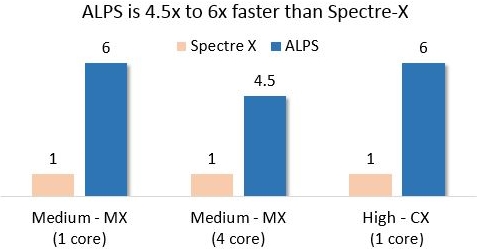
    Overall, ALPS was significantly faster than Spectre-X for "high" and
    "medium" accuracy modes.

    In particular, for "high" accuracy mode of our post-layout designs,
    we found that ALPS was 6X faster than Spectre-X.

    Each tools' "high" to "low" accuracy modes are as follows:

        - ALPS has 3 settings: (conservative, moderate, liberal)
        - Spectre-X has 5 settings: (CX = conservative/high),
          (AX, MX = moderate), and (LX, VX = liberal)


    BENCHMARK 1: POST-LAYOUT DESIGN

    For "high" and "medium" accuracy modes with our post-layout designs,

        - ALPS was up to 6X faster than Spectre-X.
        - both tools had good accuracy.
    BENCHMARK 2: PRE-LAYOUT DESIGN

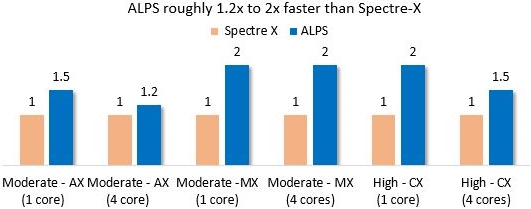
    For the "moderate" and "high" accuracy modes,

        - ALPS was up to 2X faster than Spectre-X.
        - ALPS & Spectre-X both had correct accuracy results.
    For the "low" accuracy modes:

        - ALPS accuracy was good
        - Spectre-X (LX & VX) had an accuracy loss


    BENCHMARK 3: PRE-LAYOUT DESIGN

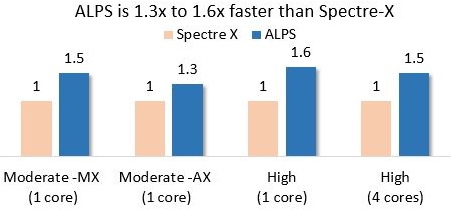
    At the "high" and "medium" settings.

        - ALPS was up to 1.6X faster than Spectre-X.
        - both tools had good accuracy.
    For "low" accuracy modes,

        - ALPS and Spectre-X speeds were mostly comparable.
        - ALPS had good accuracy.
        - Spectre-X (LX) and (VX) had a noticeable accuracy loss
          but it was acceptable.

    The bottom line is that ALPS has good accuracy and is faster for us than
    Spectre-X, for both pre- and post-layout designs.

    Our overall practice is usually to run ALPS on 4 cores in "moderate"
    accuracy mode; sometimes ALPS in "liberal" mode is also accurate enough.

        ----    ----    ----    ----    ----    ----    ----

    I say Empyrean ALPS overall because it's a fast and accurate SPICE.

    I used ALPS' GPU accelerator version, ALPS-GT, for my high-speed divider
    RCC netlist-based simulation.

    Here's our benchmarks comparing Empyrean ALPS, ALPS-GT vs. Mentor AFS,
    AFS-XT vs Cadence Spectre APS, Spectre-X

    As you can see below, for our targeted accuracy, Empyrean ALPs and
    ALPS-GT were the fastest simulators for each category.  That is:

        - ALPS is faster than BDA AFS or Spectre-APS
        - ALPS-GT is faster than Mentor AFS-XT or Spectre-X

    Benchmark details

        - 7nm process, RCC netlist, detect Fmax within range.
        - Block size: ~1M devices (MOSFET, resistors, capacitors...)
        - I used the same "high" accuracy level setting for all the
          simulators, with no RC reduction.
        - CPU Cores: 16 CPU cores (except ALPS-GT as noted below)

    For "high" accuracy setting, we found:

        - Empyrean ALPS-GT was 2.5X faster than ALPS
        - Empyrean ALPS-GT was 1.5X faster than Siemens AFS-XT (red)
        - Empyrean ALPS-GT was 3X faster than Siemens AFS (vanilla)
        - Empyrean ALPS-GT was 3X faster than Cadence Spectre-APS
        - Cadence Spectre-X (CX) accuracy was inadequate.  Fmax was
          off by 5% versus the other tools.

    Empyrean ALPS was also the only simulator where I could finish my
    simulation within 8 hours.  That meant I could tune my design twice
    a day on a fully accurate RCC database.

    Again for "high" accuracy, we found:

        Simulator                            Runtime (hours)
        --------------------------------     ---------------
        Empyrean ALPS-GT, 8 CPU on 4 GPU           8 hours
        Empyrean ALPS (sw)                        20
        Mentor AFS-XT (red)                       12
        Mentor AFS                                24
        Cadence Spectre-APS                      ~60

        Cadence Spectre-X failed because it wasn't accurate enough.
                          It ran CX in 5 hours, but it's Fmax accuracy
                          was off by 5% versus the other SPICEs.


    Note: ALPS had the same accuracy as Spectre-APS (within +/- 0.1 GHz)
    in terms of Fmax of the divider with the RCC netlist.

    I definitely recommend ALPS-GT (with the GPU accelerator).

    It was the only tool where I could finish my simulation within 8 hours.
    That meant I could tune my design twice a day on a fully accurate RCC
    database.

    It was also easy for us to run ALPS in the Cadence ADE environment using
    the command line interface.

        ----    ----    ----    ----    ----    ----    ----

    We've used Empyrean ALPS (the SW version not the GPU version) on our
    design with 2 million transistors and 100 million RC elements.

    We ran on 32 CPU cores. Below are the results without RC reduction.

        7nm   --   ALPS was 4X faster than Spectre-APS.
        5nm   --   ALPS was 1.5X faster than Spectre-X.

    Note the results above are for ALPS only, including the comparison to
    Spectre-X.  We have not used ALPS GPU accelerator.

    ALPS and Spectre-APS have similar simulation accuracy.

    I also like ALPS' RC reduction feature.  (Note that ALPS is slightly
    less accurate than Spectre-APS when we do the RC reduction.)

    Other feedback:

        - ALPS is well integrated into the Cadence environment.

        - We've use ALPS "Smart Matrix Solver" for post-layout
          simulation.  On the whole, it's efficient.  But it can
          sometimes vary depending on design and technology node.

    I can recommend ALPS as a high-performance simulator for post-layout
    simulations 5nm and 7nm.  It's mature and stable, easy to use, and
    it has lots of options for balancing speed vs. resolution.

        ----    ----    ----    ----    ----    ----    ----

    Based on my experience, for our designs of 150K devices:

        - Empyrean ALPS is faster than Synopsys HSPICE simulator,
          with about the same accuracy.

        - ALPS is at least 2X faster than HSPICE.

        - But for specific circuit like SRAM, ALPS can be slower
          than Synopsys CustomSim (FastSPICE) simulator.

    I like the associated signal function in the ALPS waveform viewer.

    I'd recommend ALPS.  It's good for speeding up your simulation while
    (mostly) maintaining the accuracy.

        ----    ----    ----    ----    ----    ----    ----

    For our circuits we use plain old Spectre, but prefer ALPS.  Both
    can do many kinds of simulation, including DC and transient simulation;
    but ALPS is noticably faster.

    We ran a 10000 device design on Empyrean ALPS:

        - For single chip simulation, ALPS simulator is 4 times faster
          than plain old Cadence Spectre under same circumstances.

        - Especially when we do corner simulations; if we use multiple
          threads, the ALPS speed can be 4-5 times faster than Spectre.

    Accuracy:

        - ALPS accuracy is basically the same as original Spectre.

    ALPS simulation results are similar to Spectre.  However some of ALPS
    functions, such as its debug, needs more work.

    ALPS post-layout simulation performance is really good.  Its netlist
    extraction is relatively simple, and it simulation speed is faster than
    Spectre.

        ----    ----    ----    ----    ----    ----    ----

    We use Empyrean ALPS directly with a Cadence Spectre or Synopsys HSPICE
    netlist without modifying anything.   We don't waste time switching
    between simulators because ALPS works interchangeably with both.

    I ran it on a design that was about 600,000 MOS elements and 20 million
    resistors.

    Performance

        - ALPS gets fast post-layout RC simulation results; it directly
          uses RC SPEF input to run post-layout simulation.

        - For our post-layout netlist, ALPS without any RC reduction ran
          at the same speed as Spectre APS or APS+ with RC reduction.

        - For Spectre to work under the same conditions, but we must use
          Spectre's post-layout RC reduction setting.  Otherwise, its
          simulation speed is unbearably slow.

        - In comparison, ALPS can establish the matrix fast and then run
          simulation normally.  We occasionally encounter convergence
          problems (e.g., DC) with ALPS; in both cases the Empyrean FAEs
          helped us resolve it.

    Accuracy

        - ALPS' post-layout simulation accuracy is high.  It is good
          enough for our high speed SerDes blocks.

    I recommend ALPS for all these reasons.

        ----    ----    ----    ----    ----    ----    ----

    Empyrean ALPS SPICE simulator is fast.  I've compared ALPS with Cadence
    Spectre and Spectre-APS.  (We have Cadence's analog design environment.)

    I usually use ALPS for my analog circuits, because:

        - ALPS is faster than Spectre and Spectre-APS.  It saves
          me a lot of time especially for top-level simulations.

        - I've found ALPS accuracy for analog circuits to be the
          same as Spectre.

    But I use Spectre to simulate a top-level designs with both analog
    circuits and digital blocks, such as PLLs, because ALPS is *not*
    case insensitive when running digital blocks (Spectre is), so you
    may get an error.

    I like ALPS best is for its speed.  It's the main reason I use it.

        ----    ----    ----    ----    ----    ----    ----

    Empyrean ALPS is a faster replacement for Cadence Spectre SPICE
    simulator.  It can run transistor level simulations and Verilog-A
    behavioral simulations.

        - ALPS is ~3 times faster than Spectre.

        - ALPS and Spectre have comparable accuracy.

        - It also has a high capacity.  My largest design has
          12.4 million devices, and my ALPS simulations are okay.

        - I use ALPS with Cadence ADE to run simulations.  The
          integration is seamless.

    I recommend ALPS as a faster substitute for the Spectre simulator.

        ----    ----    ----    ----    ----    ----    ----

    I nominate ALPS because it simulates fast, with precision and large
    capacity, saving us a lot of runtime for simulation.

        ----    ----    ----    ----    ----    ----    ----
        ----    ----    ----    ----    ----    ----    ----
        ----    ----    ----    ----    ----    ----    ----
SYNOPSYS & OTHER SPICES

        ----    ----    ----    ----    ----    ----    ----

    Synopsys HSPICE

        ----    ----    ----    ----    ----    ----    ----

    Magma FineSim & FineSim Pro

        ----    ----    ----    ----    ----    ----    ----

    HSPICE.

    We're looking at CustomSim.

        ----    ----    ----    ----    ----    ----    ----

    My Synopsys FAE told me to tell you CustomSim.

    Truth is we use a mix of Spectre, HSPICE, and CustomSim.

        ----    ----    ----    ----    ----    ----    ----

    CustomSim and HSPICE

        ----    ----    ----    ----    ----    ----    ----

    XA

        ----    ----    ----    ----    ----    ----    ----

    We do memories.  Cadence Altos

        ----    ----    ----    ----    ----    ----    ----

    We do RF.  Keysight GoldenGate.

        ----    ----    ----    ----    ----    ----    ----

    I'm in Europe.  We are required to use Mentor ELDO.

        ----    ----    ----    ----    ----    ----    ----

    Synopsys HSIM.  We're the last Nassda customer remaining.

        ----    ----    ----    ----    ----    ----    ----

Related Articles

    Users choose Joe Sawicki's AFS-XT SPICE gambit as Best of 2020 #1a
    Cadence Spectre-X users say 2x speed-up real is Best of 2020 #1b
    Empyrean ALPS-GT crushes Spectre-X and AFS-XT is Best of 2020 #1c
    EMX/Spectre-RF/Virtuoso-RF combo 75% easier use is Best of 2020 #1d
    Siemens Symphony nips at Cadence AMS Designer is Best of 2020 #1e
Join
Index
Next->Item
|
|